Mortgage Term: What It Is and How to Pick the Right One
By Sohaib Ibrahim · Published November 17, 2026
A mortgage term is the number of years you have to repay your home loan, and in the United States it is most often 15, 20 or 30 years. The term does two jobs at once. It sets the size of each monthly payment, and it sets how much interest you pay before the balance reaches zero. A longer term gives you smaller payments and a bigger interest bill. A shorter term does the reverse.
Lenders in some countries use the word differently, and a few related terms get mixed up with it, so this article sorts that out too. You will see why the term matters, how to pick one that fits your income and plans, how 10-, 15-, 20- and 30-year terms compare in dollars, and how to change your term after closing if your situation shifts.
Every figure here comes from the standard amortization formula that banks use, the same one behind the free calculators on HomeLoanCalc.io. The examples show principal and interest only, so your real payment will also include taxes and insurance. Treat the numbers as planning estimates, not financial advice or a lender quote.
Why your mortgage term matters
Your mortgage term matters because it controls the two numbers you will live with for years: your monthly payment and your total interest cost. On a typical loan, changing the term moves those numbers far more than a small change in the interest rate does. It also decides how fast you build equity and how large a loan a lender will approve.
A longer term lowers the payment and raises the cost
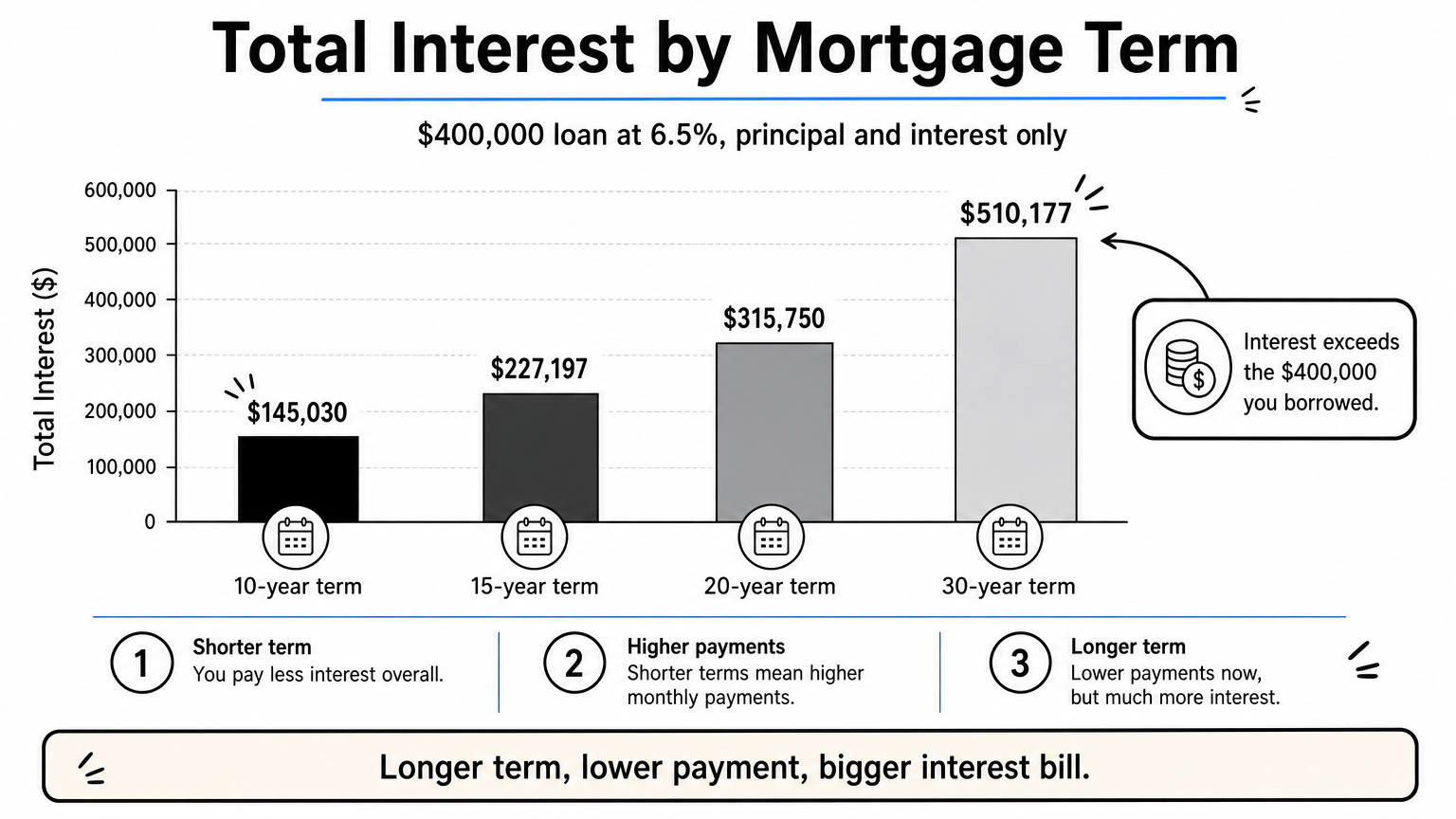
Spreading the same balance over more months makes each payment smaller, but the lender charges interest on the unpaid balance for longer. The table below shows a $400,000 loan at 6.5% across four terms. The rate is held constant so you see the effect of the term alone, and the figures cover principal and interest only.
| Term | Monthly payment | Total interest | Total repaid |
|---|---|---|---|
| 10 years | $4,541.92 | $145,030 | $545,030 |
| 15 years | $3,484.43 | $227,197 | $627,197 |
| 20 years | $2,982.29 | $315,750 | $715,750 |
| 30 years | $2,528.27 | $510,177 | $910,177 |
Read the table from the bottom up. The 30-year loan has the lowest payment, but its interest bill of $510,177 is larger than the $400,000 you borrowed. Moving to 15 years raises the payment by $956.16 a month and cuts the interest by $282,980.
A longer term buys you a lower payment today and sells you a bigger interest bill later.
Why early payments mostly go to interest
Each payment covers that month's interest first and sends the remainder to principal. On the $400,000 loan, the first month's interest is $2,166.67, which is the 6.5% annual rate divided by 12 and applied to the balance. On the 30-year loan that leaves $361.60 for principal, about 14% of the payment. On the 15-year loan, $1,317.76 goes to principal, about 38%.
The gap compounds over time. After five years of payments, the 30-year borrower still owes about $374,400, having paid down roughly 6% of the loan. The 15-year borrower owes about $306,900, having paid down roughly 23%. If you might sell within a few years on a long term, most of your equity will have to come from your down payment and any rise in the home's value, not from paying the loan down.
How the term changes what you qualify for
Lenders compare your monthly payment with your income. A common guideline is the 28/36 rule: housing costs of no more than 28% of gross monthly income, and total monthly debts of no more than 36%. The consumer finance regulator in the US describes the same idea as a debt-to-income ratio, your monthly debt payments divided by your gross monthly income.
Because a shorter term raises the payment, it lowers the price range you can qualify for. A longer term does the opposite, which is why 30-year loans are the usual choice for buyers stretching to get into a first home. Qualifying is not the same as being comfortable, though. A lender's approval ceiling is a limit, not a budget, and the next section shows how to test your own.
How to choose the right mortgage term
Choose the shortest term whose payment you can carry comfortably through a bad year, then check it against how long you plan to own the home and what the rate gap looks like. Work through the four checks below in order and the right answer usually becomes clear.
Pick the shortest term you could still afford if your income dipped for a year.
Test the payment against your income
Start with the 28% guideline. Divide the principal and interest payment by 0.28 to find the gross monthly income that supports it. For the $400,000 loan at 6.5%, the 30-year payment of $2,528.27 needs about $9,030 a month, or roughly $108,400 a year. The 15-year payment of $3,484.43 needs about $12,444 a month, or roughly $149,300 a year.
Those figures leave out property taxes, insurance, PMI and HOA fees, so the income you actually need is higher. Add those costs with a full mortgage calculator before you decide. Then look at your savings. If the shorter-term payment would leave you without an emergency fund, it is the wrong term for now, however good the interest savings look.
Match the term to how long you will own the home
How long you will stay changes which term earns its keep. Use this as a quick guide:
- Staying 10 years or more, with steady income and cash left over: a 15-year or 20-year term.
- Wanting the lowest required payment: a 30-year term, ideally paired with extra payments (covered below).
- Able to stretch a little but not a lot: a 20-year term as the middle path.
- Expecting to sell or refinance within 5 to 7 years: an adjustable-rate loan whose fixed period covers your plan.
The last option needs care. An adjustable-rate mortgage starts with a lower rate, but the rate and payment can increase substantially once the fixed period ends. Choose one only if you could afford the higher payment when your plans change.
Compare the rate gap, not just the length
Lenders often price shorter terms at lower rates, though not always, so ask for a quote on each term you are considering. Suppose a lender offered a 15-year loan at 5.75% and a 30-year loan at 6.5%. On $400,000, the 15-year payment would be about $3,321.65 and the total interest about $197,900.
Compared with the 30-year loan at $2,528.27 and $510,177 in interest, that is $793.38 more per month in exchange for about $312,300 less interest. Those rates are illustrative, not current quotes. The point is that a lower rate on a shorter loan widens the savings beyond what the shorter timeline alone delivers.
Take a long term and pay it down like a short one
A middle path is to take the 30-year loan and pay extra when you can. At the same rate, paying the 15-year amount on a 30-year loan retires it in 15 years. On our example, that means paying $3,484.43 instead of the required $2,528.27, with the freedom to drop back to the lower payment in a lean month. The cost is that 30-year rates are often higher, so a true 15-year loan can still save more.
A smaller step also works. One extra payment a year is about $210.69 added to each monthly payment of $2,528.27. That pays the loan off in roughly 24 years instead of 30 and saves about $116,000 in interest. You can test your own version in the Extra Mortgage Payment Calculator. Before you commit, confirm that your loan has no prepayment penalty and that extra money is applied to principal.
Common mortgage term lengths compared
Four fixed terms cover most borrowers: 10, 15, 20 and 30 years, with 25 years offered by some lenders. The 30-year term is by far the most common in the US, and the consumer finance regulator lists 15, 20 and 30 years as the typical choices. The table puts each term against the 30-year loan, using the same $400,000 at 6.5% from earlier.
| Term | Extra per month vs 30-year | Interest saved vs 30-year | Usually best for |
|---|---|---|---|
| 30 years | Baseline ($2,528.27) | Baseline ($510,177 total) | Tight budgets, buyers who want flexibility |
| 20 years | +$454.02 | $194,427 | Buyers who can handle a moderate step up |
| 15 years | +$956.16 | $282,980 | Steady, higher incomes and a debt-free goal |
| 10 years | +$2,013.65 | $365,147 | Very strong income and little other debt |
Every step down in term costs more each month but saves a large block of interest.
The 30-year term
The 30-year fixed loan gives you the lowest monthly payment of any standard fixed term. That makes it easier to qualify, leaves room in the budget for savings or other goals, and keeps the payment predictable. Many borrowers pick it for exactly that reason.
The price is slow equity growth and the highest lifetime interest. It fits buyers who value cash flow, plan to stay long term, or would rather invest spare money elsewhere. It also pairs well with the extra-payment approach described earlier.
The 20-year and 25-year terms
These are the middle ground. A 20-year loan costs about $454 more per month than a 30-year loan on our example, and it cuts interest by close to $194,000. A 25-year loan, which some lenders list, sits between the two on both counts.
The catch is availability. Fewer lenders offer 20-year terms than 15- or 30-year terms, so you may need to shop around. If one is on offer at a competitive rate, it suits borrowers who want to be done sooner without the full jump to a 15-year payment.
The 15-year and 10-year terms
The 15-year term is the classic choice for buyers with steady, higher incomes. You pay down principal far faster, own more of the home sooner, and often get a lower rate. People approaching retirement frequently choose it so the loan ends before their paychecks do.
The 10-year term is the extreme version. Its payment on our example is almost 1.8 times the 30-year payment, so lenders look for strong, stable income and very low existing debt. It saves the most interest, but it leaves little room if your income drops.
Mortgage term vs amortization, rate type and payoff date
In the US, a standard fixed-rate loan has a term that equals its amortization period, so the two words describe the same 15 or 30 years. They split apart on balloon loans and in countries such as Canada and the UK, so check which meaning your lender uses before comparing offers.
The term says how long you have to repay, and amortization says how your payments pay it down.
Term vs amortization period
Amortization means paying off a loan with regular payments so the balance falls with each one. A balloon loan separates the two ideas. Its payments may be calculated as if you had 30 years, but the entire remaining balance comes due after a shorter period, such as 7 years. If you cannot pay that balloon payment, you may have to refinance, sell or face foreclosure.
Other markets use "term" for the rate period instead. In Canada, the term is the length of your contract with a specific rate and lender, commonly 1 to 10 years and often 5, while the amortization period, often 25 years, is how long full repayment takes. UK lenders similarly quote an initial deal of 2 or 5 years inside a longer overall term. In India you will often see the word tenure. A five-year term in those markets is not a five-year payoff. Islamic home financing such as Diminishing Musharakah also runs over a set number of years, and the same amortization math gives a close approximation of the monthly outflow.
Fixed-rate and adjustable-rate terms
A fixed-rate mortgage keeps the same interest rate for the entire term, so your principal and interest payment never changes. An adjustable-rate mortgage (ARM) fixes the rate for an opening period, then lets it move. In a 5/1 ARM, the 5 is the number of fixed years and the 1 is how often the rate adjusts afterward, once a year. Common fixed periods are 3, 5, 7 and 10 years.
Some lenders now write the second number differently. A 5/6 ARM, for example, holds the rate for five years and then adjusts every six months. In every case the loan still has a full term, usually 30 years. The fixed period is only the opening stretch. Ask about the rate caps, which limit how much the rate can rise at the first adjustment and over the life of the loan, before you sign.
Maturity date and payoff amount
Your maturity date is the day your final scheduled payment is due, roughly one term after your first payment. After that you owe nothing more on the loan. If you prepay, you reach a payoff date earlier than the maturity date.
Your payoff amount is not the same as the balance shown on your statement. It includes interest owed through the day you pay off the loan and may include unpaid fees. Ask your servicer for a payoff statement with a date before you send the final check.
How to change your mortgage term after closing
You can change your effective term in three ways: refinance into a new term, pay extra so you finish early, or ask your servicer for a modification if you are in financial trouble. Each works differently, and each has a cost to weigh.
Refinance into a shorter or longer term
Refinancing means taking out a new loan to pay off the old one, so it is the cleanest way to switch from 30 years to 15, or the reverse. You will usually pay closing costs, so test whether the savings justify them. The break-even point is closing costs divided by monthly savings. If a refinance costs $6,000 and saves you $150 a month, you break even after 40 months.

Watch the clock. Refinancing a loan you have held for ten years into a new 30-year term restarts the 30-year clock, which can lower the payment while raising total interest. The consumer finance regulator warns you to understand how much of a lower payment comes from a lower rate and how much comes from a longer loan. A safer move is to choose a new term close to your remaining years.
Pay extra without refinancing
Extra payments shorten your real payoff without changing your contract or paying closing costs. Send a lump sum or add a fixed amount each month, and tell your servicer to apply it to principal. A bi-weekly plan collects half your payment every two weeks, which adds up to 26 half payments, or one extra monthly payment a year.
Some servicers charge fees for bi-weekly plans, and you can usually get the same result by making one extra payment yourself. Check your loan for a prepayment penalty first, since not every mortgage has one. If you took a 30-year loan for flexibility, this is how you collect its upside.
Ask for a loan modification if you are struggling
A loan modification changes your loan terms to bring your payment to an amount you can afford. It may extend the number of years you have to repay, reduce the rate, or reduce or defer part of the balance. A longer term lowers the payment, but it also raises the total you will owe over time.
Contact your servicer early if you fall behind. If you are offered a modification, ask how it changes both your monthly payment and your total owed. A HUD-approved housing counselor can review the offer with you at no cost to decide.
Mortgage terms that appear next to your loan term
A mortgage comes with its own vocabulary, and a few of the words interact directly with the length of your loan. Some change when you change the term, and others stay the same whether you choose 15 years or 30. The distinction helps you see what a term decision does and does not affect.
Your term changes how fast balances fall, not what taxes and insurance cost.
Terms your loan length changes
The table covers the terms most affected by your choice of years.
| Term | What it means | How your loan term affects it |
|---|---|---|
| Principal | The amount you borrowed and must repay | A shorter term pays it down faster |
| Interest rate | The yearly cost of borrowing, as a percentage | Shorter terms often carry lower rates |
| Amortization | Paying off a loan with regular payments over time | The term sets how many payments there are |
| Debt-to-income ratio | Monthly debt payments divided by gross monthly income | A longer term lowers the payment and the ratio |
| PMI | Insurance that protects the lender when a conventional down payment is under 20% | A shorter term reaches the cancellation point sooner |
| Prepayment penalty | A fee some lenders charge for paying off early | Matters most if you plan a short term or extra payments |
On PMI, US lenders must cancel it automatically once your scheduled balance reaches 78% of the original home price. A faster payoff schedule hits that mark sooner.
Terms that stay the same whatever the term
Some costs of owning a home do not depend on how many years you choose. Property taxes and homeowner's insurance are set by your local assessor and insurer, and a lender may collect them through an escrow account. Together with principal and interest, they make up PITI, the four basic parts of a monthly payment. Your term changes only the principal and interest parts.
The same goes for HOA dues and closing costs. HOA dues are usually paid separately from your mortgage, and closing costs are one-time fees at purchase. The annual percentage rate (APR) reflects the interest rate plus points and fees, so compare APRs only between loans of the same term. For more definitions, the consumer finance regulator keeps a plain-language glossary of mortgage terms.
Mortgage term questions answered
These are the questions readers ask most after the basics, with short answers and the numbers behind them.
For nearly every buyer, the useful choice is between 15, 20 and 30 years.
Can a mortgage term be longer than 30 years?
Not as a standard product. In the US, 30 years is the longest common term, and the qualified mortgage category generally caps the term at 30 years. Some lenders offer 40-year loans as specialty products, and a modification can stretch a struggling borrower's repayment period. Ask any lender offering one for the full terms.
If you are weighing 30 against 40, the math rarely favors 40. At 6.5% on $400,000, a 40-year payment is about $2,341.83, only $186.44 a month less than the 30-year payment. In exchange, you would pay about $213,900 more interest, and only $175.16 of your first payment would reduce the balance.
What is the shortest mortgage term?
For standard fixed-rate loans, 10 years is the shortest term most lenders list. Terms below that are uncommon, so ask each lender what it offers. On $400,000 at 6.5%, the 10-year payment is $4,541.92, which is why it suits only borrowers with high income and little other debt.
How much is a $400,000 mortgage per month?
At 6.5%, the principal and interest payment is $2,528.27 on a 30-year term and $3,484.43 on a 15-year term. Your actual payment will be higher, because the monthly bill can also include:
- Property taxes, which vary by county and home value
- Homeowner's insurance
- PMI, if your down payment is under 20% on a conventional loan
- HOA or condo fees, if the home has them
Rates change daily, so run your own numbers with the current rate you are quoted.
Pick a term you can sustain
A mortgage term is simply how many years you have to repay, but it drives your payment, your interest cost and your pace of equity. Pick the shortest term your budget can carry through a rough year, and use extra payments or a refinance to adjust later. The 30-year, 20-year and 15-year options each make sense for someone, and the right one depends on your income, savings and how long you will stay.
To see the difference in your own situation, enter two terms side by side in the free mortgage comparison calculators at HomeLoanCalc.io and compare the monthly payment and total interest before you talk to a lender.
This article is for general information and is not financial advice. Confirm figures with your lender or an official source before you decide.
Run your own numbers
Use our free calculators to see what this means for your loan.
More articles
- How Much to Afford a 500K House: Income and Down Payment
- Annual Amortization Calculator: Build a Yearly Schedule
- Mortgage Calculator with Tax and Insurance: How to Use It
- How Much House Can I Afford with a $100K Salary?
- Mortgage Insurance Disbursement: What the Line Item Means
- Insurance and Mortgage: How PMI Works and What It Costs
- How Much House Can I Afford with 70K Salary? $170K to $305K
- Amortization Schedule Payment Calculator: How to Use It
- How Much House Can I Afford with 300K Salary? Step by Step
- Mortgage Paid Off Calculator: How to Find Your Payoff Date