How Much to Afford a 500K House: Income and Down Payment
By Sohaib Ibrahim · Published November 16, 2026
Here is the short answer on how much to afford a 500k house: you need a household income of about $130,000 to $165,000 a year, a down payment of 5% to 20% ($25,000 to $100,000), and a budget that absorbs a monthly payment of roughly $3,000 to $3,800 with taxes and insurance included. Those figures assume a 30-year fixed loan and a housing budget of 28% of gross income. A $100,000 salary falls short of that standard, and the sections below show by how much.
"Afford" here means more than getting approved. It means the full cost of owning the home, not just the loan payment, fits inside about 28% of your gross monthly income. Your total debts stay under 36%, and you still have cash left after closing. A lender's approval can be far more generous than that, which is how buyers end up house poor.
This guide explains why the required income is a range, how to calculate yours in five steps, and what a $70K, $100K, $140K and $200K salary can do. It also covers how much cash you need before you get the keys and what to change when the numbers are tight. Every figure uses the same stated assumptions, so you can swap in your own rate and check the result with the free calculators at HomeLoanCalc.io.
Why there is no single income that affords a $500K house
The income you need depends on four inputs: your down payment, your mortgage rate, your local property tax and insurance, and your other monthly debts. Move each one within a normal range and the required salary shifts by tens of thousands of dollars. That is why estimates online run from about $120,000 to about $255,000, and why none of them is simply wrong.
What goes into the monthly payment
Your real payment is principal, interest, property tax and homeowners insurance, plus private mortgage insurance (PMI) when you put down less than 20% on a conventional loan. The table uses a 30-year fixed loan at 6.5% with 10% down ($50,000). It assumes property tax of 1.1% of the price per year, insurance of 0.35%, and PMI at an illustrative 0.5% of the loan per year.
| Monthly cost | Amount | How it is estimated |
|---|---|---|
| Principal and interest | $2,844 | $450,000 loan, 6.5%, 30 years |
| Property tax | $458 | 1.1% of $500,000 per year |
| Homeowners insurance | $146 | 0.35% of $500,000 per year |
| PMI | $188 | 0.5% of the loan per year |
| Total | $3,636 |
Principal and interest make up only 78% of the bill. Taxes, insurance and PMI add $792 a month. HOA dues, flood insurance and utilities are not in the table, so a condo with $300 in monthly dues pushes the same purchase to $3,936.
Why published salary figures disagree
Property tax is the biggest swing. Effective rates run from about 1% to 3% depending on where you buy, which is $417 to $1,250 a month on a $500,000 house. That $833 gap alone changes the income you need by about $35,700 a year at the 28% limit.
Down payment and rate come next. At 6.5%, putting 5% down instead of 20% raises the payment from $3,132 to $3,804, which is $672 more every month. Shortcuts like "buy a home worth 2.5 times your income" imply $200,000 for this house. They ignore rates, taxes and down payment, so use them as a rough sanity check and not as the answer.
A $500K house has no required salary, only a required payment, and your down payment, rate and local taxes set it.
How to calculate the income you need for a $500K house
Divide your total monthly housing payment by 0.28, then multiply by 12. The result is the annual gross income at which housing stays inside the standard 28% guideline. The steps below take about ten minutes, and the worked example shows every number.
The five steps
Follow these in order and write down each result:
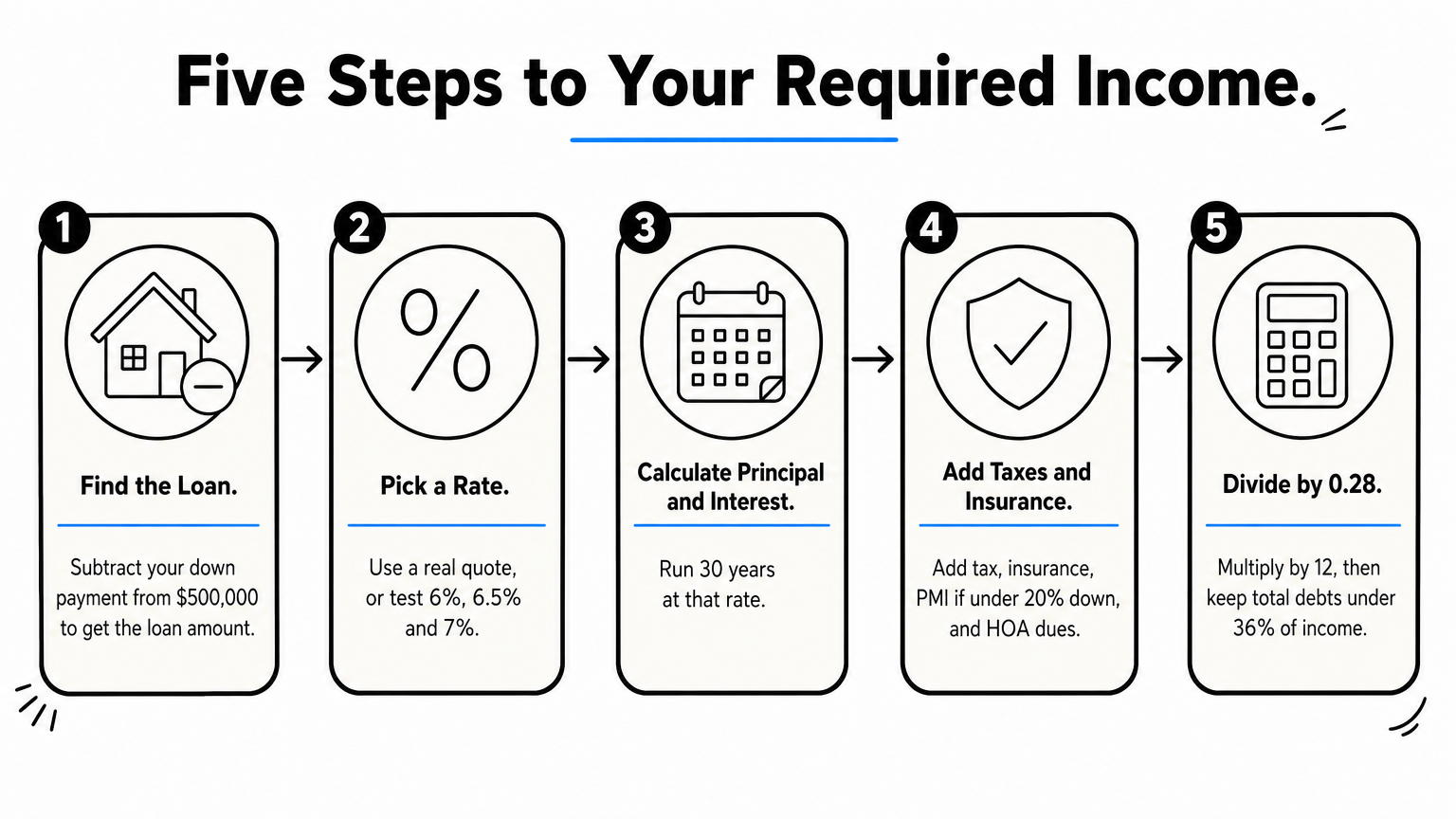
- Subtract your down payment from $500,000 to get the loan amount.
- Pick a rate. Use a real quote if you have one, or test 6%, 6.5% and 7%.
- Calculate principal and interest for 30 years at that rate.
- Add monthly property tax, homeowners insurance, PMI (if you put down less than 20%) and any HOA dues.
- Divide the total by 0.28 and multiply by 12. Then check that housing plus your other monthly debts stays under 36% of gross monthly income.
Step 3 is where most people stall. The standard amortization formula is what lenders use, and any mortgage calculator applies it, so you do not need to do it by hand.
Worked example: 10% down at 6.5%
With 10% down, the loan is $450,000 and principal and interest come to $2,844. Adding $458 in tax, $146 in insurance and $188 in PMI gives $3,636 a month. Divide by 0.28 and you get $12,986 in gross monthly income, which is about $155,800 a year.
Now run the debt check. Thirty-six percent of $12,986 is $4,675. Subtract the $3,636 housing payment and you have $1,039 a month left for car loans, student loans and card minimums. If your other debts exceed that, the 36% cap, not the 28% rule, sets your limit.
How rate and down payment change the answer
Rate and down payment are the two inputs you can influence most, so it helps to see them side by side. Every row uses the same tax, insurance and PMI assumptions as the example above.
| Rate | Down payment | Monthly payment | Income needed at 28% |
|---|---|---|---|
| 6.0% | 20% ($100,000) | $3,002 | $128,700 |
| 6.0% | 10% ($50,000) | $3,490 | $149,600 |
| 6.5% | 20% ($100,000) | $3,132 | $134,200 |
| 6.5% | 10% ($50,000) | $3,636 | $155,800 |
| 7.0% | 20% ($100,000) | $3,265 | $139,900 |
| 7.0% | 10% ($50,000) | $3,786 | $162,200 |
A one-point rate increase (6% to 7% at 10% down) adds $296 a month and about $12,700 to the income you need. Moving from 10% to 20% down at 6.5% cuts $504 a month and about $21,600 from the required income. That is why the answer to "how much income to afford a 500k house" is a band, not a point.
Required income equals your full monthly housing payment, divided by 0.28, times 12.
Let a calculator do the arithmetic
HomeLoanCalc.io's Mortgage Calculator returns the monthly payment from the price, down payment, rate, property tax, insurance, PMI and HOA fees, and it updates as you type. Run steps 1 to 4 there. Then take your income, monthly debts, down payment and credit score into the Affordability Calculator, which shows conservative, moderate and maximum price ranges.
Both tools model fixed-rate loans with the amortization formula lenders use, and neither asks you to sign up. Treat the output as a planning estimate. Your lender's quote, the county tax bill and a real insurance quote will move the final number.
Can you afford a $500K house on a $100K salary?
On a standard 28% budget, no. A $100,000 salary is $8,333 in gross monthly income, so 28% is $2,333 a month for housing. The payment on a $500K house in the scenarios above runs from $3,002 to $3,786, which is about 36% to 45% of your gross pay. Some lenders would approve it if your other debts are small, but it would leave you stretched.
How each salary lines up
The same question comes up for several salaries, so here they are in one table. It uses the 6.5% scenarios: $3,132 a month with 20% down and $3,636 with 10% down.
| Salary | 28% monthly budget | Payment share, 20% down | Payment share, 10% down | House price at 28% (20% down) |
|---|---|---|---|---|
| $70,000 | $1,633 | 53.7% | 62.3% | about $261,000 |
| $100,000 | $2,333 | 37.6% | 43.6% | about $372,000 |
| $140,000 | $3,267 | 26.8% | 31.2% | about $521,000 |
| $200,000 | $4,667 | 18.8% | 21.8% | about $745,000 |
A $70,000 salary is nowhere near this price. A $140,000 salary works with 20% down, and with 10% down it lands at 31.2%, above 28% but under the 33% stretch ceiling. A $200,000 salary handles the payment comfortably even with 10% down, as long as your other debts are modest.
What a $100K salary can buy instead
At the 28% limit, a $100,000 salary supports a house of about $372,000 with 20% down ($74,400 in cash) or about $321,000 with 10% down ($32,100). Stretch to the 33% ceiling and the numbers rise to roughly $439,000 with 20% down or $378,000 with 10% down. None of them reaches $500,000.
Household income changes this. Lenders count a co-borrower's income, so two people earning $50,000 each qualify on $100,000 together, but two earning $70,000 each reach $140,000 and make the purchase workable. The same goes for existing debt. A $400 car payment does not change the housing payment, but it uses up room under the 36% cap.
A $100K salary supports roughly a $320K to $370K house on a standard budget, so $500K takes more income, more cash down, or both.
How much cash you need up front for a $500K house
Plan on $25,000 to $125,000 in cash to close, depending on your down payment. The lower end is a 3% conventional down payment plus the cheapest closing costs. The upper end is 20% down plus the costliest. Savings, not salary, is where many buyers hit the wall first.
Down payment options and total cash to close
You do not need 20% down. Eligible conventional loans allow 3% down, FHA loans allow 3.5% with a credit score of at least 580, and eligible VA and USDA loans can require nothing down. Closing costs of 2% to 5% of the price are separate, which is $10,000 to $25,000 here.
| Down payment | Amount | Closing costs (2% to 5%) | Total cash to close |
|---|---|---|---|
| 3% | $15,000 | $10,000 to $25,000 | $25,000 to $40,000 |
| 5% | $25,000 | $10,000 to $25,000 | $35,000 to $50,000 |
| 10% | $50,000 | $10,000 to $25,000 | $60,000 to $75,000 |
| 20% | $100,000 | $10,000 to $25,000 | $110,000 to $125,000 |
HomeLoanCalc.io's Closing Cost Calculator breaks the costs into line items. Its defaults for origination, appraisal, title insurance, inspection, recording and transfer, and legal fees add up to about 2.2% of the price, or $11,000 on this house. Lender fees, prepaid insurance and tax deposits can push the real figure higher.
What PMI adds when you put down less than 20%
On a conventional loan, putting down less than 20% means paying PMI. In the 10%-down example it adds $188 a month, using an illustrative 0.5% annual rate. Your actual rate depends on your credit score and loan-to-value ratio, and HomeLoanCalc.io's PMI Calculator estimates it for your inputs.
PMI is not permanent. You can request cancellation when your loan balance reaches 80% of the original home value, and US lenders must end it automatically at 78%. With $450,000 borrowed at 6.5%, the balance reaches 78% of $500,000 ($390,000) in about nine years, sooner if you pay extra.
Keep a reserve after closing
Emptying your savings to hit 20% down is a common mistake. Moving costs, repairs and a failed water heater all arrive in the first year. A buyer who puts 10% down, pays PMI for a while and keeps six months of expenses in cash is usually safer than one who puts 20% down and has nothing left.
Six months of the $3,636 housing payment alone is about $21,800, before groceries and other bills. Add that to the cash-to-close figure when you decide how much of your savings goes into the down payment.
For many buyers, saving $35,000 to $125,000 in cash is a bigger hurdle than earning the salary.
What lenders approve versus what fits your budget
Lenders can approve you for a payment well above what is comfortable, so use their number as a ceiling and not as a budget. The 28/36 guideline is the conservative standard. Automated underwriting often accepts total debt ratios of 45% to 50%, which leaves little room for anything else.
The 28/36 rule and its stretch tiers
The 28/36 rule says housing should take no more than 28% of gross monthly income and total debts, housing included, no more than 36%. HomeLoanCalc.io's Affordability Calculator applies the rule in three tiers: about 22% for conservative, 28% for moderate and 33% for maximum. The table shows the income each tier needs for the $3,636 payment.
| Tier | Share of gross income | Income needed |
|---|---|---|
| Conservative | 22% | $198,300 |
| Moderate | 28% | $155,800 |
| Maximum | 33% | $132,200 |
At the maximum tier, 36% of a $132,200 salary is $3,966 a month. After the $3,636 housing payment, that leaves only about $330 a month for every other debt. The 33% tier works for people with almost no other obligations and fails for anyone with a car loan and student loans.
What lenders will actually approve
Fannie Mae's guidelines cap total debt-to-income at 36% for most manually underwritten loans, up to 45% with strong credit and reserves. Automated underwriting can approve up to 50%. FHA loans use 31% for housing and 43% for total debt as the starting point, with higher ratios allowed when compensating factors are strong.
Take a buyer earning $120,000 with $600 a month in car and student loan payments. The total is $4,236 against $10,000 in gross monthly income, a 42.4% debt-to-income ratio. Many approvals allow that. Housing alone, though, takes 36.4% of gross pay, well above the 28% guideline.
A take-home pay test for your real budget
Start with your monthly take-home pay, the amount that lands in your account after taxes and benefits. Subtract everything that is not housing: food, transportation, insurance, childcare, subscriptions, debt payments and the savings you actually want to keep making. What remains is your true housing ceiling.
Then compare it to the full cost, which includes maintenance. Budget 1% to 2% of the home's value per year, which is $417 to $833 a month on $500,000. The $3,636 payment becomes $4,053 to $4,469 in real monthly cost. If take-home is $9,000, spending is $3,800 and savings are $1,200, the ceiling is $4,000, and this house does not fit.
A pre-approval measures what a lender will risk, and your budget measures what you can live with.
How to afford a $500K house when the numbers are tight
Five levers close most gaps: a bigger down payment, a lower rate, a lower price, less debt and more income. Combine two or three and a house that missed the budget often fits. If it still does not, a lower price range is the right answer.
Levers that cut the monthly payment
The table shows the effect of each change on the base payment of $3,636 (10% down, 6.5%). Comparing them helps you decide where to spend effort.
| Change | Effect on monthly payment |
|---|---|
| Raise your down payment from 10% to 20% | about $504 lower |
| Rate falls from 6.5% to 6% | about $146 lower |
| Rate rises from 6.5% to 7% | about $150 higher |
| Negotiate the price down 5% to $475,000 | about $182 lower |
| Buy a $450,000 house instead | about $364 lower |
A bigger down payment wins, but only if it does not drain your reserve. Rate is worth shopping hard, since quotes from several lenders can differ. You can also buy discount points, where each point costs 1% of the loan, or $4,500 on a $450,000 loan. Whether it pays off depends on how much the lender cuts the rate and how long you keep the loan.
Low-down-payment programs and their trade-off
If cash is your constraint, FHA loans allow 3.5% down ($17,500) with a credit score of at least 580. Conventional loans can start at 3% for eligible borrowers. VA loans can require nothing down for eligible veterans and service members, and USDA loans can too, but only in eligible areas and below household income limits that a $500K purchase may exceed.
The trade-off is a bigger loan and mortgage insurance. At 6.5%, 5% down instead of 20% costs $672 more a month. Seller concessions can help with closing costs, but they cannot replace your required down payment. Check what you can ask for with your agent and lender before making an offer.
Debt, income and timing
Paying off a car loan does not change the housing payment, but it frees room under the 36% cap, dollar for dollar. Clearing a $500 monthly obligation gives you $500 more of room. Adding a co-borrower raises qualifying income directly, and a 6-to-12-month delay spent saving and paying down debt can change the outcome more than any rate move.
If you still need every lever at once, aim lower. Use the table from the $100K section in reverse: divide your monthly budget by the payment per $1,000 of price, and shop at that price. A $450,000 house you can carry beats a $500,000 house that owns you.
What to do with these numbers
To afford a $500K house, expect to need roughly $130,000 to $165,000 in household income, $25,000 to $100,000 for the down payment, and $35,000 or more in total cash to close. The payment runs about $3,000 to $3,800 a month, taxes and insurance included. A $100,000 salary supports closer to $320,000 to $370,000 on a standard budget, and the rest takes more income, more cash, or a lower price.
The method matters more than any one figure. Divide your full monthly payment by 0.28, check your debts against the 36% cap, and test the result against your take-home pay. Then run your own rate, taxes and down payment through the free affordability calculator at HomeLoanCalc.io before you talk to a lender or tour a single house.
This article is for general information and is not financial advice. Confirm figures with your lender or an official source before you decide.
Run your own numbers
Use our free calculators to see what this means for your loan.
More articles
- Mortgage Calculator with Tax and Insurance: How to Use It
- Mortgage Term: What It Is and How to Pick the Right One
- Mortgage Insurance Disbursement: What the Line Item Means
- Annual Amortization Calculator: Build a Yearly Schedule
- How Much House Can I Afford with 70K Salary? $170K to $305K
- How Much House Can I Afford with a $100K Salary?
- How Much House Can I Afford with 300K Salary? Step by Step
- Insurance and Mortgage: How PMI Works and What It Costs
- Excel Mortgage Amortization Schedule: Build One in 4 Steps
- Amortization Schedule Payment Calculator: How to Use It