Extra Mortgage Payments: How They Work and What You Save
By Sohaib Ibrahim · Published October 28, 2026
Extra mortgage payments are any dollars you pay above your required monthly payment that go straight to your loan principal. Because interest is charged on the balance you still owe, each extra dollar lowers the interest in every later month and moves your payoff date closer. On a $200,000, 30-year loan at 4%, an extra $100 a month saves about $26,800 in interest and cuts almost five years off the loan.
The extra can take several forms: a fixed add-on each month, a lump sum from a bonus or tax refund, or a biweekly schedule that adds one full payment a year. Your required payment stays the same, but the balance falls faster, so the loan ends sooner. This article explains why that works, shows the savings for several amounts, walks through how to set up payments correctly, and covers when you should hold off.
We build free mortgage calculators at HomeLoanCalc.io, including one that models extra payments. The numbers below use the same standard amortization math lenders use. Treat them as planning estimates, because your lender's actual figures can differ slightly.
Why extra mortgage payments save so much interest
Extra payments save interest because your lender charges interest on the remaining balance each month, so a lower balance means less interest from that point on. The savings build over decades, which is why small amounts produce large results.
How paying extra principal cuts interest
Take a $200,000 loan at 4% over 30 years. Your required payment is $954.83. In month one, interest is $666.67 (the balance times 4% divided by 12), so only $288.16 reduces the principal. Add $100 extra and the balance drops to $199,611.84 instead of $199,711.84.
That $100 never charges you interest again. Month two's interest is about 33 cents lower, and that 33 cents goes to principal too. The effect repeats every month for the life of the loan. Since your payment is fixed, a smaller balance also reaches zero sooner. That is how the term shrinks.
Every extra dollar of principal stops earning interest for the lender from the day you pay it.
Why early extra payments do the most work
Interest is front-loaded. In the example above, about 70% of the first payment is interest. A dollar paid in year two removes about 28 years of future interest. The same dollar paid in year 28 removes about two.

So the sooner you start, the more each dollar saves. If you can only afford extra payments for a few years, make them early. If you are late in the loan, expect smaller savings because little interest remains to cut.
How much interest you will save on a typical loan
On a $200,000, 30-year loan at 4%, an extra $100 a month saves about $26,800, $200 saves about $44,800, and $500 saves about $75,800. The totals below cover principal and interest only, with the extra paid every month from the first payment.
Monthly extra payments compared
| Extra per month | Payoff time | Total interest | Interest saved |
|---|---|---|---|
| $0 | 30 years | $143,739 | none |
| $100 | about 25 years | about $116,900 | about $26,800 |
| $200 | about 21 years 7 months | about $98,900 | about $44,800 |
| $500 | about 15 years 4 months | about $68,000 | about $75,800 |
Notice that doubling the extra amount does not double the savings. The first dollars you add give the biggest return. Your own result also depends on your rate. A higher rate saves more per dollar, and a lower rate saves less.
This table also answers two common goals. To pay off a 30-year loan in 15 years, you would need about $525 extra a month here, which is the difference between the 15-year payment and your current one. To cut 10 years, you would need about $257 extra a month.
One extra payment a year, three, or biweekly
Annual and biweekly plans are the same idea in a different rhythm. Here is what they do on the same loan:

- One extra payment a year (about $80 a month): roughly 5 years sooner and about $22,400 saved.
- Biweekly payments of $477.50: 26 half-payments equal 13 full payments a year, which shortens the loan by more than 4 years and saves more than $22,000.
- Three extra payments a year (about $239 a month): roughly 9.5 years sooner and about $50,000 saved.
Lump sums paid once a year save slightly less than the same amount spread monthly, because the balance stays higher in between. Confirm with your servicer that it accepts biweekly payments before you start.
A single extra payment a year is enough to shorten a 30-year loan by about five years.
How to make extra mortgage payments the right way
Tell your servicer the extra money is for principal, choose a method you can keep up, and check your next statement to confirm it worked. Skipping the first step is the most common mistake.
Get the payment applied to principal
Some servicers treat unlabeled extra money as an early payment on next month's bill instead of a principal reduction. That gives you almost none of the interest savings. Look for a principal-only option in your online account or on the payment slip, and follow your servicer's own procedure.
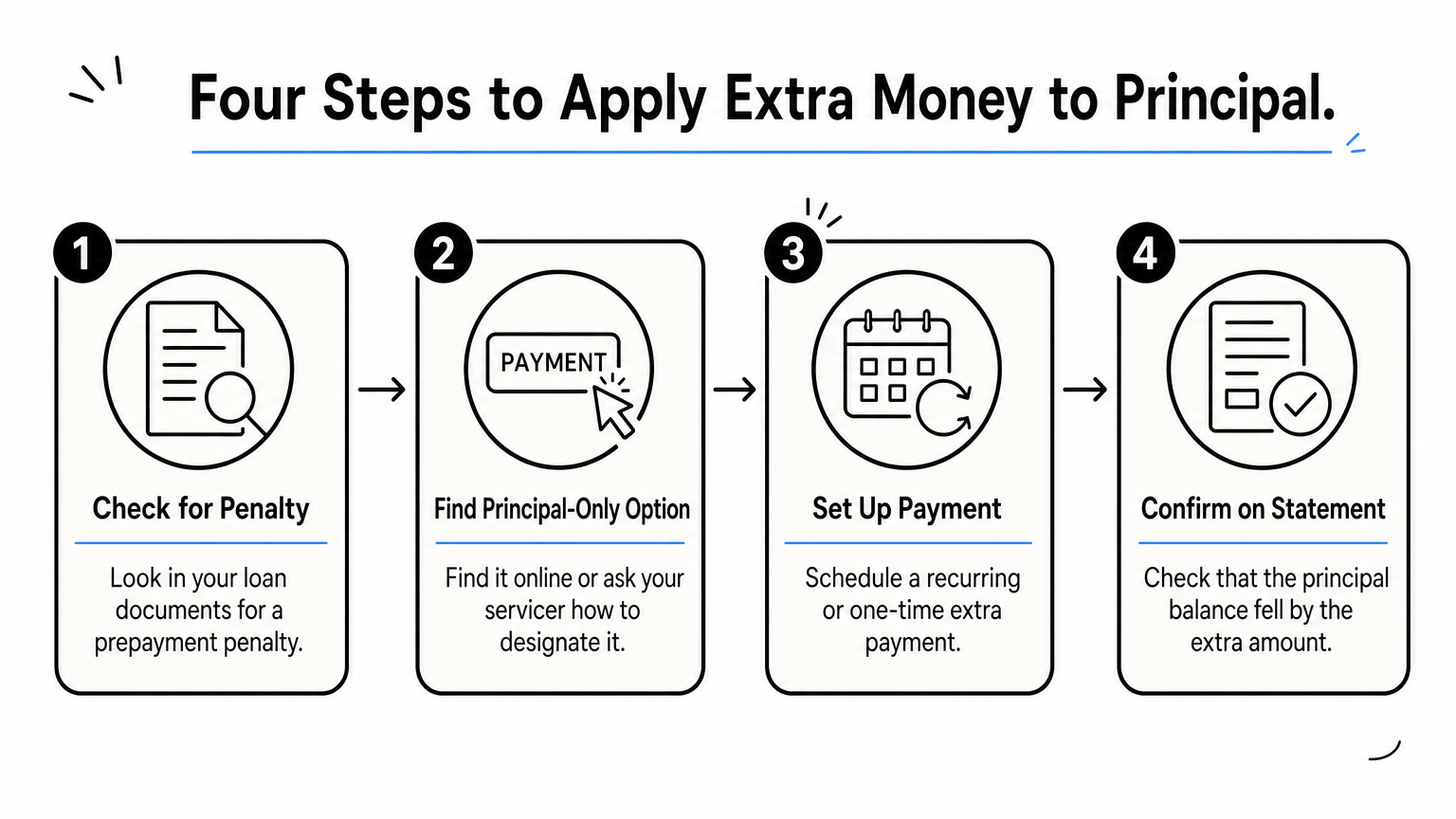
- Check your loan documents for a prepayment penalty.
- Find the principal-only payment option or ask your servicer how to designate it.
- Set up a recurring or one-time extra payment.
- Review the next statement and confirm the principal balance fell by the extra amount.
An extra payment only saves interest if the servicer applies it to principal.
Pick a method that fits your budget
Choose the method you can repeat without strain, because consistency beats a big gesture you abandon.
| Method | How it works | Best for |
|---|---|---|
| Round up | Add a fixed $50 or $100 to each payment | Steady paychecks |
| Annual lump sum | Send a bonus or tax refund to principal | Irregular income |
| Biweekly | Pay half every two weeks, making 13 payments a year | Biweekly pay schedules |
| Recast | Pay a large sum, then ask to re-amortize | Lowering the payment |
A recast is different from the others. It keeps your rate and term and lowers the monthly payment, so it does not shorten the loan. Choose it only if lower payments are your goal.
Estimate your own savings
Run your numbers before you commit. The free Extra Mortgage Payment Calculator at HomeLoanCalc.io takes your loan details and an extra monthly or one-time payment. It then compares your original payoff schedule against the accelerated one, with no signup.
Try a few amounts, such as $50, $100 and $250, and see how the payoff date moves. To view the baseline schedule month by month, use the Amortization Calculator. Both give estimates, so confirm final figures with your lender.
When paying extra is not the best move
Hold off on extra payments when you carry higher-interest debt, lack an emergency fund, face a prepayment penalty, or have a very low mortgage rate and better uses for the cash. Saving interest is only worth it if the money has no more urgent job.
Cover higher-priority needs first
Pay the most expensive debt first. Credit card and personal loan rates are usually far above mortgage rates, so each dollar there saves more. Next, build an emergency fund of three to six months of expenses. Money you put into your house is hard to get back out quickly.
Also take any employer retirement match before sending extra to the lender, since a match is free money. And if your loan carries a prepayment penalty, check whether the fee cancels your savings.
Compare your rate with what else your money could earn
Paying down a mortgage gives a guaranteed return equal to your interest rate. At 7%, that is hard to beat with a safe alternative, so extra payments make sense. At 3%, you may do better by investing or keeping more cash, though investment returns are not guaranteed.
Take a clear view of your goals. If you want to be debt-free before retirement, extra payments serve that well. If you want flexibility, keep the cash liquid. These are planning guidelines, not financial advice, and a lender or advisor can check them against your situation.
A mortgage at 3% is a weak reason to rush extra payments, and one at 7% is a strong one.
Start with one number you can sustain
Extra mortgage payments work because interest follows the balance. Every dollar of principal you remove early cuts years of future interest, and even $100 a month can save tens of thousands over a 30-year loan. The condition is that the money reaches your principal and does not come at the cost of higher-rate debt or your emergency savings.
Pick an amount you can keep paying, set it up as principal-only, and check the first statement. Then see exactly what it does to your payoff date with the free calculators at HomeLoanCalc.io, and adjust the amount until the plan fits your budget.
This article is for general information and is not financial advice. Confirm figures with your lender or an official source before you decide.
Run your own numbers
Use our free calculators to see what this means for your loan.
More articles
- How to Use an Amortisation Calculator and Read the Schedule
- Mortgage Refinance Calculator: How to Find Your Break-Even
- Oklahoma Mortgage Calculator: Add Taxes, Insurance and PMI
- Mortgage Insurance on FHA: What It Is and What It Costs
- How to Use a Mortgage Calculator to Estimate Your Payment
- VA Loan Calculator: Find Your Payment and Home Budget
- How Much Can I Afford on a House? 4 Steps to Your Number
- How Much House Can I Afford on 80K Salary? Real Numbers
- Amortization Schedule for a Mortgage with a Balloon Payment
- Primary Mortgage Insurance: What PMI Is, Costs and Removal