Longest Mortgage Term: Do 40- and 50-Year Loans Exist?
By Sohaib Ibrahim · Published November 9, 2026
A mortgage term is the number of years you have to repay a home loan. The longest mortgage term you can get from a mainstream US lender is 30 years. Loans of 40 years exist, but mostly as niche non-qualified products or as loan modifications for borrowers in hardship. A 50-year mortgage is not a standard product, and a 100-year mortgage is not something US buyers can apply for.
A longer term lowers your monthly payment, but it adds years of interest, and the savings shrink with every extra decade. This article shows what the longest terms cost in dollars, how to compare a long term with a shorter one, which lengths actually exist and who offers them, and how to lower your payment without stretching the loan.
HomeLoanCalc.io is a free set of mortgage calculators, so the figures below come from the standard amortization formula that lenders use. You can rerun every example with your own price, rate and term. The numbers are planning estimates, not quotes, and your lender's final figures will differ slightly.
Why the longest mortgage term matters for your budget
A longer term shrinks your monthly payment because the balance is spread over more months, but it adds years of interest. The trade is easy to see on a $400,000 loan at a 6.5% fixed rate, with taxes and insurance left out.
What each extra decade does to payment and interest
| Loan term | Monthly payment (principal and interest) | Total interest |
|---|---|---|
| 15 years | $3,484 | about $227,000 |
| 30 years | $2,528 | about $510,000 |
| 40 years | $2,342 | about $724,000 |
| 50 years | $2,255 | about $953,000 |
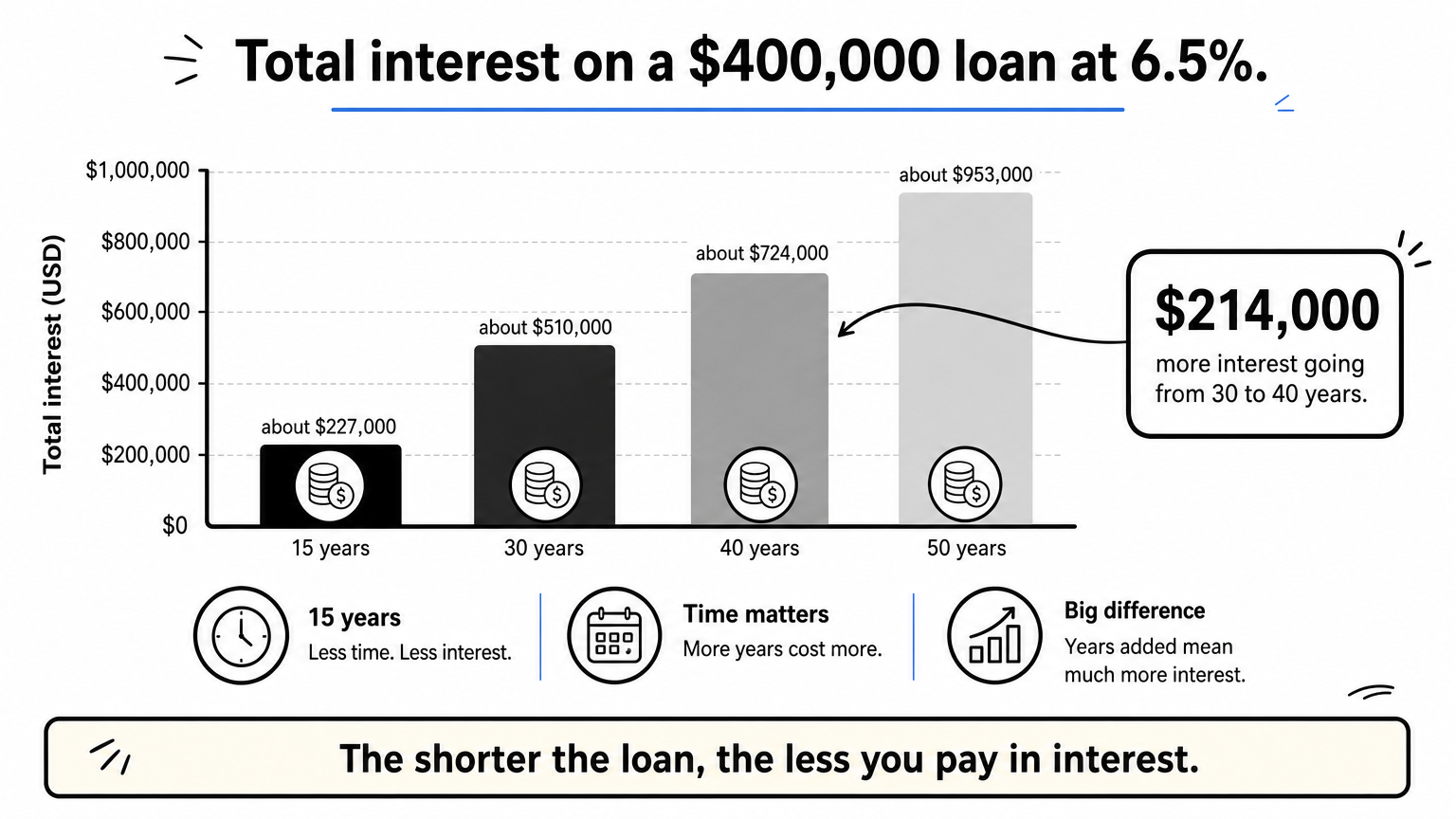
Moving from 30 to 40 years saves you about $186 a month but costs roughly $214,000 more in interest. Going from 40 to 50 years saves only $87 more. The payment can never drop below the interest-only amount, which is $2,167 on this loan, so each added decade buys less relief than the one before.
Past 30 years, every extra decade lowers your payment by less and adds more interest.
Why the rate and slow equity make it worse
Lenders usually price a long mortgage term above the going 30-year rate, because loans past 30 years sit outside the standard conventional market. At 7.0%, the same 40-year loan costs $2,486 a month. That is just $42 less than the 30-year loan at 6.5%, and total interest climbs to about $793,000. You get a tiny payment break for a very large bill.
Equity also builds slowly. In the first month of the 40-year loan at 6.5%, only about $175 of your payment reduces the balance, compared with about $362 on the 30-year loan. Slow principal repayment leaves you with less equity if you sell early or if home prices dip.
How to compare a long mortgage term with a shorter one
To compare a longer mortgage term with a shorter one, price the same loan at each term and look at total interest, not only the monthly payment. Do it before you fall for a low advertised payment.
Run the comparison in four steps
- Ask lenders for a real rate quote at each term. Long terms are priced separately, so you cannot reuse the 30-year rate.
- Enter the same home price and down payment for both options in the Mortgage Comparison Calculator, changing only the rate and term.
- Read the monthly payment, total interest and total cost for each option, and note which one the calculator says saves more interest.
- Open the Amortization Calculator for the long-term option and switch to the monthly view. Check how little principal you repay in the first five years.
If the monthly saving is under about $100 while the extra interest runs into six figures, the long term is rarely worth it.
Judge a long term by the extra interest you buy per dollar of monthly relief, not by the payment alone.
Questions to ask a lender before you accept
Some loans past 30 years come with features that change the real cost. Get clear answers to these before you sign:
- Is the rate fixed for the whole term, or adjustable after a few years?
- Is there an interest-only period at the start?
- Is this a qualified mortgage, and if not, what extra fees or reserves apply?
- Is there a prepayment penalty if you pay extra or refinance?
- What down payment and credit score does the lender require for this term?
An interest-only period or an adjustable rate can make a 40-year loan look cheap early and expensive later. A prepayment penalty is the other trap, because it blocks the easiest way out of a long loan.
Which long mortgage terms exist and who offers them
In the United States, 30 years is the longest term for standard loans. Longer terms exist only in narrow corners of the market, and you have to look for them.
The longest mortgage terms in the United States
| Term | Availability |
|---|---|
| 30 years | Standard maximum for conventional loans bought by Fannie Mae and Freddie Mac, FHA loans and VA loans |
| 40 years | Some non-QM, portfolio and credit union lenders; loan modifications for borrowers in hardship |
| 50 years | Floated in policy discussions, not a standard product you can count on |
| 100 years | Not offered to US home buyers |
The 30-year ceiling comes from the federal qualified mortgage rule, which caps the term of a qualified mortgage at 30 years. Lenders that go past it make non-QM loans, which often carry higher rates, bigger down payment requirements and stricter underwriting. Servicers can also stretch an existing loan to 40 years through a loan modification, but that is a rescue tool, not a way to buy.
On 50-year loans, a proposal is not a product. Before you plan around one, confirm that a lender will actually fund it, at what rate, and with what restrictions. Offers on 40-year loans change often, so ask mortgage brokers and non-QM lenders for current terms.
How "term" works outside the United States
The words change meaning abroad. In the UK, the typical mortgage runs 25 years, and many lenders offer 35 or 40. In India, bank home loans commonly run up to 30 years. In Canada, "term" means the length of your rate contract, often five years, while the amortization period is the true repayment length. Insured loans there are generally capped at 25 or 30 years.

When you see "how long is a mortgage term," check which meaning applies. In the US, the term is the full repayment length. In Canada, it is only the period your rate is locked.
Ways to lower your payment without a very long term
If a low payment is the goal, a bigger down payment or a cheaper home often beats a longer loan. Both cut interest instead of adding it.
Borrow less instead of borrowing longer
On a 30-year loan at 6.5%, each extra $10,000 of down payment lowers your payment by about $63 a month. To match the $186 monthly saving of a 40-year loan, you would borrow about $29,400 less, and you would skip the extra $214,000 of interest. Test different down payments in the Mortgage Calculator, and compare prices that fit a 28/36-style budget.
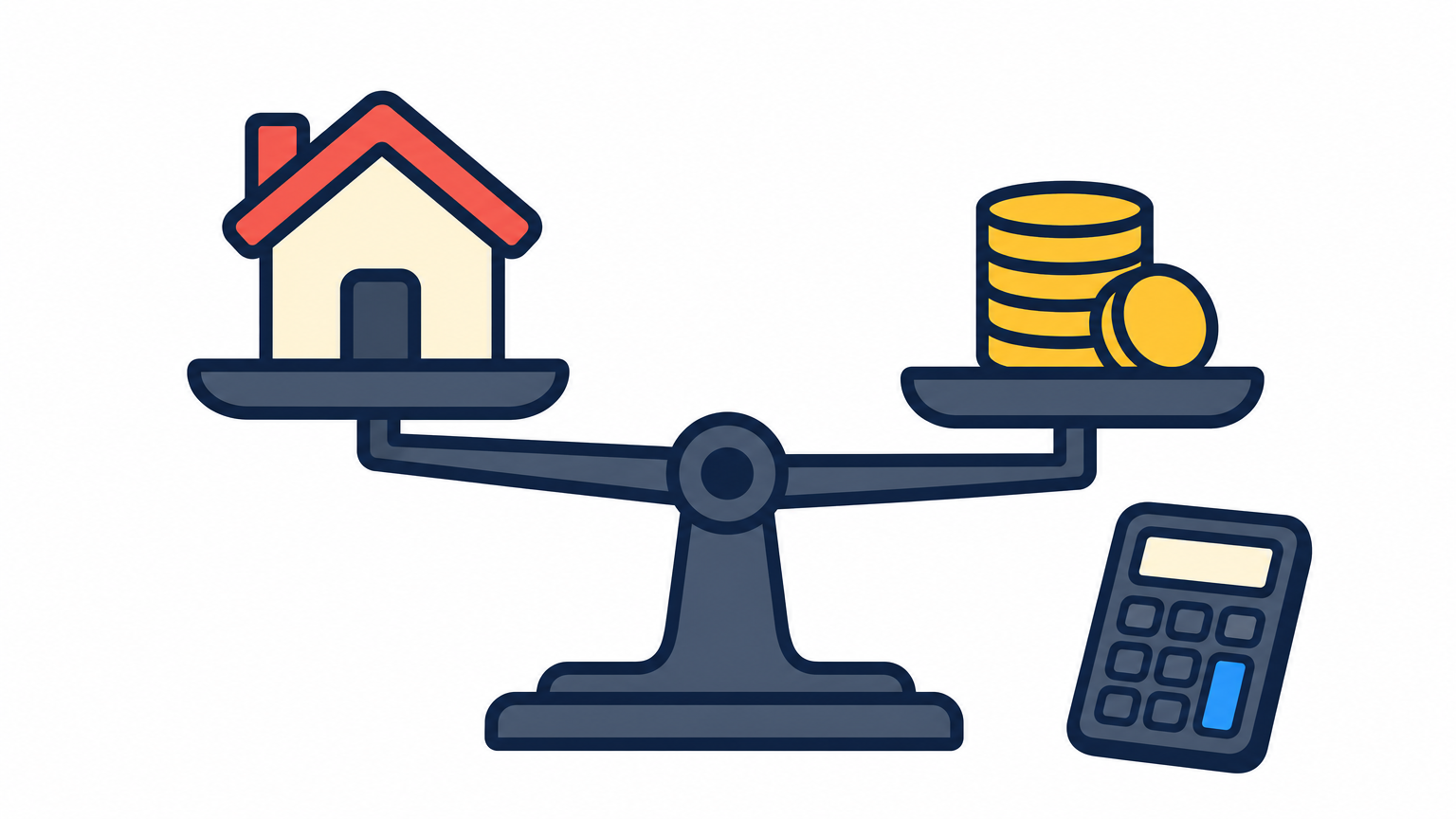
A $29,400 smaller loan saves the same monthly amount as a 40-year term, without the $214,000 interest bill.
When a longer term can still make sense
A long term can work if you truly need payment headroom, the rate premium is small, and you plan to pay extra principal whenever income allows. Check that your loan has no prepayment penalty. Then use the Extra Mortgage Payment Calculator to see how many years and how much interest each added payment removes. Used that way, a long term is a flexible minimum, not a 40-year commitment.
The bottom line on long mortgage terms
The longest mortgage term for standard US loans is 30 years. A 40-year loan is possible through niche lenders, usually at a higher rate. A 50-year loan is not a product you can rely on. Each extra decade cuts the payment by less and adds more interest, so the lowest payment is rarely the cheapest loan.
Before you choose, compare the same loan at two terms and look at total cost. You can do that in minutes with the free mortgage calculators at HomeLoanCalc.io, with no signup and no email.
This article is for general information and is not financial advice. Confirm figures with your lender or an official source before you decide.
Run your own numbers
Use our free calculators to see what this means for your loan.
More articles
- FHA Debt-to-Income Ratio Calculator: How to Check 31/43
- $60K Salary Home Budget: How Much House Can You Afford?
- Current FHA Interest Rates: What Sets Your 30-Year Rate
- Excel Mortgage Amortization Schedule: Build One in 4 Steps
- How Much Down Payment Do You Need for a 500K House?
- How Much House Can I Afford with 300K Salary? Step by Step
- How to Calculate PMI on a Conventional Loan, Step by Step
- How Much House Can I Afford with 70K Salary? $170K to $305K
- Down Payment on 200k House: What You Need by Loan Type
- Mortgage Insurance Disbursement: What the Line Item Means