Insurance and Mortgage: How PMI Works and What It Costs
By Sohaib Ibrahim · Published October 19, 2026
When people talk about insurance and mortgage together, they usually mean mortgage insurance. It is a policy you pay for that protects your lender, not you, if you stop making payments on your home loan. Lenders typically require it when you put down less than 20% on a conventional loan, and FHA and USDA loans carry their own versions. Expect to pay roughly 0.1% to 2% of the loan amount per year, depending on your loan and credit.
The confusion comes from the name. Mortgage insurance does not cover your house, your belongings, or your family. Homeowners insurance does that, and you may need both. The rest of this article separates them clearly.
HomeLoanCalc.io builds free mortgage calculators, so the numbers below are worked through the way our PMI and mortgage tools handle them. You will see why mortgage insurance exists, how it works on each loan type, what it costs, how to avoid or remove it, and how it differs from other policies.
Why mortgage insurance matters when you buy
Mortgage insurance matters because it decides how much cash you need to buy a home and how much each month costs afterward. It is the trade that lets you buy with a small down payment, at a price you pay every month.
What mortgage insurance protects
Mortgage insurance protects the lender if you default. If your home is sold in foreclosure and the sale does not cover your balance, the insurance pays the shortfall to the lender. You still face the damage to your credit and the loss of the home, so the policy gives you no safety net. The Consumer Financial Protection Bureau says the same: it protects the lender, not you.
Mortgage insurance protects your lender, but it is the price you pay for a smaller down payment.
What you get in return
Lenders see a small down payment as riskier, so insurance makes them willing to lend. On a $400,000 home, 20% down is $80,000. Five percent down is $20,000. Saving the extra $60,000 could take years, and home prices may rise while you wait. For many buyers, paying PMI for a few years costs less than waiting to buy.
The cost is real, though. It raises your monthly payment and brings nothing back when the loan ends. Plan for it from the start.
How mortgage insurance works on each loan type
The cost goes by a different name on each loan type, and it is charged and removed differently. Check which loan you are getting before you compare quotes.
The four loan types side by side
| Loan type | What it is called | Upfront cost | Ongoing cost |
|---|---|---|---|
| Conventional | PMI | Usually little or none | Monthly premium, based on credit score and down payment |
| FHA | MIP | 1.75% of the base loan, can be financed | Annual premium paid monthly, commonly 0.55% on most 30-year loans |
| VA | Funding fee | One-time fee, varies by service, down payment and prior VA use | No monthly premium |
| USDA | Guarantee fee | Upfront fee | Annual fee, paid monthly |
FHA premiums do not change with your credit score. Conventional PMI does, which is why borrowers with good credit often pay less for PMI than for FHA insurance. VA and USDA loans have no mortgage insurance by name, but the fees do the same job.
How PMI is paid on conventional loans
On a conventional loan you can pay PMI in four ways:
- Borrower-paid: a monthly premium added to your payment, which you can cancel later.
- Lender-paid: no premium line, but a higher interest rate for the life of the loan.
- Single premium: one payment at closing.
- Split premium: part at closing, part monthly.
Most buyers choose the monthly option. You do not choose the insurance company either, because the lender picks it.
With lender-paid PMI you still pay, through a higher interest rate you cannot cancel.
How much mortgage insurance costs
PMI typically runs between 0.1% and 2% of your loan amount per year, and your credit score and down payment move you within that range. The annual cost divided by 12 is what you add to your monthly payment.
What PMI costs on a $300,000 and $500,000 loan
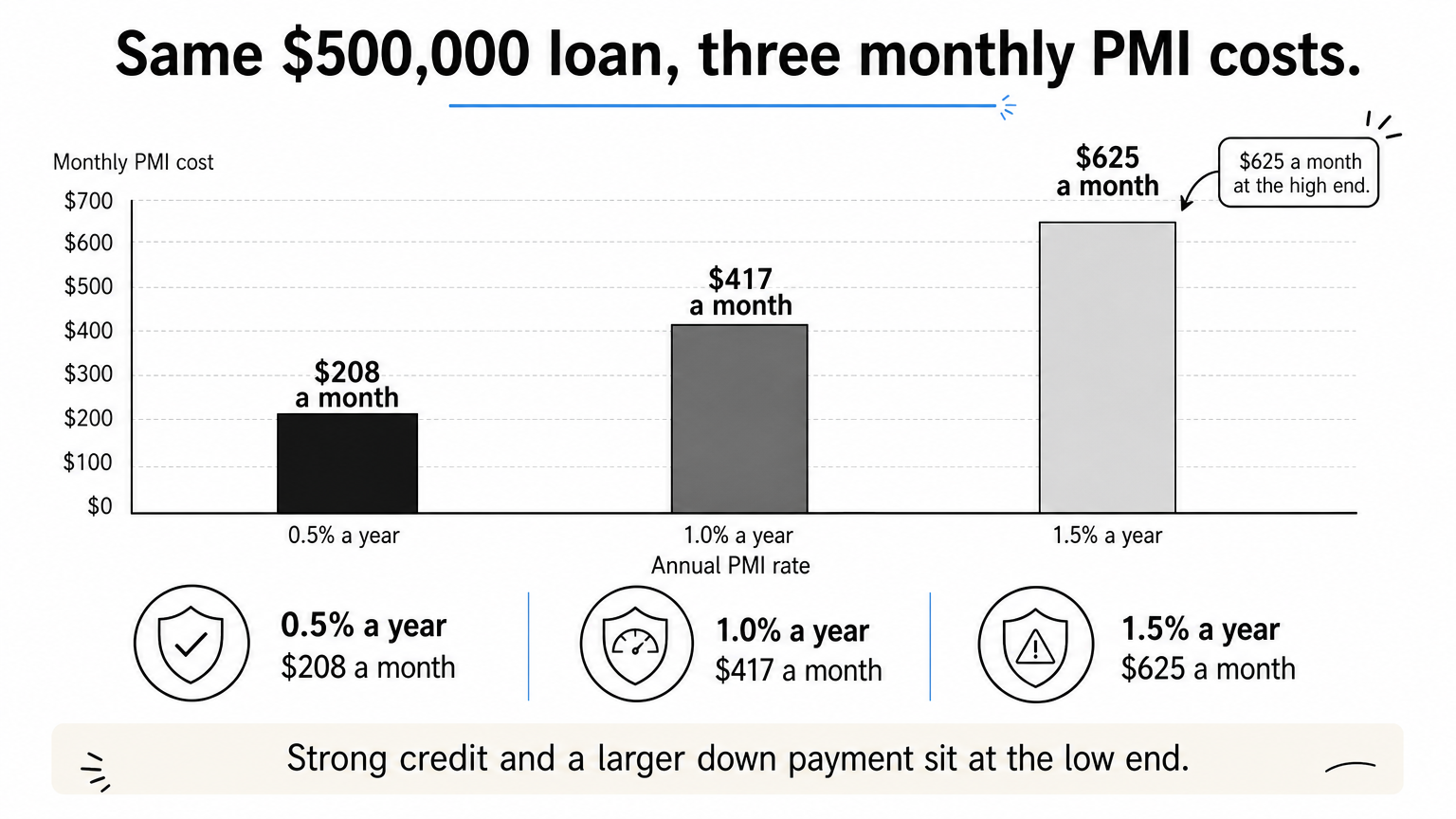
Here is the same math at three rates. A rate near 0.5% suits strong credit and a larger down payment. A rate near 1.5% suits weaker credit and a smaller down payment.
| Annual PMI rate | $300,000 loan, per year | $300,000 loan, per month | $500,000 loan, per year | $500,000 loan, per month |
|---|---|---|---|---|
| 0.5% | $1,500 | $125 | $2,500 | $208 |
| 1.0% | $3,000 | $250 | $5,000 | $417 |
| 1.5% | $4,500 | $375 | $7,500 | $625 |
The spread is large. The same $500,000 loan can cost $208 or $625 a month depending on your profile. Improving your credit score before you apply is one of the cheapest ways to cut it.
What FHA insurance costs on the same loan
Take a $300,000 base loan. The upfront premium at 1.75% is $5,250. The annual premium at 0.55% is $1,650, or $137.50 a month. If you finance the upfront premium, your loan grows to $305,250 and you pay interest on that extra amount for years.
Run the numbers for your own price and score, because the same loan can cost three times as much per month at the high end of the PMI range.
You can test your own figures in the PMI calculator, which asks for home price, down payment, credit score, loan term and rate. The FHA loan calculator does the same for FHA premiums.
How to avoid or remove mortgage insurance
You can avoid mortgage insurance with a large enough down payment or a different loan type, and you can usually remove conventional PMI once you build equity. FHA insurance follows different rules.
Ways to avoid it from the start
- Put 20% or more down. This is the simplest way, and lenders do not charge PMI above that line.
- Use a piggyback loan. You take a first mortgage at 80% of the price and a second loan for part of the rest. Compare the total cost of both loans and their closing costs first, because the cheaper-looking option often is not.
- Choose VA or USDA. Neither has monthly mortgage insurance, though both charge fees.
- Consider lender-paid PMI only if you expect to sell or refinance soon, since you cannot cancel it.
The down payment calculator compares 5%, 10%, 15% and 20% scenarios side by side, so you can see where PMI stops.
Ways to remove it later
On a conventional loan you can ask your lender in writing to cancel PMI once your balance reaches 80% of the home's value. Expect to show a good payment history and no new liens. By law, lenders must cancel PMI automatically when your scheduled balance reaches 78% of the original value, and at the midpoint of the loan term if you are current.
Here is an example. You buy a $400,000 home with 5% down, so your loan is $380,000. The 80% mark is $320,000 and the 78% mark is $312,000. You can also ask for a new appraisal if your home has gained value, or refinance into a loan without PMI. Extra payments speed all of this up.
FHA loans are different. With less than 10% down, FHA insurance generally lasts for the life of the loan, so the usual exit is refinancing into a conventional loan once you have 20% equity.
Know your 80% and 78% balance targets now, and you will know when to call your lender.
Mortgage insurance vs homeowners and life insurance
Mortgage insurance, homeowners insurance and life insurance protect three different things. Mixing them up is the most common mistake first-time buyers make.
Mortgage insurance vs homeowners insurance
| Mortgage insurance | Homeowners insurance | |
|---|---|---|
| Protects | The lender | You, your home and your belongings |
| Required when | Down payment is under 20% (conventional), or FHA/USDA | Almost every lender requires it |
| Paid by | You | You |
| Ends | At 78% to 80% balance, or never on some FHA loans | When you cancel or stop renewing it |
Lenders often collect homeowners insurance through your monthly payment and pay the bill for you. Your mortgage calculator should include both, which is why the HomeLoanCalc.io mortgage calculator has separate fields for insurance and PMI.
You can owe both policies at once, and only one of them protects you.
Insurance that pays off a mortgage if you die
Mortgage insurance does not pay off your loan if you die. A different product does that, usually sold as mortgage life or mortgage protection insurance, and a regular term life policy can do the same job. It is optional, not a condition of getting a home loan. Compare the coverage amount, the price, and who receives the payout before you buy one.
Run your numbers before you commit
Mortgage insurance protects your lender, costs you roughly 0.1% to 2% of the loan each year, and is the price of buying with less than 20% down. You can avoid or remove it with the right plan. It is not homeowners insurance and it is not life insurance.
Before you apply, check how it changes your payment. You can estimate your monthly payment with PMI included using a free mortgage payment calculator that needs no signup. The results are planning estimates, so confirm the final figures with your lender.
This article is for general information and is not financial advice. Confirm figures with your lender or an official source before you decide.
Run your own numbers
Use our free calculators to see what this means for your loan.
More articles
- How Much House Can I Afford with a $100K Salary?
- Amortization Schedule Payment Calculator: How to Use It
- Annual Amortization Calculator: Build a Yearly Schedule
- Mortgage Paid Off Calculator: How to Find Your Payoff Date
- Mortgage Term: What It Is and How to Pick the Right One
- Amortization Schedule for a Mortgage with a Balloon Payment
- How Much to Afford a 500K House: Income and Down Payment
- How Much Can I Afford on a House? 4 Steps to Your Number
- Mortgage Calculator with Tax and Insurance: How to Use It
- How to Use a Mortgage Calculator to Estimate Your Payment