How Much House Can I Afford with a $100K Salary?
By Sohaib Ibrahim · Published October 18, 2026
The honest answer to how much house you can afford with a $100K salary is a range, not a single number: about $285,000 to $435,000 for most buyers, with roughly $365,000 as the comfortable middle. Affordability means the price at which your whole monthly housing cost, not just the loan payment, fits inside lender limits and your own budget. Your salary sets the size of that payment. Debt, down payment and interest rate decide how much house it buys.
A rule of thumb gets you a range. The arithmetic gets you your number. This article shows the math step by step, so you can rerun it with your own figures. You will see why salary alone is not the limit, how to turn a monthly payment into a price, how existing debt, down payment and rate move the result, and what a $500K, $700K or $1 million house would cost each month.
HomeLoanCalc.io builds free mortgage calculators, and the logic below follows the same 28/36 approach as our Affordability Calculator. Every figure here uses a 6.5% rate on a 30-year fixed loan as an illustration, not a quote. Treat the results as planning estimates, not financial advice, because your lender, county and insurer set the real numbers.
Why your salary alone does not set your home price
A $100,000 salary does not fix one price because lenders and sensible budgets cap your monthly payment, and the same payment buys very different houses depending on rate, down payment and debt. The salary tells you how big the payment can be. Everything else decides what that payment purchases.
What the 28/36 rule says at $100,000
Your gross monthly income is $8,333. The 28/36 rule caps housing at 28% of that, or $2,333, and caps all debt payments, housing included, at 36%, or $3,000. Housing means principal, interest, property tax and homeowners insurance, plus PMI and HOA dues when they apply.
| Limit | Share of gross income | Monthly amount | What it covers |
|---|---|---|---|
| Conservative housing | 22% | $1,833 | Housing only |
| Moderate housing | 28% | $2,333 | Housing only |
| Maximum housing | 33% | $2,750 | Housing only |
| Total debt | 36% | $3,000 | Housing plus car, student loan and card payments |
Lenders often approve higher ratios. A debt-to-income ratio of 43% or more is common, and some conventional loans allow up to 50% with strong credit. Approval is not the same as comfort, so use the 28% line as your planning ceiling.
A $100K salary gives you about $2,333 a month for housing, and that payment, not the salary, sets your price.
Gross pay versus take-home pay
Lenders measure against gross income, but you pay the mortgage from take-home pay. On $100,000, take-home often lands around $6,000 to $6,400 a month, depending on your state and retirement contributions. That makes $2,333 roughly 36% to 39% of what actually reaches your account.
If that feels tight, drop to the 22% level. At $1,833 a month, housing takes closer to 29% to 31% of take-home pay, which leaves more room for savings and repairs.
How to calculate your own price on a $100K salary
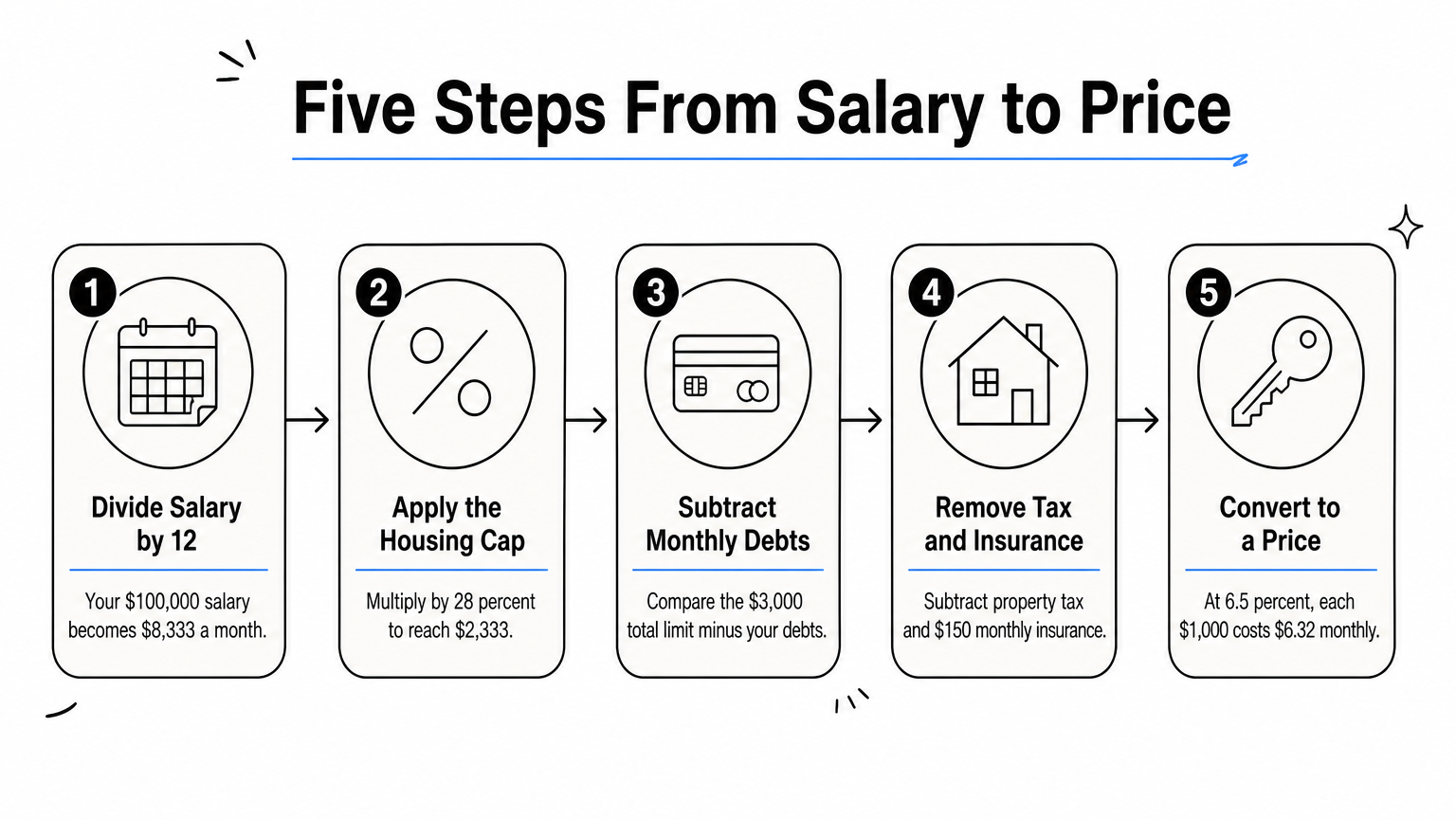
Start with your monthly housing cap, subtract property tax and insurance, then solve for the price whose loan payment fits what remains. You can do it on a calculator in five steps.
Five steps from salary to price
- Divide your salary by 12. For $100,000, that is $8,333.
- Multiply by 28%, or by 22% or 33% for a safer or stretchier budget. That gives $2,333.
- Subtract your monthly debts from the 36% total of $3,000. If the result is lower than step 2, use it instead.
- Subtract monthly property tax and insurance. This article assumes tax of 1.1% of the price per year and $150 a month for insurance. Your local figures will differ.
- Convert what is left into a price. At 6.5% over 30 years, each $1,000 borrowed costs $6.32 a month in principal and interest.
Worked example: a $365,000 home
Take $2,333 and subtract $150 for insurance. That leaves $2,183 for principal, interest and tax. With 20% down, each dollar of price costs about $0.00506 a month in principal and interest and $0.00092 in tax. Divide $2,183 by $0.00597 and you get about $365,000.
| Monthly cost at $365,000 (20% down, $73,000) | Amount |
|---|---|
| Principal and interest on a $292,000 loan | $1,848 |
| Property tax at 1.1% a year | $335 |
| Homeowners insurance | $150 |
| Total housing payment | $2,333 |
Many quick estimates divide $2,333 by the loan factor and stop there. That counts only principal and interest and suggests a price near $461,000. Leaving out tax and insurance overstates the price by about $96,000.
Subtract taxes and insurance before you convert the payment into a price, or you overshoot by close to $100,000.
Three budgets, three prices
Run the same steps at each budget level and you get the full range for a $100K salary. The 20% down payment assumption and 6.5% rate stay the same.
| Budget level | Housing cap | Estimated price |
|---|---|---|
| Conservative (22%) | $1,833 | about $282,000 |
| Moderate (28%) | $2,333 | about $365,000 |
| Maximum (33%) | $2,750 | about $435,000 |
The Affordability Calculator on HomeLoanCalc.io shows these three scenarios side by side, along with the maximum payment and resulting debt-to-income ratio for each. It updates as you type, so you can test your own debts and down payment in seconds.
How debt, down payment and rate change your number
At the 28% budget, three inputs move the price most: the debt you already carry, the cash you put down and your interest rate. Of the three, debt is the one that surprises people.
Existing monthly debt
Debt only hurts your price once it passes $667 a month. Below that, the 28% housing cap is the binding limit. Above it, the 36% total cap takes over and every extra dollar of debt comes straight out of your housing payment.
| Other monthly debt | Maximum housing payment | Estimated price (20% down) |
|---|---|---|
| $0 | $2,333 | about $365,000 |
| $500 | $2,333 | about $365,000 |
| $1,000 | $2,000 | about $310,000 |
| $1,500 | $1,500 | about $226,000 |
Past that threshold, each extra $100 of monthly debt removes about $16,700 of price. Having no debt at all does not lift you above $365,000, because the 28% cap still applies. A lender may stretch past it, but your budget should not.
Debt above $667 a month, not your salary, is what starts shrinking a $100K budget.
Down payment
A bigger down payment raises your price in two ways. It cuts the loan and it removes PMI. The table assumes PMI of 0.9% of the loan per year at 5% down and 0.7% at 10% down, both of which vary with your credit score.
| Down payment | Cash down | Estimated price at $2,333 a month |
|---|---|---|
| 5% | $14,300 | about $286,000 |
| 10% | $30,600 | about $306,000 |
| 20% | $73,000 | about $365,000 |
If you bring $100,000 down, the same budget reaches about $389,000. In the US, lenders must cancel PMI automatically once your scheduled balance hits 78% of the original home price, so it is a cost with an end date. Our down payment calculator compares 5%, 10%, 15% and 20% side by side if you want to test other prices.
Interest rate
Rate changes the price through the payment factor. At the same $2,333 budget and 20% down, a one-point swing is worth about $32,000 of house.
| Interest rate (30-year fixed) | Estimated price |
|---|---|
| 6.0% | about $382,000 |
| 6.5% | about $365,000 |
| 7.0% | about $350,000 |
Credit score drives the rate you are offered, so improving it before you apply can lift your price ceiling without changing your income.
Can you stretch to $500K, $700K or $1M on $100K?
A $500K house is a stretch on $100,000, and $700K or $1 million is out of reach on that income alone, because the payment passes 37% of gross income before any other debt. Lenders may approve more than you can comfortably carry, so look at the monthly cost first.
What bigger homes cost per month
This table assumes 20% down, 6.5% over 30 years, property tax of 1.1% a year and $150 a month for insurance.
| Home price | 20% down | Monthly housing cost | Share of $8,333 gross |
|---|---|---|---|
| $400,000 | $80,000 | $2,539 | 30.5% |
| $500,000 | $100,000 | $3,137 | 37.6% |
| $700,000 | $140,000 | $4,331 | 52.0% |
| $1,000,000 | $200,000 | $6,123 | 73.5% |
A $400,000 home is only slightly above the 28% line, so it is realistic with low debt or a larger down payment. At $500,000, the payment would take roughly half of your take-home pay. Reaching $700,000 or more takes a second income, large existing equity or a much bigger down payment.
A $500K house may get approved, but it would take about half your take-home pay.
Costs the 28% rule leaves out
The 28% figure covers the mortgage payment, not the rest of owning a home. Plan for these on top:
- Closing costs. Our closing cost calculator's default fee breakdown adds up to about 2.2% of the price, roughly $8,000 on a $365,000 home. Lenders often quote 2% to 5% or more, depending on the loan.
- Maintenance and repairs. A common rule of thumb is 1% to 3% of the price each year, or about $300 to $900 a month at $365,000.
- Utilities and HOA dues. These vary widely by home size and neighborhood.
- An emergency fund. Keep several months of expenses in cash after closing, separate from your down payment.
Your number is a range, so test it
On a $100,000 salary, the 28/36 rule gives you about $2,333 a month for housing. After taxes and insurance, that buys roughly $365,000 with 20% down at 6.5%. Heavy debt, a small down payment or a higher rate push the figure toward $285,000, while a lower rate or a big down payment pull it toward $435,000.
Pick the budget level you can live with, not the one a lender will approve. Then check it against your own debts, local taxes and cash on hand. To run your own version of this math in seconds, open the free affordability calculator at HomeLoanCalc.io. It needs no signup and updates as you type.
This article is for general information and is not financial advice. Confirm figures with your lender or an official source before you decide.
Run your own numbers
Use our free calculators to see what this means for your loan.
More articles
- Annual Amortization Calculator: Build a Yearly Schedule
- Insurance and Mortgage: How PMI Works and What It Costs
- Mortgage Term: What It Is and How to Pick the Right One
- Amortization Schedule Payment Calculator: How to Use It
- How Much to Afford a 500K House: Income and Down Payment
- Mortgage Paid Off Calculator: How to Find Your Payoff Date
- Mortgage Calculator with Tax and Insurance: How to Use It
- Amortization Schedule for a Mortgage with a Balloon Payment
- Mortgage Insurance Disbursement: What the Line Item Means
- How Much Can I Afford on a House? 4 Steps to Your Number