How Much House Can I Afford with 70K Salary? $170K to $305K
By Sohaib Ibrahim · Published November 13, 2026
How much house you can afford with a $70K salary depends on your debts, down payment, and interest rate, but a realistic range runs from about $170,000 to $305,000. At a 6.5% rate with 10% down, the middle of that range is about $219,000, which keeps your full monthly payment near $1,633, or 28% of your gross income. Put 20% down and keep your other debts low, and you can reach roughly $300,000. Online answers vary far more widely than that, because each one rests on different assumptions about rates, taxes, and debt.
Affordability, in plain terms, is the home price whose total monthly cost fits your income under lender rules like the 28/36 rule and still leaves room for the rest of your life. It is not the maximum a lender will approve. It is the price at which the payment, the upfront cash, and the repair bills all stay manageable on one salary.
This guide shows why $70,000 produces a range, how to calculate your own price in four steps, and how debts, rates, and down payment move the number. You will also see whether a $200,000, $250,000, or $300,000 house fits, and which costs the mortgage payment hides. HomeLoanCalc.io builds free mortgage and affordability calculators, and every figure below uses the standard amortization formula, so you can rerun it with your own inputs.
Why $70K points to a range, not one price
A $70,000 salary supports a range of prices because lenders cap your monthly payment as a share of income, and your debts, rate, and down payment decide how far that cap stretches. Nobody can name one number for how much house you can afford on a $70K salary without knowing those inputs.
What the 28/36 rule says about $70,000
Your gross monthly income is $5,833, which is $70,000 divided by 12. The 28/36 rule says housing should take no more than 28% of that, or $1,633 a month. It also says all debt payments together should stay under 36%, or $2,100. Housing means principal, interest, property taxes, homeowners insurance, PMI if you put down less than 20%, and HOA dues.
The rule uses gross pay, not take-home pay. Car loans, student loans, and minimum credit card payments count toward the 36%. Groceries, utilities, and childcare do not.
Lenders cap your payment, not the price, so the same $1,633 buys very different homes depending on rate, down payment, and taxes.
Three budgets from the same salary
Instead of one cap, think in three. A conservative budget uses 22% of gross income, a moderate one uses 28%, and a stretch budget uses 33%. The table converts each payment into a home price, assuming a 6.5% rate on a 30-year fixed loan, property tax and insurance of 1.5% of the price per year, and PMI of 0.7% of the loan per year when you put down less than 20%.
| Budget | Share of gross income | Monthly housing payment | Price at 10% down | Price at 20% down |
|---|---|---|---|---|
| Conservative | 22% | $1,283 | $172,000 | $203,000 |
| Moderate | 28% | $1,633 | $219,000 | $259,000 |
| Stretch | 33% | $1,925 | $258,000 | $305,000 |
These are planning estimates, not a quote. Your county's tax rate and your insurer's premium will move the result. The same three scenarios appear in our free Affordability Calculator, which also checks the 36% total-debt limit for you.
Why the lender's maximum is not your budget
Many conventional lenders will approve debt ratios well above 36%, sometimes around 43%. That tells you what the bank will risk, not what fits your life. On $70,000, take-home pay is often around $4,400 to $4,900 a month, depending on your state, retirement contributions, and health premiums. A $1,633 payment therefore takes roughly a third or more of the money you actually receive.
Being house poor means you can make the payment but have little left for savings, travel, or surprises. With a single income, there is no second paycheck to absorb a job change. If your paycheck is the only one, lean toward the conservative or moderate row.
How to calculate your own price on a $70K income
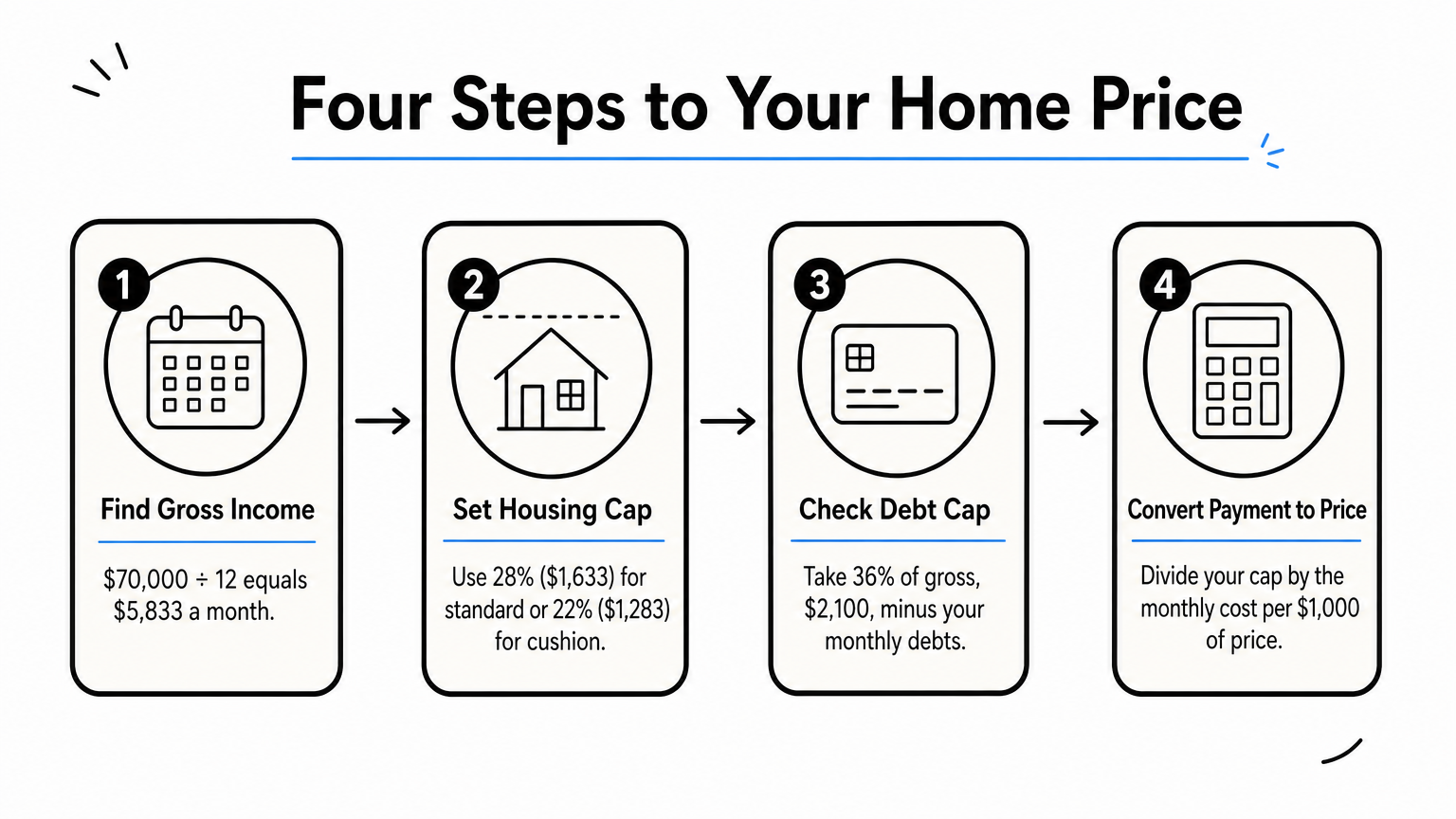
You can estimate your price in four steps: find your gross monthly income, set a housing cap, subtract your debts, and divide by the monthly cost per $1,000 of home price. The whole calculation fits on a napkin.
The four-step calculation
- Find gross monthly income. $70,000 ÷ 12 = $5,833.
- Set the housing cap. Use 28% for a standard budget ($1,633) or 22% for a cushion ($1,283).
- Check the debt cap. Take 36% of gross ($2,100) and subtract your monthly debt payments. Your housing cap is the lower of this result and step 2.
- Convert payment to price. Divide your cap by the monthly cost per $1,000 of price, then multiply by 1,000.
At a 6.5% rate with 10% down, my assumptions above work out to about $7.46 a month per $1,000 of price. That covers principal, interest, tax, insurance, and PMI. So $1,633 ÷ 7.46 × 1,000 gives about $219,000. With 20% down there is no PMI and the cost drops to about $6.31 per $1,000, so the same payment buys roughly $259,000.
How monthly debts change the answer
Debts only bite once they eat into your 36% room. With no debts, the 28% housing rule is the limit. The 36% rule takes over once your debts pass about $467 a month, which is $2,100 minus $1,633.
| Monthly debts | Room under 36% | Housing cap you can use | Price at 10% down |
|---|---|---|---|
| $0 | $2,100 | $1,633 | $219,000 |
| $300 | $1,800 | $1,633 | $219,000 |
| $500 | $1,600 | $1,600 | $214,000 |
| $800 | $1,300 | $1,300 | $174,000 |
| $1,000 | $1,100 | $1,100 | $147,000 |
Every $100 of monthly debt above about $467 takes roughly $13,400 off the price you can afford.
That makes paying off a $300 car loan before you apply one of the cheapest ways to raise your ceiling. Count the minimum payment on every card and loan on your credit report, not just the big ones.
Scaling the math to other salaries
The same method works for any income. Each $5,000 of salary changes the 28% payment by about $117 a month, which moves the price by roughly $15,600 at 10% down. That puts a $65,000 salary near $203,000 and an $80,000 salary near $250,000, using the same assumptions.
To skip the arithmetic, enter your income, debts, down payment, and credit score into the Affordability Calculator. It updates as you type and needs no signup. Then plug the resulting price into the Mortgage Calculator to see the full payment, total interest, and amortization schedule.
How down payment and interest rate move your budget
Both levers change the same thing: how many dollars of house each dollar of monthly payment buys. A lower rate or a larger down payment raises your price ceiling without raising your payment, and the effect is bigger than most buyers expect.
Interest rate: a two-point swing costs about $35,000
Holding the payment at $1,633 and the down payment at 10%, a 2-point rate swing moves the price by about $35,000. You cannot control the market, but you can shop several lenders and improve your credit score before applying.
| Rate | Principal and interest per $1,000 borrowed | Price at 10% down | Change vs. 6.5% |
|---|---|---|---|
| 5.5% | $5.68 | $237,000 | +$18,000 |
| 6.0% | $6.00 | $228,000 | +$9,000 |
| 6.5% | $6.32 | $219,000 | baseline |
| 7.0% | $6.65 | $210,000 | -$9,000 |
| 7.5% | $6.99 | $202,000 | -$17,000 |
Check live rates before you rely on any table, including this one. The rates here are examples, not forecasts.
Down payment: 10% versus 20%
Moving from 10% down to 20% lifts your moderate-budget price from $219,000 to $259,000. That extra $40,000 of house costs you $29,900 more in cash at closing, because 20% of $259,000 is $51,800 and 10% of $219,000 is $21,900. Part of the gain comes from skipping PMI, which typically runs about 0.58% to 1.86% of the loan per year depending on your credit and down payment.
PMI does not last forever. On a conventional loan, US lenders must cancel it automatically when your scheduled balance reaches 78% of the original home price, and you can usually request removal earlier at 80%. FHA loans allow as little as 3.5% down but carry their own mortgage insurance, which works differently.
A bigger down payment buys more house and removes PMI, but only if you keep cash left for closing costs and repairs.
Do not drain your savings to hit 20%. Our Down Payment Calculator compares 5%, 10%, 15%, and 20% side by side, showing the loan amount, monthly payment, and whether PMI applies. The PMI Calculator then estimates the monthly cost and when it can drop off.
Can you afford a $200K, $250K, or $300K house on $70K?
You can afford a $200,000 house comfortably, a $250,000 house with either a solid down payment or a tight budget, and a $300,000 house only with about $60,000 down and very little other debt. The table shows the monthly payment and its share of your $5,833 gross monthly income, using the same assumptions as before.
Payment and share of income by price
| Home price | Down (10%) | Payment at 10% down | Share of gross | Down (20%) | Payment at 20% down | Share of gross |
|---|---|---|---|---|---|---|
| $200,000 | $20,000 | $1,493 | 25.6% | $40,000 | $1,261 | 21.6% |
| $250,000 | $25,000 | $1,866 | 32.0% | $50,000 | $1,577 | 27.0% |
| $300,000 | $30,000 | $2,239 | 38.4% | $60,000 | $1,892 | 32.4% |
What each price asks of you
A $200,000 home stays under 28% either way. Even with $600 in monthly debts and 10% down, your total of $2,093 is just under the $2,100 limit. This is the safest answer for a single earner.
A $250,000 home at 10% down costs 32% of gross income, above the 28% guideline and leaving only $234 a month for other debts. With 20% down it drops to 27% and fits the standard rule. Treat it as a stretch unless you have the larger down payment.
A $300,000 home at 10% down needs 38.4% of gross income for housing alone, which breaks the 36% rule. At 20% down it takes 32.4% and leaves $208 for debts. It works only with $60,000 down, almost no debt, and a willingness to live on a tight budget.
On $70,000, $200,000 is comfortable, $250,000 depends on your down payment, and $300,000 is a stretch for almost everyone.
Costs beyond the payment, and ways to raise your budget
The mortgage payment is not your full cost of owning. Upfront cash, maintenance, and utilities add thousands that the 28/36 rule ignores, so budget for them before you pick a price. The good news is that several moves can raise your ceiling.
Cash you need before closing day
Take the $219,000 moderate-budget home with 10% down. The down payment is $21,900. Closing costs typically run 2% to 5% of the price, which is $4,380 to $10,950. Together that is $26,280 to $32,850 before moving costs, immediate repairs, or furniture. Our Closing Cost Calculator breaks the fees into lender, appraisal, title, inspection, and recording lines so you can see where the money goes.
Keep an emergency fund separate. If the down payment leaves you with no cash, a lower price is the safer choice.
Ongoing costs the 28% rule skips
A common rule of thumb is to set aside 1% to 3% of the home's price each year for maintenance and repairs. On a $219,000 home that is $2,190 to $6,570 a year, or $183 to $548 a month. Add utilities, which are usually higher than in a rental, and HOA dues, which range from under $50 to more than $500 a month where they apply.
These costs depend heavily on the home's age and condition. A newer house or condo lowers repair risk but may add HOA fees, so compare the full monthly picture, not just the listing price.
Ways to raise your price ceiling
Small changes to your finances compound. Work through this list in order of effort:
- Pay down monthly debts. Clearing $300 of payments adds about $40,000 of price once the 36% rule is the limit.
- Raise your credit score. A higher score can lower your rate, and a 2-point rate drop is worth about $35,000 of price.
- Save a larger down payment. More cash cuts the loan, the PMI, and the payment.
- Compare lender quotes. Rates, fees, and closing costs differ between lenders, so get at least three.
- Check assistance programs. First-time buyer programs, state housing agencies, and FHA, VA, or USDA loans can reduce the cash you need upfront.
- Add a co-borrower. A second qualifying income raises the payment you can carry, with shared responsibility for the loan.
The cheapest way to afford more house is to remove debt and shop rates, not to stretch the payment.
Pick a payment first, then the price
On a $70,000 salary, the lender's maximum is not your budget. Start with a monthly payment you can live with, usually between $1,283 and $1,633, subtract your debts under the 36% limit, and convert what is left into a price. That gives roughly $170,000 to $260,000 at 10% down, and up to about $305,000 with 20% down and little debt. Then add closing costs, maintenance, and an emergency fund before you commit.
These figures are estimates for planning, not financial advice, and your lender's final numbers will differ. To see your own range in seconds, try the free affordability calculator at HomeLoanCalc.io. It takes your income, debts, down payment, and credit score, shows conservative, moderate, and maximum scenarios, and asks for no signup or email.
This article is for general information and is not financial advice. Confirm figures with your lender or an official source before you decide.
Run your own numbers
Use our free calculators to see what this means for your loan.
More articles
- How Much House Can I Afford with 300K Salary? Step by Step
- Mortgage Insurance Disbursement: What the Line Item Means
- Excel Mortgage Amortization Schedule: Build One in 4 Steps
- Mortgage Calculator with Tax and Insurance: How to Use It
- $60K Salary Home Budget: How Much House Can You Afford?
- How Much to Afford a 500K House: Income and Down Payment
- Longest Mortgage Term: Do 40- and 50-Year Loans Exist?
- Mortgage Term: What It Is and How to Pick the Right One
- FHA Debt-to-Income Ratio Calculator: How to Check 31/43
- Annual Amortization Calculator: Build a Yearly Schedule