Amortization Schedule for a Mortgage with a Balloon Payment
By Sohaib Ibrahim · Published October 22, 2026
An amortization schedule for a mortgage with a balloon payment is a payment-by-payment table that splits each installment into principal and interest and ends with the lump sum still owed when the short loan term runs out. Your monthly payment is calculated as if you had 30 years (or 20, or 15) to repay. The loan, though, comes due in 5 to 7 years, so the schedule stops with a large unpaid balance. That balance is the balloon.
This guide shows you why the schedule matters before you sign, how to build one with a free calculator or a spreadsheet, and a full worked example on a $300,000 loan. You will also see how the amortization period changes the balloon, what your options are when it comes due, and which input mistakes make a schedule wrong.
HomeLoanCalc.io is a free set of mortgage calculators that use the standard amortization formula lenders use. Its Amortization Calculator has no separate balloon field, but the method below gets you the same answer with the inputs it does have.
Why a balloon schedule matters before you sign
A balloon schedule matters because the monthly payment alone understates your debt. On a $300,000 loan at 7% with a 30-year amortization, you pay $1,995.91 a month and still owe about $282,400 after five years. The payment looks like a normal mortgage. The balance tells you the truth.
The payment hides the real obligation
Lenders quote the monthly payment because it is the smallest number in the deal. A 30-year amortization keeps that payment low, and a 5-year term keeps the lender's risk short. The gap between the two is the balloon. You never see it in the monthly figure, only in the schedule.

Early payments are also mostly interest. In the first month of the example above, $1,750.00 of your $1,995.91 goes to interest and only $245.91 reduces the loan. Five years of that pace pays down barely 6% of what you borrowed.
A balloon mortgage payment tells you what you owe each month, but only the schedule tells you what you owe when the loan ends.
What the schedule shows that a quote does not
A full schedule gives you four numbers you need before committing:
- The exact balloon amount due at the end of the term.
- How much of what you paid went to interest and how much to principal.
- Your remaining balance at any month, which matters if you plan to sell early.
- The size of the refinance you will need, so you can test it against higher rates.
Knowing the balloon amount early gives you time to plan. If the number is more than you could refinance, sell, or pay in cash, you find out now and not in year five.
How to build the schedule with a free calculator
To build the schedule, run your loan through an amortization calculator using the long amortization period, then read the balance at the month your loan comes due. That balance is your balloon. You are not entering the short term at all.
Steps with the Amortization Calculator
The free Amortization Calculator takes three inputs: loan amount, annual interest rate, and loan term in years. It returns the monthly payment, total interest, and total cost, and lets you switch between an annual summary and a detailed monthly view. Follow these steps:

- Enter the loan amount you will borrow.
- Enter the annual interest rate from your loan estimate.
- Enter the amortization period as the term (for example 30), not the balloon term (for example 5).
- Switch to the monthly view and scroll to the payment number where your loan matures, such as payment 60 for a 5-year balloon.
- Read the remaining balance on that row. That is the balloon.
If you are still choosing a home price and down payment, the free Mortgage Calculator builds the same schedule from home price, down payment, and rate, with taxes, insurance, PMI, and HOA fees included.
Worked example: $300,000 at 7% with a 5-year balloon
Take a $300,000 loan at 7% with a 30-year amortization and a 5-year balloon. Here are the key rows from the monthly schedule:
| Payment | Interest | Principal | Remaining balance |
|---|---|---|---|
| 1 | $1,750.00 | $245.91 | $299,754.09 |
| 2 | $1,748.57 | $247.34 | $299,506.75 |
| 60 | about $1,649 | about $347 | about $282,395 |
Now the five-year totals:
| Item | Amount |
|---|---|
| Monthly principal and interest | $1,995.91 |
| Total of 60 payments | about $119,755 |
| Interest paid | about $102,150 |
| Principal paid | about $17,605 |
| Balloon due at month 60 | about $282,395 |
| Total cash out over the term | about $402,150 |
Only about 15 cents of every dollar you paid reduced the loan. The rest was interest.
The balloon is simply the remaining balance on the row where your short term ends.
Spreadsheet version
If you prefer a spreadsheet, two Excel or Google Sheets formulas do the job. The first returns the payment and the second returns the balloon. Replace the numbers with your own.
Payment:  =PMT(0.07/12, 360, 300000)
Balloon:  =-FV(0.07/12, 60, PMT(0.07/12, 360, 300000), 300000)
In both, 360 is the amortization period in months and 60 is the balloon term in months. The payment comes out negative in Excel, which is normal. For an interest-only balloon, skip the formulas. Your payment is the loan times the rate divided by 12, and the balloon equals the full loan amount.
How the amortization period changes the balloon
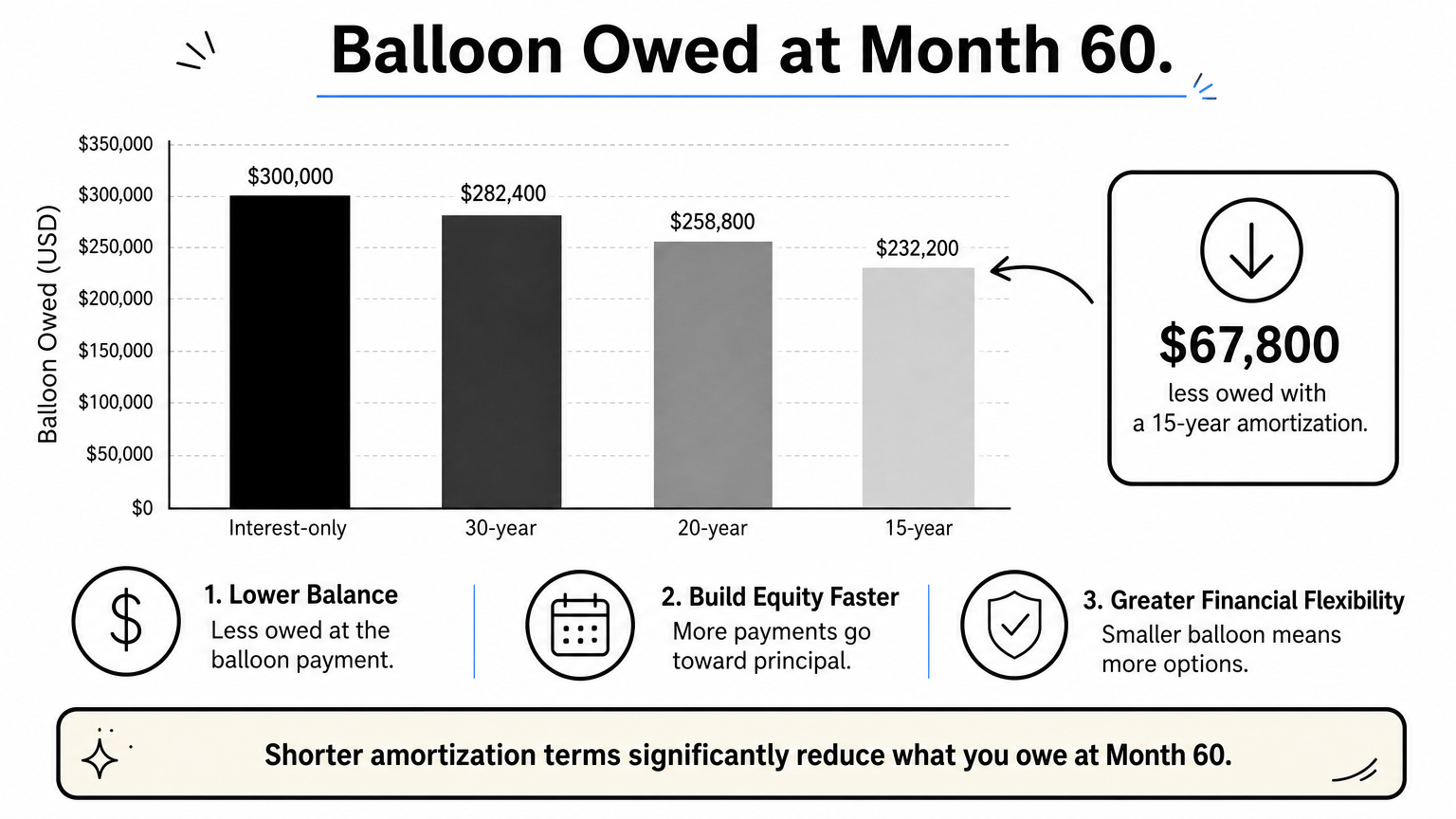
A shorter amortization period raises your monthly payment and shrinks the balloon, while a longer one does the reverse. The balloon term sets when the bill arrives. The amortization period sets how large it is.
Comparing four structures on the same loan
Here is the same $300,000 loan at 7% with a 5-year balloon under four structures:
| Structure | Monthly payment | Balloon at month 60 | Principal paid down |
|---|---|---|---|
| Interest-only | $1,750.00 | $300,000 | $0 |
| 30-year amortization | $1,995.91 | about $282,400 | about $17,600 |
| 20-year amortization | $2,325.90 | about $258,800 | about $41,200 |
| 15-year amortization | $2,696.48 | about $232,200 | about $67,800 |
Moving from a 30-year to a 20-year amortization costs you about $330 more a month and cuts the balloon by about $23,600. Even the most aggressive option leaves a six-figure balloon.
Shortening the amortization period buys you a smaller balloon, but only a very short amortization makes it disappear.
What a 20-year amortization with a 5-year balloon means
It means the lender calculates your payment as though you would repay over 20 years, then requires full payoff after 5. You make 60 payments of $2,325.90 on the $300,000 example and owe about $258,800 on top.
A balloon payment is not fully amortized. The schedule is built on a long amortization, but the term ends before that schedule finishes. Paying extra principal during the term lowers the balloon dollar for dollar, which the free Extra Payment calculator can model.
What happens when the balloon comes due
When the balloon comes due, you have three ways to pay it: refinance, sell the property, or pay cash. Most balloon loans do not convert to a regular payment schedule on their own, so a missed balloon means default and possible foreclosure. Read your note for any conversion or extension clause, and do not assume one exists.
Refinance, sell, or pay cash
Refinancing replaces the balloon with a new loan. Start shopping 6 to 12 months before the due date, because you must qualify again on your credit, payment history, and debt. Rates may also be higher. Refinance the $282,395 balance at 8% over 30 years and your payment becomes about $2,072, up from $1,995.91.
Selling works if the home is worth more than the balloon plus selling costs. It is risky when prices fall, because the sale may not cover the balance. Paying cash works only if you have saved for it, and a schedule tells you the exact target.
Use the schedule to plan backward
Run your schedule and note the balloon, then test it against a stress case. Ask whether you could refinance at a rate 1 or 2 points higher, and whether you could pay the balloon if the home sold for 10% less.
Lenders must also verify that you can repay a balloon loan under federal ability-to-repay rules. That check protects them, not you. Keep a cash reserve in case refinancing falls through.
Mistakes that make a balloon schedule wrong
The most common mistake is entering the balloon term as the loan term. On the $300,000 example, a 5-year term shows a payment of about $5,940.37 and a balance of zero. That is a different loan, not your balloon mortgage.
Input errors to avoid
The first check is the amortization period. Use the period your lender states in the loan estimate, not the term. Second, use the real note rate, not an advertised one. Third, count payments from the first due date, since balloon timing can differ by a month depending on closing.
Also remember that the schedule covers principal and interest only. Taxes, insurance, PMI, and HOA fees sit on top of it, and the Mortgage Calculator adds them to the monthly total.
What the schedule leaves out
HomeLoanCalc.io calculators model fixed-rate loans. If your balloon loan has an adjustable rate, the schedule is only a baseline. Fees, odd first periods, and lender rounding can also shift the numbers slightly.
Treat every result as a planning estimate, not a quote. Your lender's final figures come from your actual loan documents, and this site's content is for planning and education, not financial advice.
Know your balloon number first
An amortization schedule for a balloon mortgage comes down to one number: the balance left at the end of the short term. Build the schedule on the long amortization period, read the balance at your maturity month, and plan your refinance, sale, or cash payoff around it.
You do not need to sign up for anything to see your own figures. Run your loan through the free amortization calculator, switch to the monthly view, and find your balloon before a lender asks you to commit.
This article is for general information and is not financial advice. Confirm figures with your lender or an official source before you decide.
Run your own numbers
Use our free calculators to see what this means for your loan.
More articles
- Mortgage Paid Off Calculator: How to Find Your Payoff Date
- How Much Can I Afford on a House? 4 Steps to Your Number
- Amortization Schedule Payment Calculator: How to Use It
- How to Use a Mortgage Calculator to Estimate Your Payment
- Insurance and Mortgage: How PMI Works and What It Costs
- Oklahoma Mortgage Calculator: Add Taxes, Insurance and PMI
- How Much House Can I Afford with a $100K Salary?
- How to Use an Amortisation Calculator and Read the Schedule
- Annual Amortization Calculator: Build a Yearly Schedule
- Extra Mortgage Payments: How They Work and What You Save