Mortgage Calculator with Tax and Insurance: How to Use It
By Sohaib Ibrahim · Published November 15, 2026
To get your real monthly payment, enter your home price, down payment, rate and term into a mortgage calculator with tax and insurance fields. Then add your yearly property tax, your homeowners insurance premium, PMI if you put less than 20% down, and any HOA dues. The total is what your lender will actually collect. On a $400,000 home with 10% down at 6.5%, it comes to about $3,002 a month, not the $2,275 that the loan alone suggests.
Most basic calculators stop at principal and interest. Buyers budget for that smaller number, then see a larger one on their first escrow statement. Taxes and insurance often add hundreds of dollars a month, and nobody hands you those figures. You have to estimate them yourself, and a bad estimate means a payment that does not fit your budget.
This guide walks you through four steps with one worked example from start to finish. You can follow along with the free mortgage calculator on HomeLoanCalc.io, which handles principal, interest, property tax, insurance, PMI and HOA fees in one place. It updates as you type and needs no signup.
What goes into a full monthly mortgage payment
A full monthly payment has up to five parts: principal and interest, property tax, homeowners insurance, private mortgage insurance (PMI), and HOA dues. A basic loan calculator covers only the first part. A calculator that includes taxes and insurance adds the rest, which is why its answer is the one to budget around.
The five parts and who controls each
Principal and interest come from your loan terms and stay flat on a fixed-rate loan. The other four come from outside parties and can change, so you estimate them now and verify them later. The table shows where each number comes from.
| Part | Who sets it | Does it change? |
|---|---|---|
| Principal and interest | Your loan amount, rate and term | No, on a fixed-rate loan |
| Property tax | Local government and assessor | Yes, with reassessments and rate changes |
| Homeowners insurance | Your insurer | Yes, at each renewal |
| PMI | Lender and insurer, based on down payment and credit | Ends once you build enough equity |
| HOA dues | Your homeowners association | Yes, dues can rise |
A payment that leaves out taxes and insurance is not your payment, only a fraction of it.
Why lenders fold taxes and insurance into one bill
Most lenders set up an escrow account. They collect one twelfth of your yearly tax and insurance bills with every payment, then pay those bills when they come due. Lenders require insurance, and unpaid property tax can lead to a lien on the home, so they prefer to control the money.
For you, that means the amount leaving your bank account each month includes taxes and insurance. It also means the total can rise even on a fixed-rate loan, because escrow is recalculated whenever your tax or insurance bills change.
Step 1. Enter your price, down payment, rate and term
Start with four loan inputs: home price, down payment, interest rate and loan term. Together they set principal and interest, the only part of your payment that stays the same for 30 years on a fixed-rate loan.
Work out the loan amount
The loan amount is the home price minus your down payment. Our example buyer looks at a $400,000 home and puts 10% down, which is $40,000. That leaves a loan of $360,000. Enter the down payment in whichever form the calculator accepts, then confirm that the loan amount shows $360,000 before you move on.
Choose a rate and term you can defend
Use the rate from a lender quote or pre-approval, not a headline average. Our example uses 6.5% over 30 years. That is an illustrative assumption, not a forecast. HomeLoanCalc.io pre-fills country defaults and lets you change every field, so overwrite them with your own numbers.
At those inputs, principal and interest comes to about $2,275 a month. A shorter term raises that payment and cuts total interest. Keep in mind that the calculator models fixed-rate loans, so if you are considering an adjustable-rate loan, you need to test higher rates in Step 4.
Use the rate you were actually quoted, because every other number in the estimate builds on it.
Step 2. Estimate your property tax and insurance
Estimate property tax as your home price times the local effective tax rate, divided by 12. Estimate insurance as a real quote divided by 12. Neither has to be exact today, but both should come from the address you are buying, not from a guess.
Property tax: find the local rate
Ask the county assessor or tax collector for the effective rate, which is the yearly tax as a share of home value. In the US it runs from well under 1% to more than 2%, depending on state and locality. Listing pages often show the seller's tax bill. Do not copy it, because many areas reassess a property after a sale and your bill can be much higher.
Our example assumes 1.1%:
- Yearly tax: $400,000 × 1.1% = $4,400
- Monthly tax: $4,400 ÷ 12 = about $367
Check whether the calculator's tax field takes a percentage or a yearly dollar amount, and convert before you enter it.
Homeowners insurance: get a real quote
Call an insurance agent or request an online quote for the specific address. The premium depends on rebuild cost, location, coverage limits and deductible. Standard policies usually exclude floods and earthquakes, which need separate coverage, so ask about both before you settle on a number.
Our example assumes $1,800 a year, an illustrative figure and not an average. That is $150 a month. If you only have rough numbers, run the calculator twice, once with a low estimate and once with a high one, so you know the range your budget has to survive.
Estimate taxes from the house you are buying, not from the seller's old bill.
Step 3. Add PMI and HOA fees, then read the total
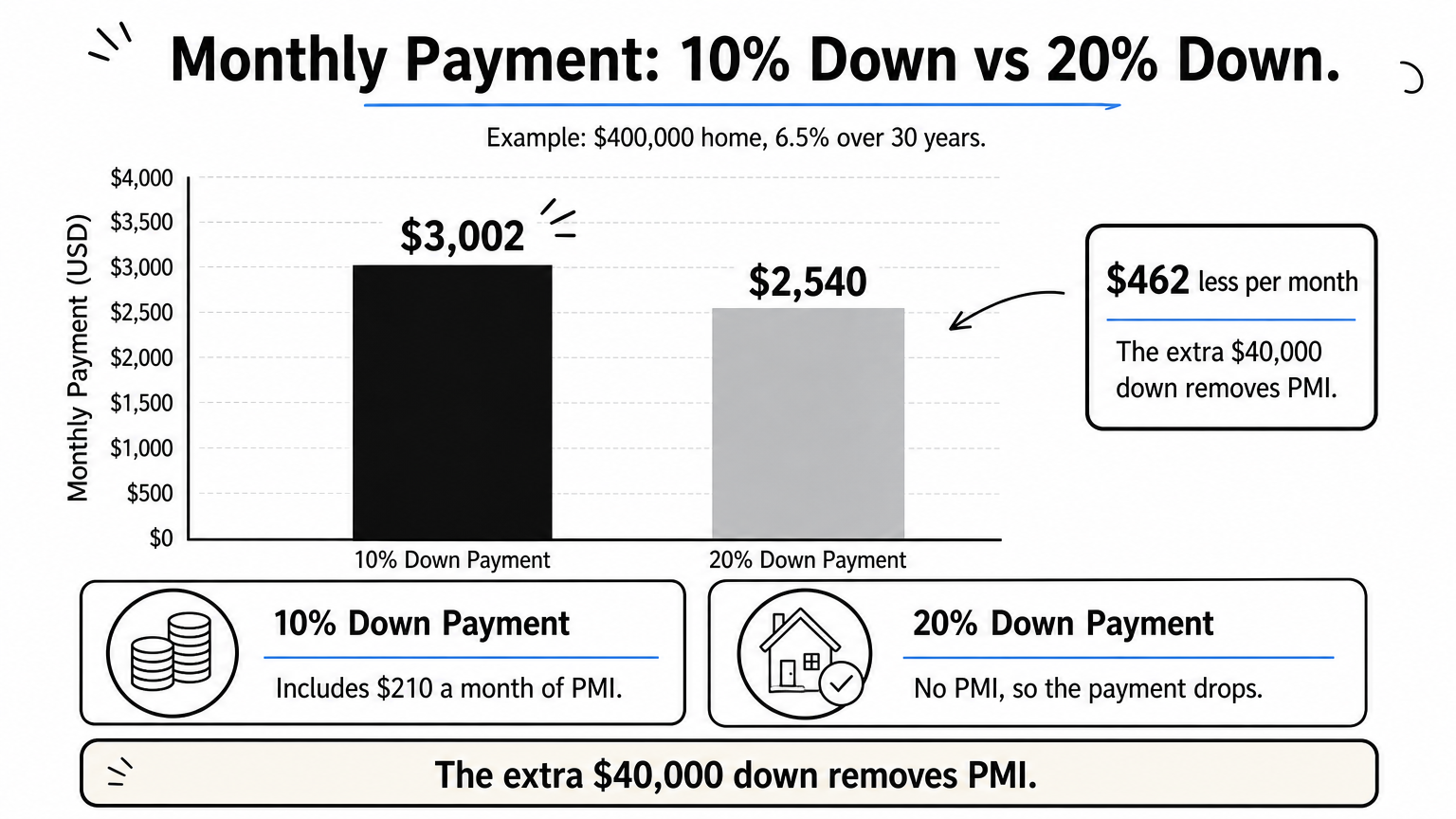
Add PMI only if you put less than 20% down on a conventional loan, and add HOA dues only if the home has an association. Then read the combined total. In our example, the total is $3,002 a month at 10% down and $2,540 at 20% down.
PMI: estimate it from loan size and credit
PMI typically runs about 0.46% to 1.50% of the loan amount per year, depending on your loan type, credit score and down payment. On our $360,000 loan, that range works out to $138 to $450 a month. The example uses 0.7%, which is $2,520 a year, or $210 a month.
This also answers the common question about PMI on a $400,000 home. The cost depends on the loan left after your down payment, so a smaller down payment means a larger loan and a larger premium. On a conventional loan you can request cancellation once your balance reaches 80% of the home's value, and US lenders must cancel automatically when the scheduled balance reaches 78% of the original value. FHA and VA loans follow different insurance rules.
HOA dues: ask for the exact amount
Ask the listing agent or the association for the monthly dues and any special assessments. Enter that amount in the HOA field, or leave it at zero if the home has no association. Dues are common in condos and planned communities, and they can climb over time.
Compare the totals side by side
Here is the full example at two down payments. Property tax and insurance stay the same because the home price does not change.
| Item | 10% down ($40,000) | 20% down ($80,000) |
|---|---|---|
| Loan amount | $360,000 | $320,000 |
| Principal and interest | $2,275 | $2,023 |
| Property tax | $367 | $367 |
| Homeowners insurance | $150 | $150 |
| PMI | $210 | $0 |
| HOA | $0 | $0 |
| Total monthly payment | $3,002 | $2,540 |
The extra $40,000 down saves $462 a month. It also means finding that cash before closing.
In this example, the extra $40,000 down removes PMI and cuts the payment by $462 a month.
Step 4. Test the total against your budget
Compare your total with your gross income using the 28/36 rule. Housing should take no more than 28% of gross monthly income, and all debt payments together no more than 36%. A payment that fails this test needs a change in price or down payment, not a more optimistic tax estimate.
See what share goes to taxes and insurance
In the example, property tax and insurance add up to $517 of the $3,002 payment, or about 17%. Add PMI and the non-loan share rises to $727, or about 24%. Your share will differ. A high-tax area or a pricey insurance market pushes it higher, and a 20% down payment removes PMI from the mix.
Apply the 28/36 rule
Divide the payment by 0.28 to find the income it needs: $3,002 ÷ 0.28 is about $10,721 of gross income a month, or roughly $128,700 a year. At the 36% limit, that income supports $3,860 in total monthly debt, which leaves about $858 for car loans, student loans and credit cards.
HomeLoanCalc.io's affordability calculator applies the same logic. It shows a conservative scenario at about 22% of income, a moderate one at 28% and a maximum at 33%, with total debt capped at 36%.
If the total tops 28% of your gross income, adjust the price or down payment, not the tax and insurance inputs.
Stress test, then verify with a lender
Raise the rate by half a point. At 7.0%, principal and interest on the $360,000 loan becomes about $2,395, which is $120 a month more. Also raise insurance by 10% to 20% to mimic a bad renewal. If the payment still fits, your budget has a margin.
Treat the result as a planning estimate, not a binding quote. The final rate, tax and insurance figures come from your lender and local assessor, so compare your numbers with the Loan Estimate you receive once you apply.
Run your own numbers
A real monthly payment is principal and interest plus property tax, homeowners insurance, PMI and HOA dues. Estimate each from your own address and quotes, add them up, and test the total against the 28/36 rule. In our example, a $400,000 home costs $3,002 a month with 10% down and $2,540 with 20% down.
Now put your own figures in. The free mortgage calculator on HomeLoanCalc.io takes all five payment parts, updates as you type and asks for no signup or email.
This article is for general information and is not financial advice. Confirm figures with your lender or an official source before you decide.
Run your own numbers
Use our free calculators to see what this means for your loan.
More articles
- Mortgage Insurance Disbursement: What the Line Item Means
- How Much to Afford a 500K House: Income and Down Payment
- How Much House Can I Afford with 70K Salary? $170K to $305K
- Mortgage Term: What It Is and How to Pick the Right One
- How Much House Can I Afford with 300K Salary? Step by Step
- Annual Amortization Calculator: Build a Yearly Schedule
- Excel Mortgage Amortization Schedule: Build One in 4 Steps
- How Much House Can I Afford with a $100K Salary?
- $60K Salary Home Budget: How Much House Can You Afford?
- Insurance and Mortgage: How PMI Works and What It Costs