Primary Mortgage Insurance: What PMI Is, Costs and Removal
By Sohaib Ibrahim · Published November 2, 2026
Primary mortgage insurance is almost always a mix-up for private mortgage insurance, or PMI. It is an insurance policy that protects your lender, not you. Lenders usually require it on a conventional loan when your down payment is under 20% of the home's value. It typically costs about 0.5% to 1.5% of the loan amount per year, and it ends once you build enough equity, generally around 78% to 80% of the original home value.
People also search for "property mortgage insurance" or "PMI loan," and they mean the same thing. This guide explains why lenders require PMI and what it costs, with a worked example on a $300,000 loan. It also covers how to remove PMI and how to decide whether to pay it or avoid it.
HomeLoanCalc.io builds free mortgage calculators, including a PMI calculator, so you can run the same kind of numbers yourself with no signup. Treat every figure below as a planning estimate. Your lender's quote sets the real cost.
Why lenders require PMI and what it means for you
Lenders require PMI because a small down payment leaves them exposed to loss if the loan fails, and you pay the premium for a policy that covers them.
Who PMI protects
If you put 5% down and later default, a foreclosure sale may not cover your balance plus the lender's costs. PMI is arranged by the lender and provided by private insurance companies, and it reimburses the lender for part of that loss. The 20% line is the usual threshold because at 20% equity the lender has a thick cushion.
You pay the premium, but you get no protection from it. If you miss payments, you still owe the debt and still face foreclosure and credit damage. That is the honest answer to "is PMI bad": it is a pure cost with no benefit to you beyond getting the loan approved.
PMI protects the lender, but you are the one who pays for it.
PMI versus MIP and other lookalikes
The names cause most of the confusion. "Primary" and "property" mortgage insurance are not real product names. PMI belongs to conventional loans, while FHA loans use a mortgage insurance premium (MIP) that works differently.
| Policy | Who it protects | Who requires it |
|---|---|---|
| PMI | Your lender | Lender, on conventional loans with under 20% down |
| FHA MIP | Your lender | FHA loans |
| Homeowners insurance | You and the house, against damage | Lender, on virtually every mortgage |
| Mortgage life insurance | Your family, by paying the balance if you die | Nobody, it is optional |
FHA also charges an upfront premium of 1.75% of the loan, usually financed into the balance. On an FHA loan with less than 10% down, MIP lasts for the life of the loan, so some owners later refinance into a conventional loan to drop it.
How much PMI costs on a home loan
What primary mortgage insurance costs depends mostly on your credit score and down payment, and it usually lands between 0.5% and 1.5% of the loan amount per year.
What sets your rate
Lenders price PMI on risk. These factors move your rate the most:
- Credit score: A higher score earns a lower rate, and the gap between a 760 and a 660 score can be large.
- Loan-to-value ratio (LTV): 5% down costs more than 10% down, because the lender carries more risk.
- Loan type and term: Fixed or adjustable, and 15 or 30 years, change how insurers price the risk.
- How you pay it: Monthly, upfront or built into your rate, as covered below.
A worked example on a $300,000 loan
PMI is quoted as an annual percentage of the original loan amount, then divided by 12 for your monthly payment.
| Annual PMI rate | Cost per year | Cost per month |
|---|---|---|
| 0.5% | $1,500 | $125 |
| 1.0% | $3,000 | $250 |
| 1.5% | $4,500 | $375 |
Some lenders quote a simpler rule of thumb, $30 to $70 per month for every $100,000 borrowed. On $300,000 that is $90 to $210 per month. Expect a range of roughly $90 to $375, with strong credit and 10% down at the low end and a 5% down payment with weaker credit at the high end.
How you pay for it
Most borrowers pay PMI monthly, added to the mortgage payment alongside principal, interest, taxes and homeowners insurance. You can also pay a single premium at closing, or have it financed. With lender-paid PMI, the lender covers the premium and charges you a higher interest rate. That rate stays for the life of the loan, so you cannot cancel it the way you can cancel monthly PMI.
A 1% PMI rate on a $300,000 loan adds about $250 a month to your payment.
How to remove PMI from your mortgage
Borrower-paid PMI on a conventional loan ends in three ways: you ask your servicer to cancel it at 80% LTV, it terminates automatically at 78%, or you refinance or get a new appraisal.
Request, automatic and final termination
PMI does not simply go away at 20% equity. Under the federal Homeowners Protection Act, which covers most conventional loans on a primary home made after July 1999, the rules work like this:
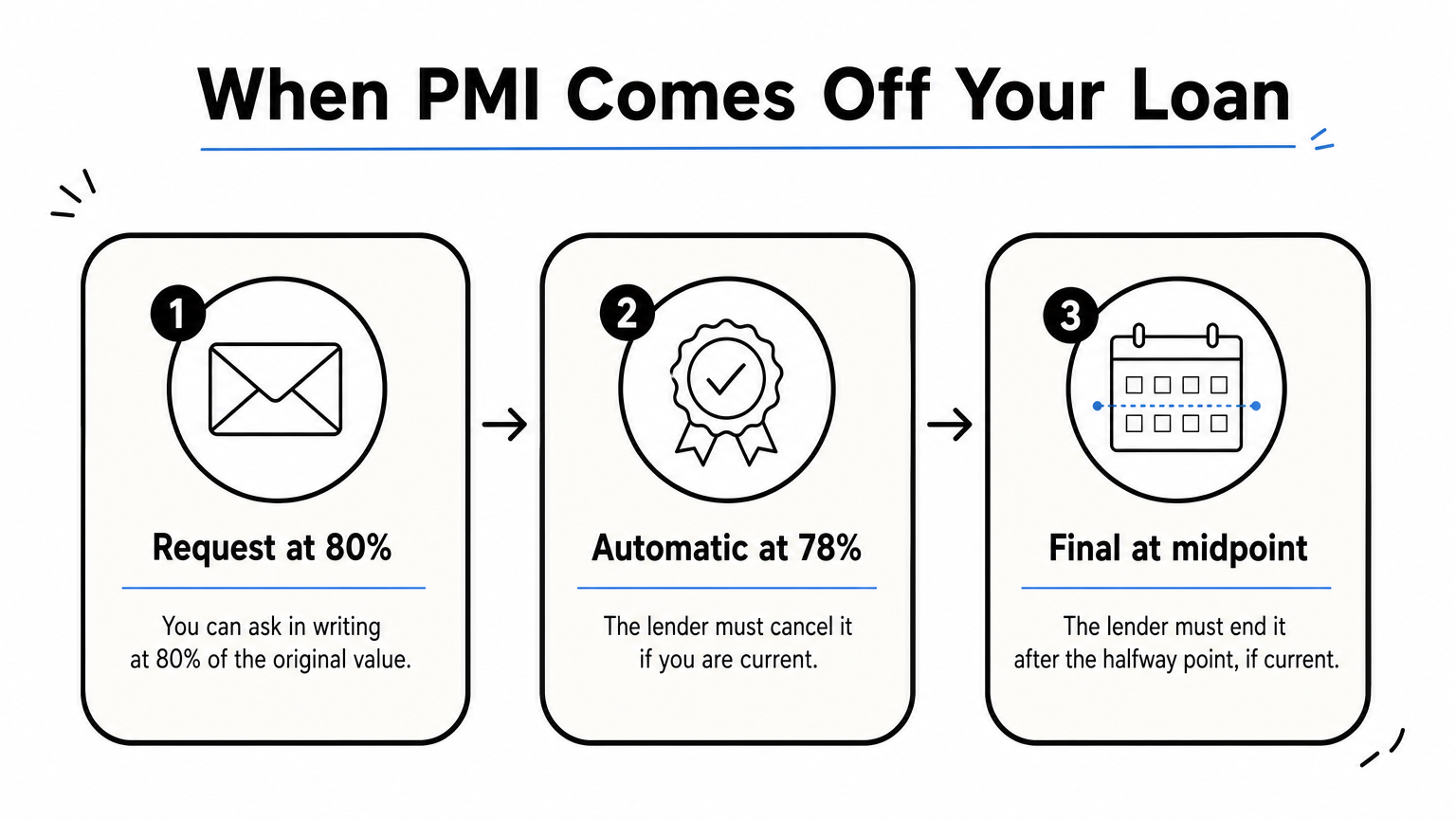
- At 80% of the original value: You can request cancellation in writing. You need a good payment history, no second liens, and a property that has not dropped in value.
- At 78% of the original value: The lender must cancel PMI automatically if you are current on payments. This is based on your scheduled balance, not your actual one.
- At the midpoint of the loan term: The lender must end PMI the month after the halfway point, for example year 15 of a 30-year loan, if you are current.
Lender-paid PMI and FHA MIP are not covered by these rules.
Ask for cancellation at 80%, because waiting for automatic removal at 78% costs you extra months of premiums.
Example: when 10% down reaches 78%
Say you buy a $300,000 home with 10% down. Your loan is $270,000 at 6.5% over 30 years, so principal and interest run about $1,707 a month. Your balance reaches 80% of the original price ($240,000) after about 8 years. It reaches 78% ($234,000) after about 9 years. Extra principal payments pull both dates earlier.
The PMI calculator does this math for you. It finds the first month your scheduled balance hits 78% of the original price, and you can add your credit score and rate to estimate the monthly cost along the way.
Getting PMI cancelled early
Your home may have gained value, which can put you under 80% LTV sooner than the schedule says. Ask your servicer what it requires. Many lenders want a waiting period after closing and a new appraisal at your expense, and rules vary by lender and loan owner.
Refinancing into a new loan at or below 80% LTV also drops PMI. It carries closing costs, so check the break-even point first. That is closing costs divided by your monthly savings.
Should you pay PMI or avoid it?
Pay PMI when it gets you into a home sooner than saving 20% would and the payment still fits your budget. Avoid it when 20% is within reach or a cheaper alternative exists.
The trade-off in numbers
On a $300,000 home, 20% down is $60,000 and 10% down is $30,000. At a 1% rate, PMI on the $270,000 loan costs about $225 a month. Over the roughly 8 years it takes to reach 80% LTV, that is about $21,600. The question is whether buying years earlier is worth that to you. For many buyers it is, especially when saving the extra $30,000 would take years and rent keeps going out the door.
The cost matters most when your budget is tight. PMI raises your monthly payment, which can push your debt-to-income ratio higher and shrink the price range you qualify for.
Ways to skip or shrink PMI
- Put 20% down, or enough to reach 80% LTV.
- Improve your credit score before applying, since it lowers the rate.
- Consider a VA loan if you are eligible. It has no monthly mortgage insurance, though it charges a funding fee.
- Ask about a second loan that covers part of the down payment. It can avoid PMI, but you carry two payments.
- Compare lender-paid PMI with a higher rate against borrower-paid PMI you can cancel later.
The Down Payment Calculator compares 5%, 10%, 15% and 20% down side by side. It shows the loan amount, the monthly payment and whether PMI is likely to apply, which makes the trade-off concrete before you talk to a lender.
If saving the last 10% takes longer than PMI would last, paying PMI is usually the cheaper path.
Putting the PMI numbers to work
PMI is an insurance policy that protects your lender when you put down less than 20% on a conventional loan. It typically costs 0.5% to 1.5% of the loan per year, so about $125 to $375 a month on a $300,000 loan. You can request cancellation at 80% LTV, and it ends automatically at 78%. Whether to pay it comes down to how soon you want to buy and what your budget can carry.
Do the math on your own situation before you commit. Plug your price, down payment and credit score into the free PMI calculator at HomeLoanCalc.io to see your monthly cost and an estimated removal date. Your lender's final quote will differ, but you will know what to expect.
This article is for general information and is not financial advice. Confirm figures with your lender or an official source before you decide.
Run your own numbers
Use our free calculators to see what this means for your loan.
More articles
- How Much House Can I Afford on 80K Salary? Real Numbers
- How to Use a Pay Down Loan Calculator to Save Interest
- VA Loan Calculator: Find Your Payment and Home Budget
- Down Payment on 200k House: What You Need by Loan Type
- Mortgage Insurance on FHA: What It Is and What It Costs
- How to Calculate PMI on a Conventional Loan, Step by Step
- Mortgage Refinance Calculator: How to Find Your Break-Even
- How Much Down Payment Do You Need for a 500K House?
- Extra Mortgage Payments: How They Work and What You Save
- Current FHA Interest Rates: What Sets Your 30-Year Rate