How Much House Can I Afford with 300K Salary? Step by Step
By Sohaib Ibrahim · Published November 12, 2026
If you are working out how much house can I afford with 300k salary, the answer is about $960,000 with 10% down and up to roughly $1.175 million with 25% down. That assumes no other debt, a 6.5% 30-year fixed rate, and a total housing payment of $7,000 a month, which is 28% of your $25,000 gross monthly income. Debts, local property taxes, and your rate can pull that figure down by $100,000 or more.
The trouble is that quick answers disagree. The 3x to 5x income rule of thumb spans $900,000 to $1.5 million, and online estimates run from about $925,000 to well over $1.1 million. Most of the gap comes from hidden assumptions about rate, down payment, and whether taxes and insurance are counted. At this price level, one changed input moves your answer by tens of thousands of dollars, and a loan above $832,750 may switch to a different loan type.
This guide walks you through six steps, from setting a budget to testing a specific home price, with every figure worked out in dollars. HomeLoanCalc.io is a free calculator suite, and the math here uses the same standard amortization formula lenders use. Treat the results as planning estimates, not a quote or financial advice.
Why a $300K salary gives a range, not one number
A $300,000 salary supports a range of home prices because four inputs decide the answer: your monthly debts, your down payment, your interest rate, and your local carrying costs. Change any one and the number moves. This guide fixes a clear set of assumptions first, then changes one input per step so you can see what each one costs you.
The short answer and the assumptions behind it
Start with the math lenders use. Your gross monthly income is $25,000, and a common ceiling for the full housing payment is 28% of that, or $7,000. Every price in this guide comes from the assumptions below. Swap in your own numbers as you go.
| Input | Assumption used in this guide |
|---|---|
| Gross annual income | $300,000 ($25,000 a month) |
| Housing budget | 28% of gross income, $7,000 a month, all in |
| Loan | 30-year fixed at 6.5% |
| Property tax | 1.10% of the home price per year |
| Homeowners insurance | 0.35% of the home price per year |
| PMI | 0.50% of the loan per year when down payment is under 20% |
| HOA dues and other debt | $0 unless stated |
On those inputs, 10% down supports about $960,000, 20% down supports about $1,115,000, and 25% down supports about $1,175,000. Treat these three numbers as anchors. The 6.5% rate is an illustration, not a quote, so check what lenders offer you today.
With no other debt, a $300K salary supports roughly $960,000 to $1.175 million, and the steps below show what moves you inside or outside that range.
Why published estimates disagree
Online answers differ because each one bakes in different choices. Some count only principal, interest, and PMI against the 28% limit. That leaves taxes and insurance outside the budget and overstates the price by close to $200,000 at 10% down. Others assume a different rate or down payment, so always check what a number includes before you compare it with yours.
Rules of thumb have the same problem. Multiplying income by 3 to 5 gives $900,000 to $1.5 million, a range too wide to act on. It also ignores your debts, your taxes, and your rate.
What to gather before you start
Collect these items first, so every step uses your real figures instead of ours:
- Gross annual income. If you buy with a partner, add both gross incomes. The math works the same on a $300,000 household income.
- Required monthly debt payments. Car loans, student loans, credit card minimums, and similar obligations.
- Cash available. Down payment, closing costs, and a reserve for repairs and emergencies.
- Credit score. It affects your rate and your PMI price.
- Local property tax rate and an insurance quote. Your county assessor and an insurance agent can supply both.
- HOA dues for the neighborhoods you are considering.
Step 1. Set your monthly housing budget
Set your housing budget at 28% of gross monthly income, which is $7,000 on a $300,000 salary, and keep housing plus all other debts under $9,000. Those two limits, known as the 28/36 rule, are the starting point for nearly every estimate of how much house you can afford on a $300K salary.
The 28/36 rule in dollars
Divide $300,000 by 12 to get $25,000 a month. Then 28% gives $7,000 for housing and 36% gives $9,000 for total debt. "Housing" means principal, interest, property tax, homeowners insurance, PMI, and HOA dues in one number. Lenders may approve a higher ratio, sometimes 43% to 50% depending on the loan type, but approval is not comfort. The Consumer Financial Protection Bureau explains how debt-to-income ratios work if you want the official definition.
Three budget levels
Pick a level on purpose instead of defaulting to the maximum. The table converts three common budget levels into a home price, using the guide's assumptions with 20% down.
| Budget level | Share of gross income | Monthly housing payment | Home price at 20% down |
|---|---|---|---|
| Conservative | 22% | $5,500 | $878,000 |
| Moderate | 28% | $7,000 | $1,115,000 |
| Maximum | 33% | $8,250 | $1,317,000 |
The Affordability Calculator at HomeLoanCalc.io uses these same three scenarios, roughly 22%, 28%, and 33% of gross monthly income, with a 36% cap on total debt. Each scenario shows the estimated maximum price, the maximum payment, and the resulting debt-to-income ratio, so you can compare them side by side.
My advice is to treat 28% as a ceiling, not a goal. The maximum level leaves only $750 a month for every other debt before you reach the 36% line, and most buyers at this income carry more than that.
Treat 28% of gross income, $7,000 a month, as your ceiling, and 22%, $5,500, as a comfortable target.
Step 2. Subtract your monthly debts
Subtract your required monthly debt payments from $9,000. If the remainder is smaller than $7,000, that smaller number becomes your housing budget. Debt is the input that surprises high earners most, because a $300K salary gives you a generous cushion and then a steep drop after it.
Which debts count
Lenders count payments that appear on your credit report or that a court or contract requires. Everyday spending is left out, though it still belongs in your own budget.

- Counted: car loans, student loan payments, minimum credit card payments, personal loans, and child support or alimony.
- Not counted: groceries, utilities, child care, health care, subscriptions, and retirement savings.
What debt does to your price
The first $2,000 of monthly debt costs you nothing, because $9,000 minus $2,000 still leaves the full $7,000 for housing. Beyond that, every extra dollar of debt comes straight out of the housing budget. A debt-free buyer on a $300K salary can afford about $1,115,000 at 20% down, and the table shows how that shrinks.
| Monthly non-housing debt | Housing budget left | Home price at 20% down |
|---|---|---|
| $0 to $2,000 | $7,000 | $1,115,000 |
| $3,000 | $6,000 | $955,000 |
| $4,000 | $5,000 | $795,000 |
| $5,000 | $4,000 | $635,000 |
Past the $2,000 mark, each extra $1,000 of monthly debt costs about $160,000 of home. A $650 car payment, a $750 student loan payment, and $400 in card minimums total $1,800 and change nothing. A second $1,000 car payment pushes the total to $2,800 and trims your budget to $6,200.
So paying off a car loan before you apply can raise your buying power more than saving another $20,000 for a down payment. Run both versions before you decide where to put your cash.
Debt up to $2,000 a month is free at this income, and every $1,000 beyond it removes about $160,000 from your price.
Step 3. Choose your down payment and loan type
Your down payment sets the loan size and decides whether you pay PMI. At a $7,000 budget, each step from 10% to 25% down raises your price, with the biggest jump at 20%, where PMI disappears. It also decides whether your loan is conforming or jumbo, which matters at this price.
Price by down payment
The table holds the budget at $7,000 and applies the guide's rate, tax, and insurance assumptions. PMI is 0.5% of the loan per year below 20% down.
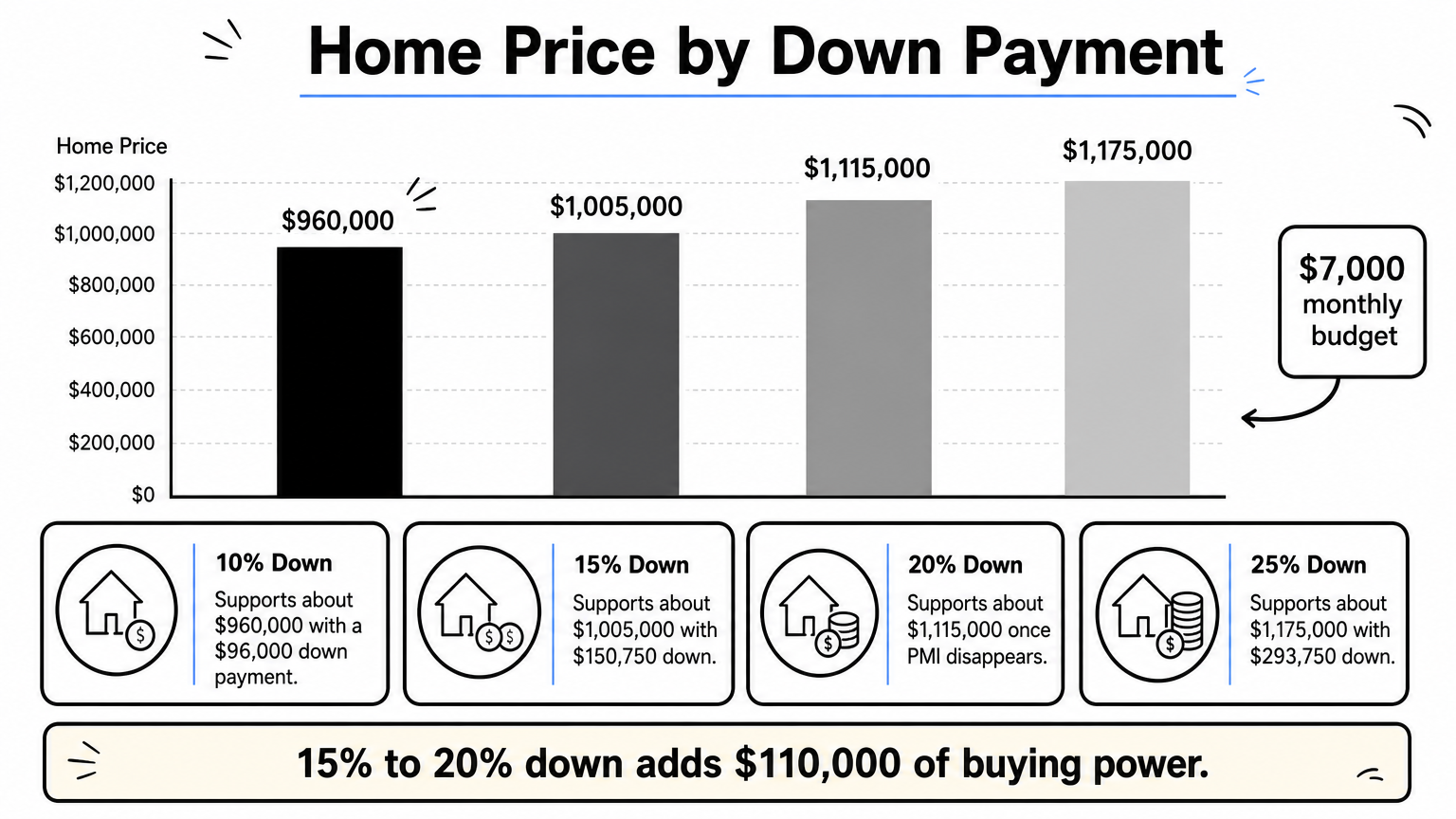
| Down payment | Home price | Cash down | Loan amount | Monthly PMI | Total monthly |
|---|---|---|---|---|---|
| 10% | $960,000 | $96,000 | $864,000 | $360 | $6,981 |
| 15% | $1,005,000 | $150,750 | $854,250 | $356 | $6,970 |
| 20% | $1,115,000 | $223,000 | $892,000 | $0 | $6,985 |
| 25% | $1,175,000 | $293,750 | $881,250 | $0 | $6,990 |
Moving from 15% to 20% down adds $110,000 of buying power, more than double the $45,000 gained from 10% to 15%. The reason is that roughly $356 a month stops going to PMI and starts supporting a bigger loan. Federal rules require lenders to cancel PMI automatically once your scheduled balance reaches 78% of the original home value.
Your actual PMI price depends on your credit score and loan-to-value ratio. The Down Payment Calculator compares 5%, 10%, 15%, and 20% down side by side, and the PMI Calculator estimates monthly PMI and when it can come off.
Closing costs and cash to bring
Your down payment is not the only cash you need. At 20% down on $1,115,000, you put down $223,000. The Closing Cost Calculator's line items alone (about 1% for origination, 0.5% for title insurance, 0.3% for recording and transfer, 0.2% for legal fees, and 0.1% each for appraisal and inspection) add up to roughly 2.2% of the price. That is about $24,500, so plan on close to $247,500 in cash before reserves.
Conforming, jumbo, FHA and VA
The 2026 baseline conforming loan limit is $832,750 for one-unit homes in most counties, and up to $1,249,125 in designated high-cost areas, according to the Federal Housing Finance Agency. Every loan in the table above is larger than $832,750. In a standard-limit county, most scenarios here would be jumbo loans. A buyer with 20% down who wants a conforming loan tops out near $1.04 million, below the $1.115 million budget.
Lenders set their own standards for jumbo loans, and you should expect stricter credit, down payment, and cash reserve requirements. Other loan types matter less at this price:
- FHA loans have a 2026 one-unit limit of $541,287 in most areas, so they rarely fit unless you live in a high-cost county.
- VA loans can allow no down payment for eligible veterans and service members, and are worth pricing if you qualify.
The jump from 15% to 20% down adds $110,000 of buying power because PMI disappears, and most loans at this price are jumbo in a standard-limit county.
Step 4. Plug in your interest rate
Use a rate from a real lender quote, then test one point higher and lower. On a loan near $900,000, each full percentage point changes the home price you can afford by roughly $90,000 to $95,000.
How rate changes your price
The table holds the budget at $7,000 with 20% down and the same tax and insurance assumptions. Only the rate changes.
| Interest rate | Home price | Loan amount | Total monthly |
|---|---|---|---|
| 6.0% | $1,165,000 | $932,000 | $6,995 |
| 6.5% | $1,115,000 | $892,000 | $6,985 |
| 7.0% | $1,070,000 | $856,000 | $6,988 |
| 7.5% | $1,025,000 | $820,000 | $6,972 |
The gap between 6.0% and 7.5% is $140,000 of home price with an identical monthly payment. If you find a home you love, ask how the payment looks at a rate one point worse than today's quote. A deal that only works at the best rate is a fragile deal.
What sets the rate you get
Four factors matter most. A higher credit score lowers your rate, and most conventional lenders want at least 620 before they will lend. A larger down payment lowers it too, and so does a shorter term. Jumbo pricing varies widely by lender.
A 15-year loan carries a much higher monthly payment than a 30-year loan at the same size, so it supports a far lower price on the same budget. Compare Loan Estimates from at least three lenders, and compare both the rate and the points so a lower rate is not just a prepaid fee. The mortgage rate you can lock is the one that goes into your calculation, not an average you read online.
On a loan near $900,000, one percentage point of rate costs you about $90,000 of house.
Step 5. Add property taxes, insurance and HOA dues
Replace this guide's tax and insurance assumptions with your local numbers, because at this price they can swing your budget by $100,000 or more. A 28% budget includes them, so every dollar of tax or HOA dues reduces the loan you can carry.
Property tax rate
Property tax rates vary by state, county, and even school district. The table keeps the $7,000 budget and 20% down, and changes only the annual tax rate.
| Property tax rate | Home price | Monthly property tax |
|---|---|---|
| 0.6% | $1,195,000 | $598 |
| 1.1% | $1,115,000 | $1,022 |
| 2.0% | $995,000 | $1,658 |
| 2.5% | $940,000 | $1,958 |
The spread between the lowest and highest rows is $255,000 of home price. Ask the county assessor for the effective rate on recent sales. In many areas the assessed value resets after a sale, so the seller's tax bill can understate yours. Use the rate on the price you will pay.
Insurance and HOA dues
Our 0.35% insurance assumption comes to about $3,900 a year, or $325 a month, on a $1,115,000 home. Premiums can run far higher in areas exposed to flood, wildfire, hurricanes, or earthquakes, and lenders require adequate coverage. Get a quote for a specific address before you trust any estimate.
HOA dues count toward your housing payment, so they cut your price directly. A $500 monthly fee reduces your housing budget to $6,500 and lowers your price to about $1,037,000, roughly $78,000 less house than the same budget without dues.
At this price, taxes, insurance, and HOA dues can move your maximum home by $100,000 or more, so use your local figures.
Step 6. Pick a price and test it
Pick a price at or below your calculated maximum, then run the full payment with your own inputs. Confirm it passes both ratios and your real monthly budget. This final test turns an estimate into a decision.
Worked example: a $1,000,000 home
Take a $1,000,000 home with 20% down at 6.5%, and a buyer with $2,500 of monthly debts: a $1,000 car payment, a $750 student loan, $250 in card minimums, and $500 of other required payments.
| Item | Amount |
|---|---|
| Home price | $1,000,000 |
| Down payment (20%) | $200,000 |
| Loan amount | $800,000 |
| Principal and interest | $5,057 |
| Property tax (1.10%) | $917 |
| Homeowners insurance (0.35%) | $292 |
| PMI | $0 |
| Total housing payment | $6,265 |
| Housing ratio (of $25,000) | 25.1% |
| Total monthly debt with housing | $8,765 |
| Total debt ratio | 35.1% |
The payment clears both limits, with $235 to spare under the 36% line. You can reproduce it in the Mortgage Calculator, which covers principal, interest, property tax, insurance, PMI, and HOA fees. Cash needed is about $200,000 down plus roughly $22,000 in closing costs.
Leave room below the maximum
Lenders measure gross income, but you pay the bill from take-home pay. After income and payroll taxes, a $7,000 payment can take well over a third of what reaches your bank account. Add maintenance, which many owners budget at around 1% of the home's value a year, and a maxed-out budget gets tight.
I would aim for 22% to 25% of gross income, which is $5,500 to $6,250 a month. The $1,000,000 example sits right at that level. If one income drops or rates reset, that cushion is what keeps a good purchase from becoming a stressful one.
Quick answers to related questions
- How much house can I afford on 300k salary with 20% down? About $1,115,000 with no other debt, using a loan of about $892,000.
- How much mortgage can I afford? Roughly $864,000 with 10% down and $892,000 with 20% down.
- Can I afford a million dollar home? Yes, as the worked example shows, if your other debts stay below about $2,700 a month.
- What income do you need for an $800,000 mortgage? About $268,000 at 28%, for a $1,000,000 home with 20% down, a 6.5% rate, and our tax and insurance assumptions.
- Can I afford a $300,000 house on a $100,000 salary? Yes. The payment is about $1,880 with 20% down (22.6% of gross income) and about $2,180 with 10% down (26.2%). With 10% down, keep other debts under about $800 a month.
The same method scales to other incomes. These figures assume no other debt, 20% down, and the guide's rate, tax, and insurance assumptions.
| Gross annual salary | 28% monthly budget | Approximate home price |
|---|---|---|
| $200,000 | $4,667 | $745,000 |
| $250,000 | $5,833 | $930,000 |
| $300,000 | $7,000 | $1,115,000 |
| $350,000 | $8,167 | $1,300,000 |
| $400,000 | $9,333 | $1,490,000 |
Choose a price whose full payment passes 28/36 with your own debts, taxes, and rate, and keep it closer to 25% than 28%.
Run your own numbers
On a $300,000 salary, you can afford roughly $960,000 to $1.175 million with no other debt, and the real figure depends on four things you can measure: your monthly debts, your down payment, your rate, and your local taxes, insurance, and dues. Set a budget near 22% to 28% of gross income, subtract debts, and test a specific price.
The biggest levers are the ones in your control. Paying off a car loan, reaching 20% down, and shopping lenders each move your price by tens of thousands of dollars. Treat every figure here as a planning estimate, since a lender's quote will differ.
Ready to see your own numbers? Open HomeLoanCalc.io's free calculators, enter your income, debts, and down payment, and compare scenarios with no signup.
This article is for general information and is not financial advice. Confirm figures with your lender or an official source before you decide.
Run your own numbers
Use our free calculators to see what this means for your loan.
More articles
- Excel Mortgage Amortization Schedule: Build One in 4 Steps
- How Much House Can I Afford with 70K Salary? $170K to $305K
- $60K Salary Home Budget: How Much House Can You Afford?
- Mortgage Insurance Disbursement: What the Line Item Means
- Longest Mortgage Term: Do 40- and 50-Year Loans Exist?
- Mortgage Calculator with Tax and Insurance: How to Use It
- FHA Debt-to-Income Ratio Calculator: How to Check 31/43
- How Much to Afford a 500K House: Income and Down Payment
- Current FHA Interest Rates: What Sets Your 30-Year Rate
- Mortgage Term: What It Is and How to Pick the Right One