Mortgage Insurance Disbursement: What the Line Item Means
By Sohaib Ibrahim · Published November 14, 2026
A mortgage insurance disbursement is a payment your lender or loan servicer makes on your behalf to an insurance company. The money comes out of your escrow account, not out of your pocket in that moment. On most mortgage statements and closing documents, the insurer being paid is your homeowners insurance company. Less often, it is the company behind your mortgage insurance, such as PMI or FHA mortgage insurance.
The label confuses people because "insurance" covers two different products. Homeowners insurance protects your house and belongings. Mortgage insurance protects only the lender if you stop paying. A third meaning exists too: after a covered loss, an insurer's claim payment is also called a disbursement. In that case money flows to you, the opposite direction. If you see a negative number next to the words "homeowners insurance disbursement" on a statement, it is almost always your servicer paying a premium out of escrow.
This guide explains why the line matters for your monthly payment, how to read it on your paperwork, whether you can remove it, and when you get money back. The examples use US rules and US-style figures.
Why this line item matters for your monthly payment
The disbursement matters because it is the end point of the money you pay into escrow each month, and it is the reason your payment can rise even when your interest rate is fixed. Your servicer is spending your money, so you should know exactly what it pays and when.
Two kinds of insurance, one confusing label
Check which insurer is named on the line. The payee tells you which kind of disbursement you are looking at.
| Label you see | Who gets paid | Who it protects | Where the money comes from |
|---|---|---|---|
| Homeowners insurance disbursement | Your homeowners insurer | You and the lender | Your escrow account |
| Mortgage insurance premium (PMI or FHA MIP) | The mortgage insurer or FHA | The lender only | Your monthly payment, passed on by the servicer |
| Claim disbursement | You, your contractor, often your lender | You | Your insurer, after a covered loss |
Mortgage insurance protects the lender, not you, if you fall behind. You still pay for it. Homeowners insurance, by contrast, is coverage you would need to carry anyway, and your lender simply insists that it never lapses.
A disbursement is a bill paid for you, not a charge added on top of your loan.
How escrow turns a premium into a monthly cost
Your servicer estimates the year's bills, divides the total by 12, and adds that amount to your payment. When a bill comes due, it disburses the full amount to the insurer or tax office.

Take a homeowners premium of $1,800 a year and property taxes of $3,600. The servicer collects $5,400 a year, or $450 a month. Of that, $150 a month sits aside for insurance. When the $1,800 premium is due, one disbursement of $1,800 leaves the account. You never write that check yourself.
Escrow does not make the policy cheaper or more expensive. It only spreads the cost across 12 payments and makes sure it is paid on time.
Why the amount changes from year to year
If your insurer raises the premium at renewal, your escrow payment rises to match. Suppose the premium goes from $1,800 to $2,160. Your servicer collected only $1,800 during the year, so the account is $360 short, ignoring any cushion. The servicer usually spreads that shortage over 12 months.
Your insurance portion then looks like this:
- New monthly insurance escrow: $2,160 ÷ 12 = $180, which is $30 more than before.
- Shortage repayment: $360 ÷ 12 = $30 a month for one year.
- Total increase in year one: $60 a month. After that, the increase settles at $30 a month.
You can see how this affects your total payment by entering a higher insurance figure into the Mortgage Calculator, which includes principal, interest, property tax, insurance, PMI, and HOA fees in the monthly total.
How to read a disbursement on your paperwork
Read a disbursement by finding the payee, the amount, and the date, then matching them against your insurance bill. The same payment appears in slightly different forms at closing, on your annual escrow statement, and on your online account.
On your closing documents
At closing, the homeowners insurance money shows up in two places on the Closing Disclosure. In the section for prepaid items, you will usually see the first year's homeowners premium, paid to the insurer. In the section for the initial escrow payment, you will see a starting reserve of a few months of premiums, which funds your new escrow account.
Both are real costs, and both count toward the cash you bring to closing. If the totals look high, compare them with the premium on your insurance quote. The Closing Costs Calculator breaks down the fees paid when buying a home, so you can see how these items fit with the rest.
On your escrow statement
Your servicer sends an annual escrow account statement. It lists deposits into the account and disbursements out of it, with a date and payee for each. Use this short routine to check one:
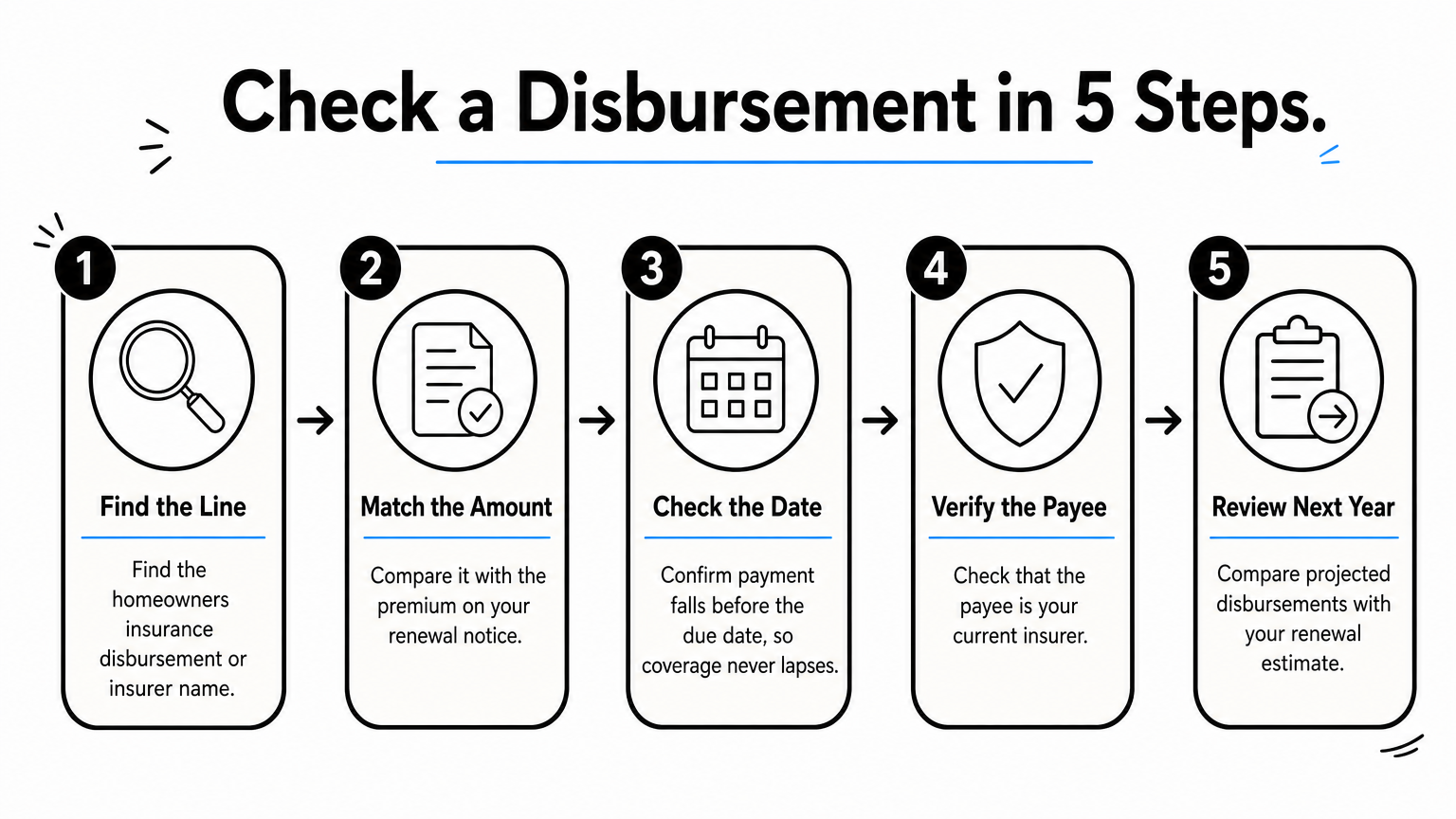
- Find the disbursement labeled for homeowners insurance, or for the insurer's name.
- Compare the amount with the premium on your policy's renewal notice or declarations page.
- Confirm the payment date falls before the due date, so your coverage did not lapse.
- Check that the payee is your current insurer, not a company you already left.
- Look at the projected disbursements for the coming year and compare them with your renewal estimate.
Red flags worth a phone call
Two disbursements in one year to the same insurer, a payment to a former insurer, or an amount that differs from your bill all deserve a call. Ask the servicer for the payment date, the payee, and the check or transfer details. An early call is far easier than untangling a lapsed policy.
Match every insurance disbursement to a bill you can name, or ask your servicer why it does not match.
Can you remove a mortgage insurance disbursement?
You cannot delete the disbursement while you carry the loan and the policy, but you can end the reason for it. That means either dropping the escrow arrangement for your homeowners insurance or cancelling mortgage insurance you no longer need.
Dropping escrow for homeowners insurance
Many lenders will let you pay your homeowners insurance yourself once you have meaningful equity and a clean payment history. A common benchmark is a loan balance below 80% of your home's value, but the lender decides and may charge a fee. Some loan types, such as FHA loans, generally require escrow.
Think twice before opting out. You then owe the whole premium in one lump, and a missed payment can lead the lender to buy expensive coverage on your behalf and bill you for it. If you opt out, set aside the monthly amount yourself.
Cancelling mortgage insurance
For a conventional loan, PMI is the part you can remove. Under federal law, you can request cancellation when your balance reaches 80% of the home's original value, if you are current and meet your lender's other conditions. The lender must cancel it automatically when the scheduled balance reaches 78% of the original value. The PMI Calculator estimates the first month that happens for your loan.
Other loan types follow different rules:
| Loan type | How mortgage insurance is charged | Can it be removed? |
|---|---|---|
| Conventional | Private mortgage insurance, usually monthly | Yes, at 80% by request and 78% automatically |
| FHA | Upfront fee plus monthly premium | Depends on your loan terms. Often it lasts much longer, so check your documents |
| USDA | Upfront fee plus monthly premium | Check your loan terms, since it is typically tied to the loan |
| VA | No monthly premium, upfront funding fee instead | Nothing monthly to remove |
If your loan is FHA, refinancing into a conventional loan is the usual route to end the premium. Run the Refinance Calculator first, because closing costs divided by monthly savings gives your break-even point.
You cannot delete a disbursement, but you can remove the PMI or escrow that triggers it.
What you cannot avoid
Your homeowners insurance itself stays. Your lender requires coverage for as long as it holds the loan. Your real lever is the price. Shopping for a new policy has no effect on your escrow account, and once you switch, your new insurer or you notify the servicer so the next disbursement goes to the right company.
Do you ever get the money back?
Mostly no. A premium that bought a year of coverage is spent, and monthly PMI that covered the lender's risk is not returned. Money does come back in three specific situations: an escrow surplus, a cancelled policy, and cancelled mortgage insurance.
Escrow surplus refunds
Servicers may hold a small cushion in escrow. At your annual review, if the account holds more than it needs, you have a surplus. Under federal rules, a surplus of $50 or more must be refunded to you within 30 days, while a smaller one may be credited toward next year's payments. This is the most common way the money comes back.
A surplus happens when taxes or premiums come in lower than projected. It is not a refund of the insurance you bought.
Refunds when you cancel or switch policies
If you change homeowners insurers mid-term, the old insurer owes you the unearned portion of the premium. When the premium was paid from escrow, that refund often goes to the servicer and is credited to your account rather than sent to you. Ask both the insurer and the servicer where the check will go, so the money does not get lost between them.
For PMI, a servicer must return any unearned premium within 45 days after the insurance is cancelled or terminated. Confirm this on your first statement after cancellation.
Money you will not get back
Monthly PMI and FHA mortgage insurance that you paid while they were required are generally not refundable. The same goes for a homeowners premium for a period you were covered. If your payment feels too high, the better fix is a smaller premium or an earlier PMI cancellation, not a refund request.
Escrow surpluses and unearned premiums come back. Premiums that bought coverage do not.
What to do next
A mortgage insurance disbursement is simply your servicer paying an insurer from the money you put into escrow, almost always your homeowners policy and sometimes your mortgage insurance. Read it by payee, amount, and date. Expect it to change when your premium changes. End it only by cancelling PMI or ending escrow, and expect refunds only from surpluses and unearned premiums.
Before your next escrow review, test how a higher premium changes your total payment with the free calculators at HomeLoanCalc.io. They estimate your payment, PMI, and the point where PMI can drop off, with no signup. Your lender's figures are the final word, so use the results as a planning estimate.
This article is for general information and is not financial advice. Confirm figures with your lender or an official source before you decide.
Run your own numbers
Use our free calculators to see what this means for your loan.
More articles
- How Much House Can I Afford with 70K Salary? $170K to $305K
- Mortgage Calculator with Tax and Insurance: How to Use It
- How Much House Can I Afford with 300K Salary? Step by Step
- How Much to Afford a 500K House: Income and Down Payment
- Excel Mortgage Amortization Schedule: Build One in 4 Steps
- Mortgage Term: What It Is and How to Pick the Right One
- $60K Salary Home Budget: How Much House Can You Afford?
- Annual Amortization Calculator: Build a Yearly Schedule
- Longest Mortgage Term: Do 40- and 50-Year Loans Exist?
- How Much House Can I Afford with a $100K Salary?