How Much House Can I Afford on 80K Salary? Real Numbers
By Sohaib Ibrahim · Published November 1, 2026
On an $80,000 salary, most buyers can afford a home priced between roughly $190,000 and $350,000. A realistic middle for someone with normal debts and a decent down payment is $230,000 to $300,000. That is the short answer to how much house can I afford on 80k salary. Affordability means the highest price whose full monthly cost fits your income without squeezing everything else. Your exact number depends on your monthly debts, down payment, credit score and mortgage rate.
This article shows how to get your own figure instead of borrowing someone else's. You will see the 28/36 rule applied to $80,000, a worked example you can repeat with your numbers, and tables showing how debt, rates and down payment move the result. It also checks specific prices such as $300,000, $400,000 and an FHA purchase.
At HomeLoanCalc.io, we build free mortgage calculators, so every figure here uses the same fixed-rate amortization math that lenders use. The numbers are planning estimates, not a loan offer or financial advice. Your lender's final rate, taxes and insurance will differ.
Why $80K gives you a range, not one price
Your price range is a range because lenders cap your monthly housing payment as a share of income, and the price that fits that payment changes with rate, down payment and debt. Change any one input and the answer moves by tens of thousands of dollars.
The 28/36 rule in plain terms
The 28/36 rule says your housing payment should stay under 28% of gross monthly income. Your housing payment plus all other monthly debts should stay under 36%. Housing means principal, interest, property tax, homeowners insurance, PMI and any HOA dues.
At $80,000 a year, your gross income is $6,667 a month. That gives you $1,867 for housing and $2,400 for housing plus debts. Cautious buyers use 22% and stretch buyers use 33%, and the table below turns each into a price.
| Scenario | Share of gross income | Max monthly housing | Approx. home price |
|---|---|---|---|
| Conservative | 22% | $1,467 | $233,000 |
| Moderate | 28% | $1,867 | $296,000 |
| Maximum | 33% | $2,200 | $349,000 |
These assume a 30-year fixed rate of 6.5%, 20% down, taxes and insurance of 1.5% of the price per year, and no other debt. Treat the rate as a placeholder and swap in a current quote.
The 28% line gives you the price a lender will approve. The 22% line gives you the price you can live with comfortably.
Why quick answers online disagree
Quick answers range from about $160,000 to $380,000 because each one quietly assumes a different rate, down payment and debt load. Some also measure against take-home pay instead of gross income.
Take-home matters for your comfort level. Depending on state taxes and retirement contributions, $80,000 often nets $5,000 to $5,500 a month. A $1,867 payment is then about 35% of take-home. If that feels heavy, a 25% share of take-home, near $1,325, is a sensible stress test.
How to estimate your own number step by step
To estimate your own number, turn income into a monthly budget, subtract non-mortgage costs, and convert what is left into a loan and price. The five steps below reproduce the moderate $296,000 result.
A worked example in five steps
- Find gross monthly income. $80,000 ÷ 12 = $6,667.
- Set your housing cap. 28% gives $1,867. Also compute 36% ($2,400), subtract your monthly debts, and use the lower result.
- Subtract taxes and insurance. On a $296,000 home at 1.5% a year, that is about $370 a month, leaving $1,497 for principal and interest.
- Convert payment into a loan. At 6.5% over 30 years, each $1,000 borrowed costs about $6.32 a month. $1,497 ÷ $6.32 per $1,000 gives a loan near $236,800.
- Add your down payment. A $236,800 loan with 20% down means a price of $296,000 and about $59,200 down.
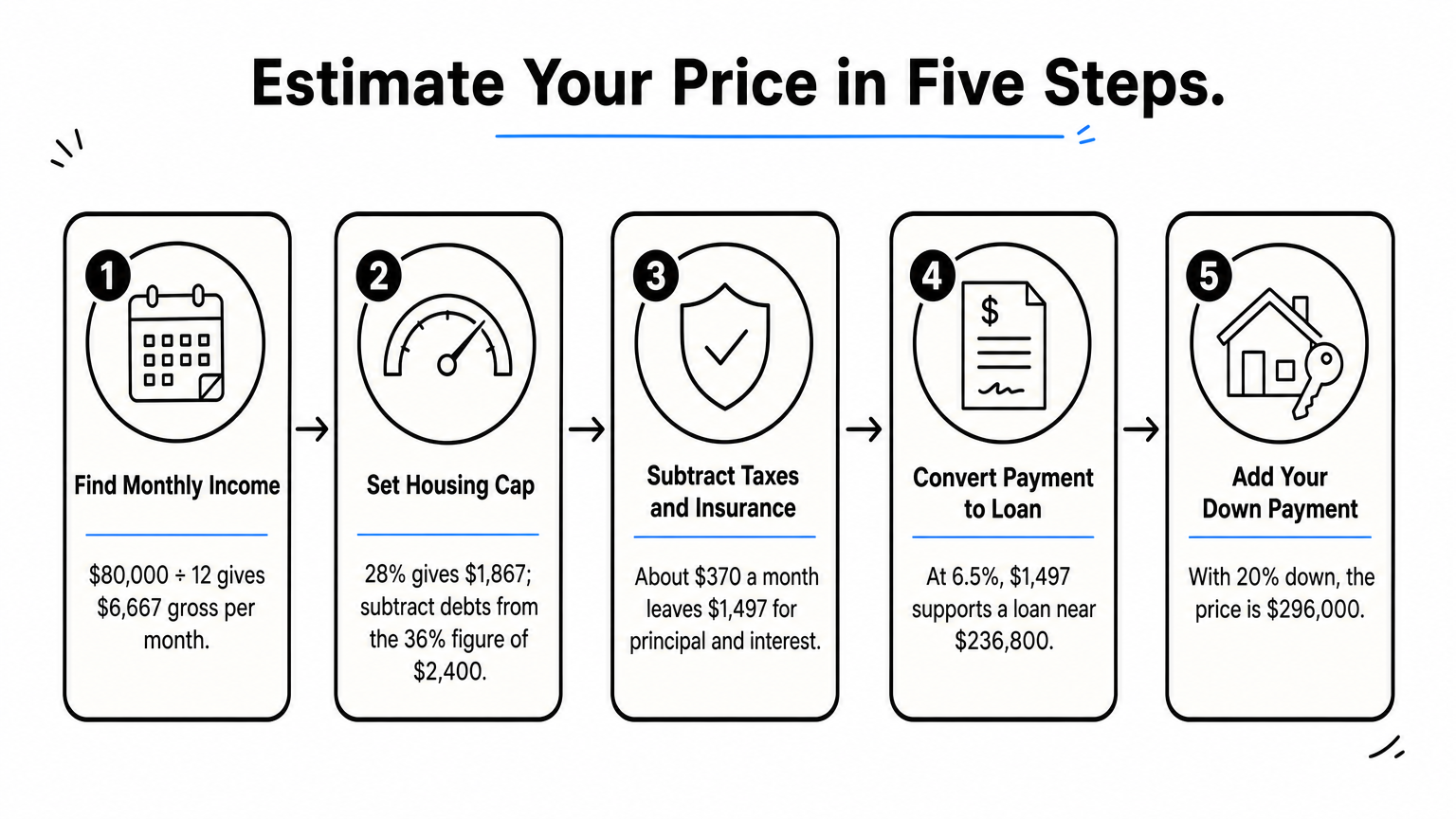
Work backward from the payment you can carry, and the price falls out as the last step.
Property taxes and insurance vary a lot by area, so replace my 1.5% with real local figures for homes you are considering. Our Mortgage Calculator includes taxes, insurance, PMI and HOA fees, and our Affordability Calculator runs the conservative, moderate and maximum scenarios as you type, with no signup.
Budget the cash, not just the payment
Closing costs commonly run 2% to 5% of the price, so $5,900 to $14,800 on a $296,000 home. Our Closing Cost Calculator breaks that into origination, appraisal, title and other fees. Add an emergency cushion, because lenders approve payments but do not budget repairs.
Plan on maintenance too. A common rule of thumb is 1% of the home's value per year, about $2,960 on this home. You can compare down payment sizes side by side in the Down Payment Calculator before deciding how much cash to commit.
What moves the number up or down
Four inputs matter most: existing debt, interest rate, down payment and credit score. Each one can shift your price ceiling by $20,000 to $100,000.
Monthly debt
Debt only changes your answer once it passes about $533 a month. Below that, the 28% cap is the limit. Above it, the 36% cap takes over and your housing budget shrinks dollar for dollar.
| Monthly debts (car, student loans, cards) | Housing budget | Approx. home price |
|---|---|---|
| $0 | $1,867 | $296,000 |
| $500 | $1,867 | $296,000 |
| $800 | $1,600 | $254,000 |
| $1,200 | $1,200 | $190,000 |
Paying off a $400 car loan before applying can raise your ceiling by more than $40,000. If you have no debt at all, the 28% rule is your only limit.
Interest rate
Rate is the largest outside force on your budget. Holding the $1,867 payment, 20% down and the same tax assumptions, here is the effect:
| 30-year rate | Approx. home price |
|---|---|
| 5.5% | $322,000 |
| 6.5% | $296,000 |
| 7.5% | $273,000 |
Each full percentage point moves your price by roughly $23,000 to $26,000. If rates fall after you buy, you can refinance, but do not count on it when setting your budget.
Down payment and credit score
A bigger down payment helps twice. It shrinks the loan and removes PMI, which is private mortgage insurance. PMI commonly costs roughly 0.3% to 1.5% of the loan per year, depending on credit score and down payment. With 5% down and PMI at an assumed 0.7%, the same $1,867 budget buys about $239,000. That is $57,000 less than with 20% down, though you need only about $11,950 in cash.
Credit score works through your rate and PMI price. Conventional loans generally require around 620. FHA loans allow 3.5% down with a score of 580 or higher, and 10% down for scores of 500 to 579.
Can you afford $300K, $400K or an FHA purchase?
A $300,000 home fits only with about 20% down and little other debt. A $400,000 home is out of reach on $80,000 without a very large down payment.
Checking $300,000 and $400,000
| Price | Down payment | Monthly housing | Share of gross |
|---|---|---|---|
| $300,000 | 20% ($60,000) | $1,892 | 28.4% |
| $300,000 | 5% ($15,000) | $2,342 | 35.1% |
| $400,000 | 20% ($80,000) | $2,523 | 37.8% |
These use the same 6.5% rate and 1.5% tax and insurance assumption, with PMI at 0.7% on the 5% down case. The $300,000 home sits right at the 28% line with 20% down and breaks the 33% ceiling with 5% down. To get a $400,000 home down to 33% of income, you would need roughly $131,000 down. To reach 28%, you would need about $184,000.
FHA loans and small mortgages
An FHA loan trades a low down payment for mortgage insurance. With 3.5% down, an upfront premium of about 1.75% usually financed into the loan, and an annual premium commonly near 0.55%, your $1,867 budget buys roughly $236,000. You would put down about $8,300. Our FHA Loan Calculator runs your exact figures.
If you are asking what salary a smaller mortgage needs, such as $80,000, the same math applies. On a $100,000 home with 20% down at these assumptions, the monthly cost is about $631. Meeting the 28% rule would take an income near $27,000.
Putting your $80K number to work
An $80,000 salary supports roughly $230,000 to $300,000 for most buyers, within a wider band of $190,000 to $350,000. Your debts, rate, down payment and credit score decide where you land. Each extra $10,000 of salary adds about $37,000 to the moderate price under these assumptions. Calculate backward from a payment you can sustain, and keep cash aside for closing costs and repairs.
Before you tour homes, run your income, debts and down payment through our free home affordability calculator to see your conservative, moderate and maximum prices. Then confirm the real rate, taxes and insurance with a lender.
This article is for general information and is not financial advice. Confirm figures with your lender or an official source before you decide.
Run your own numbers
Use our free calculators to see what this means for your loan.
More articles
- VA Loan Calculator: Find Your Payment and Home Budget
- Primary Mortgage Insurance: What PMI Is, Costs and Removal
- Mortgage Insurance on FHA: What It Is and What It Costs
- How to Use a Pay Down Loan Calculator to Save Interest
- Mortgage Refinance Calculator: How to Find Your Break-Even
- Down Payment on 200k House: What You Need by Loan Type
- Extra Mortgage Payments: How They Work and What You Save
- How to Calculate PMI on a Conventional Loan, Step by Step
- How to Use an Amortisation Calculator and Read the Schedule
- How Much Down Payment Do You Need for a 500K House?