Mortgage Insurance on FHA: What It Is and What It Costs
By Sohaib Ibrahim · Published October 30, 2026
Mortgage insurance on FHA loans is called the mortgage insurance premium, or MIP, and you pay it on nearly every FHA purchase loan. It has two parts: an upfront premium of 1.75% of the base loan amount, and an annual premium of 0.15% to 0.75% that your servicer splits into monthly payments. Most buyers who put 3.5% down on a 30-year loan pay 0.55% a year. You pay the annual part for 11 years if you put down 10% or more, and for the life of the loan if you put down less.
MIP is insurance that protects your lender, not you. The Federal Housing Administration insures loans made by approved lenders, and your premiums fund that guarantee. It is the reason lenders accept down payments as low as 3.5% and credit scores that a conventional lender might turn away.
This guide covers why MIP changes the real cost of an FHA loan, how to calculate it with the current rate chart, how long you pay it, how to cut or end it, and how it compares with PMI on a conventional loan. At HomeLoanCalc.io we build free home loan calculators, and you can check the examples below against your own numbers with our FHA loan calculator.
Why FHA mortgage insurance matters for your budget
MIP is the biggest cost an FHA loan adds to a mortgage, and it can last as long as the loan itself. Knowing how it works before you apply keeps your payment estimate honest.
What the premium protects
FHA mortgage insurance repays your lender for part of the loss if you stop paying and the home sells for less than you owe. The FHA does not lend you money. It insures loans from approved lenders, and that guarantee is what lets those lenders offer low down payments. The Consumer Financial Protection Bureau explains the same split between the borrower who pays and the lender who is covered.
It does not protect you. MIP does not pay off your loan if you die, replace lost income, or cover missed payments. If you want that kind of protection, you need life or disability insurance, which is a separate product.
You pay FHA mortgage insurance, but the lender is the one it covers.
Why the cost deserves your attention
The trade-off is simple. An FHA loan lets you buy with at least 3.5% down and a credit score of 580 or higher, or 10% down with a score from 500 to 579. In exchange, you pay MIP at closing and every month after.
Because the annual premium can run for 30 years, it should sit inside your monthly payment estimate from day one. Buyers who compare only the interest rate on an FHA loan and a conventional loan often miss this. Compare the full payment, including mortgage insurance, taxes and homeowners insurance.
How to calculate mortgage insurance on an FHA loan
Multiply your base loan amount by 1.75% for the upfront premium. Then multiply the base loan amount by your annual rate and divide by 12 for the monthly premium. Two things set the numbers: the base loan amount and the annual rate.
Find your base loan amount
The base loan amount is the purchase price minus your down payment. It does not include the upfront premium if you finance it. Follow these steps:
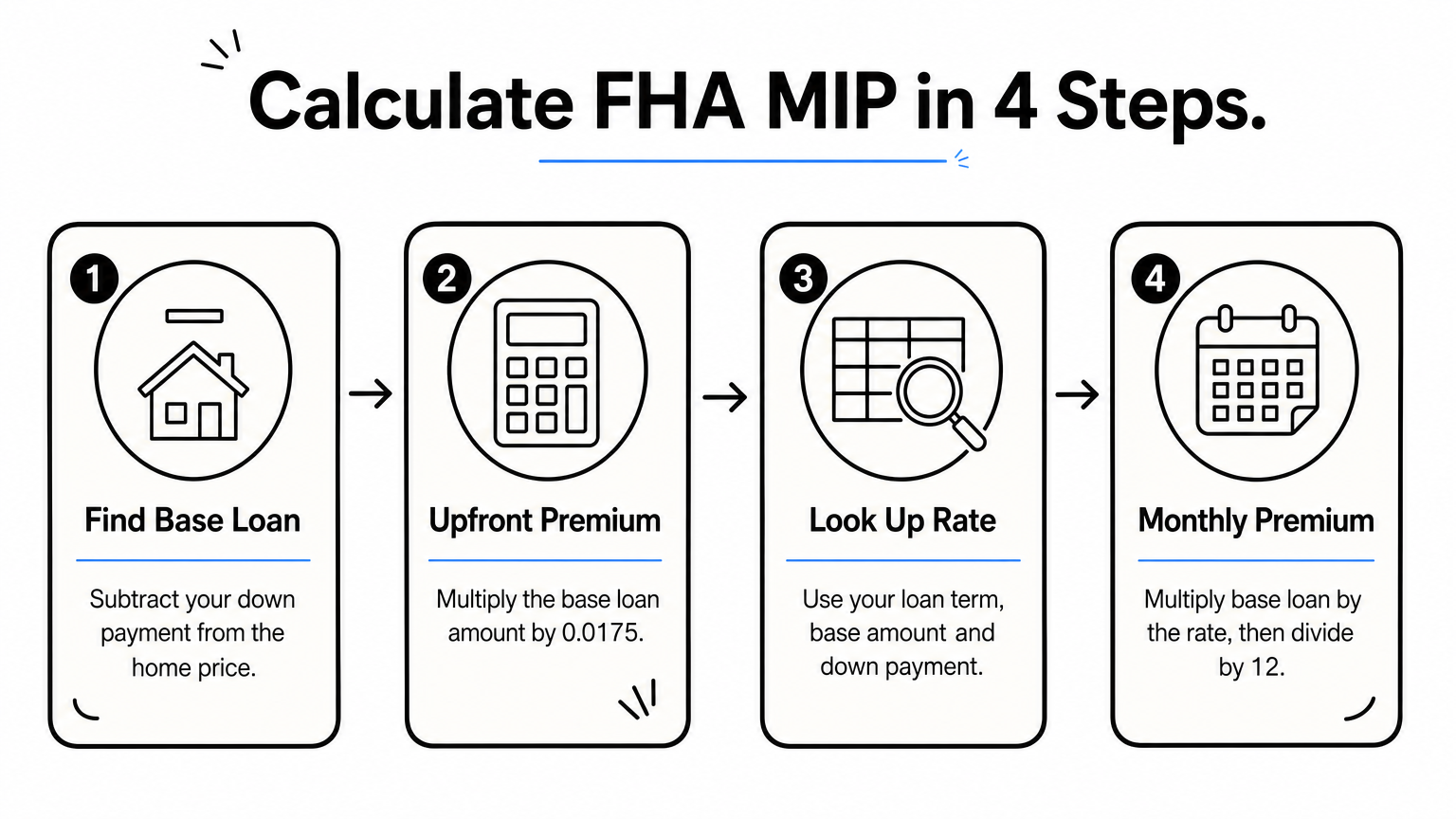
- Subtract your down payment from the home price to get the base loan amount.
- Multiply that amount by 0.0175 to get the upfront premium.
- Look up your annual rate in the charts below, using your loan term, base loan amount and down payment.
- Multiply the base loan amount by that rate, then divide by 12 for the monthly premium.
You can pay the upfront premium in cash at closing or add it to the loan. Financing it lowers your cash needed at closing, but you pay interest on it for the life of the loan.
Read the annual rate chart
If you searched for an FHA PMI chart, this is the one you want. FHA calls its insurance MIP, not PMI. The rate depends on your term, your base loan amount and your original loan-to-value ratio (LTV), which a down payment of 10% or more brings to 90% or less. The first table covers terms longer than 15 years, which includes the standard 30-year loan.
| Base loan amount | Down payment | Annual MIP rate | You pay it for |
|---|---|---|---|
| $726,200 or less | 10% or more | 0.50% | 11 years |
| $726,200 or less | 5% to under 10% | 0.50% | Full loan term |
| $726,200 or less | Under 5% | 0.55% | Full loan term |
| Over $726,200 | 10% or more | 0.70% | 11 years |
| Over $726,200 | 5% to under 10% | 0.70% | Full loan term |
| Over $726,200 | Under 5% | 0.75% | Full loan term |
Terms of 15 years or less carry lower rates:
| Base loan amount | Down payment | Annual MIP rate | You pay it for |
|---|---|---|---|
| $726,200 or less | 10% or more | 0.15% | 11 years |
| $726,200 or less | Under 10% | 0.40% | Full loan term |
| Over $726,200 | 22% or more | 0.15% | 11 years |
| Over $726,200 | 10% to under 22% | 0.40% | 11 years |
| Over $726,200 | Under 10% | 0.65% | Full loan term |
For most buyers the number to remember is 0.55% a year on a 30-year loan with the minimum down payment.
Worked example: a $400,000 home
Here is the same $400,000 purchase with the minimum down payment and with 10% down, both on 30-year loans.
| Item | 3.5% down | 10% down |
|---|---|---|
| Down payment | $14,000 | $40,000 |
| Base loan amount | $386,000 | $360,000 |
| Upfront MIP (1.75%) | $6,755 | $6,300 |
| Loan if upfront MIP is financed | $392,755 | $366,300 |
| Annual MIP rate | 0.55% | 0.50% |
| Annual MIP | $2,123 | $1,800 |
| Monthly MIP | about $176.92 | $150.00 |
| Annual MIP ends | After the full term | After 11 years |
Treat the monthly figure as a first-year estimate. The FHA calculates annual MIP on the expected average balance for each year, so the dollar amount slips a little as you pay the loan down. Your lender's Loan Estimate shows the exact amount.
How long you pay FHA mortgage insurance
For loans with FHA case numbers assigned on or after June 3, 2013, annual MIP lasts 11 years if your original LTV was 90% or less, and the full loan term if it was higher. The upfront premium is a one-time charge and has no duration.
The 11-year rule and the life-of-loan rule
Your down payment at closing decides the length. Put down 10% or more and annual MIP drops off after 11 years. Put down less than 10% and it stays until you pay off, sell or refinance the loan.
Reaching 20% equity later does not end MIP on a newer FHA loan. That is the biggest difference from PMI on a conventional loan, and it catches many owners off guard after they have paid down the balance for years.
On a newer FHA loan, your down payment on closing day decides how long you pay MIP.
Loans from before June 2013
FHA loans with case numbers assigned before June 3, 2013 can follow different cancellation rules. Some qualify for cancellation once the balance reaches 78% of the original property value, usually after a minimum payment period. Your servicer can confirm which rule applies to your loan, since it depends on your loan's dates and original terms.
How to reduce or remove FHA mortgage insurance
You cannot skip MIP on an FHA loan, but you can shorten it or end it. The main routes are a larger down payment, a refinance into a conventional loan, or selling or paying off the loan.
Choose the down payment with MIP in mind
A down payment of 10% or more is the cleanest way to cap the annual premium at 11 years, and it also shrinks the loan and the upfront premium. In the example above, 10% down saves about $27 a month and ends the premium after 11 years instead of 30.
Smaller steps matter too. On a loan of $726,200 or less with a term over 15 years, 5% down gets a 0.50% rate instead of 0.55%. To see how 5%, 10%, 15% and 20% change your loan amount and payment, our free down payment calculator compares them side by side.
Refinance when the math works
Many owners refinance into a conventional loan once they have built enough equity. The new loan must meet conventional rules for credit, debt-to-income ratio and equity, and it may carry PMI if your equity is below 20%. A US lender must cancel PMI automatically when the scheduled balance reaches 78% of the original home value.
Refinancing has costs, so find the break-even point first: closing costs divided by monthly savings. If a refinance costs $6,000 and saves $150 a month, you break even after 40 months. Keep the new loan longer than that and you come out ahead.
Two other routes also end MIP. The premium stops when you sell the home or pay off the loan. If you refinance one FHA loan into another within three years, you may get a partial credit on the upfront premium, which shrinks the longer you held the first loan. Ask your lender to calculate it before you commit.
Refinance only when the monthly savings recover your closing costs within the time you will keep the loan.
FHA MIP versus PMI on a conventional loan
MIP and PMI both protect the lender, but they belong to different loans and end in different ways. FHA loans carry MIP. Conventional loans carry PMI when your down payment is under 20%. There is no PMI on an FHA loan.
Side-by-side comparison
| Feature | FHA MIP | Conventional PMI |
|---|---|---|
| Loan type | FHA loan | Conventional loan |
| When it applies | Nearly every FHA purchase loan | Down payment under 20% |
| Upfront charge | 1.75% of the base loan | No standard upfront fee |
| What sets the cost | Term, LTV and base loan amount | Credit score, down payment and insurer pricing |
| How it ends | 11 years with 10% down, otherwise full term | Cancels on request near 80% LTV and automatically at 78% |
Because PMI pricing depends on your credit score and down payment, no single chart covers it, and one answer for a $400,000 house would mislead you. Our PMI calculator estimates the monthly cost from your home price, down payment, credit score, loan term and rate, and shows roughly when PMI can drop off.
Which one costs less
It depends on your situation. A buyer with strong credit and 10% or more down often pays less with PMI, because PMI can be cancelled. A buyer with a lower score or little cash may find FHA cheaper, because FHA pricing does not depend on the credit score the way PMI does.
Compare the full picture rather than one rate. Look at the monthly payment, the cash needed at closing, the interest rate, the insurance cost and how long you plan to keep the loan.
Judge an FHA loan by its total monthly payment and your plan for the loan, not by the rate alone.
The short version on FHA mortgage insurance
FHA mortgage insurance costs 1.75% upfront plus 0.15% to 0.75% a year, with 0.55% typical for a 30-year loan at 3.5% down. You pay it for 11 years with 10% down or more, and for the life of the loan with less. You can shorten it with a bigger down payment, or end it by refinancing, selling or paying off the loan. It protects your lender, not you.
Run your own numbers before you commit. Remember that results are planning estimates, not a quote, because your lender sets the final rate, premium and taxes. You can estimate your FHA payment with HomeLoanCalc.io's free calculators, with no signup or email needed.
This article is for general information and is not financial advice. Confirm figures with your lender or an official source before you decide.
Run your own numbers
Use our free calculators to see what this means for your loan.
More articles
- Mortgage Refinance Calculator: How to Find Your Break-Even
- VA Loan Calculator: Find Your Payment and Home Budget
- Extra Mortgage Payments: How They Work and What You Save
- How Much House Can I Afford on 80K Salary? Real Numbers
- How to Use an Amortisation Calculator and Read the Schedule
- Primary Mortgage Insurance: What PMI Is, Costs and Removal
- Oklahoma Mortgage Calculator: Add Taxes, Insurance and PMI
- How to Use a Pay Down Loan Calculator to Save Interest
- How to Use a Mortgage Calculator to Estimate Your Payment
- Down Payment on 200k House: What You Need by Loan Type