Down Payment on 200k House: What You Need by Loan Type
By Sohaib Ibrahim · Published November 4, 2026
The down payment on a $200k house is the cash you pay at closing so the lender finances only the rest. It runs from $0 to $40,000 or more, depending on your loan. A VA or USDA loan can require nothing, a conventional loan can start at 3% ($6,000), and an FHA loan starts at 3.5% ($7,000). Putting down 20% ($40,000) lets you skip private mortgage insurance on a conventional loan.
This guide explains why that number matters and how to find the minimum for your loan type. It also shows what each amount does to your monthly payment and how to decide how much to put down. You will also see the cash you need beyond the down payment, because closing costs catch many buyers off guard.
HomeLoanCalc.io builds free mortgage calculators, so the figures here use the same standard amortization formula lenders use. The examples assume a 6% rate on a 30-year fixed loan. Your actual rate, taxes and insurance will differ, so treat every number as a planning estimate, not a quote.
Why your down payment on a $200k house matters
Your down payment sets the size of your loan, decides whether you pay mortgage insurance, and fixes how much equity you own on day one. Those three effects follow you for years, so the number deserves more thought than the minimum a lender will accept.
What each percentage costs in dollars
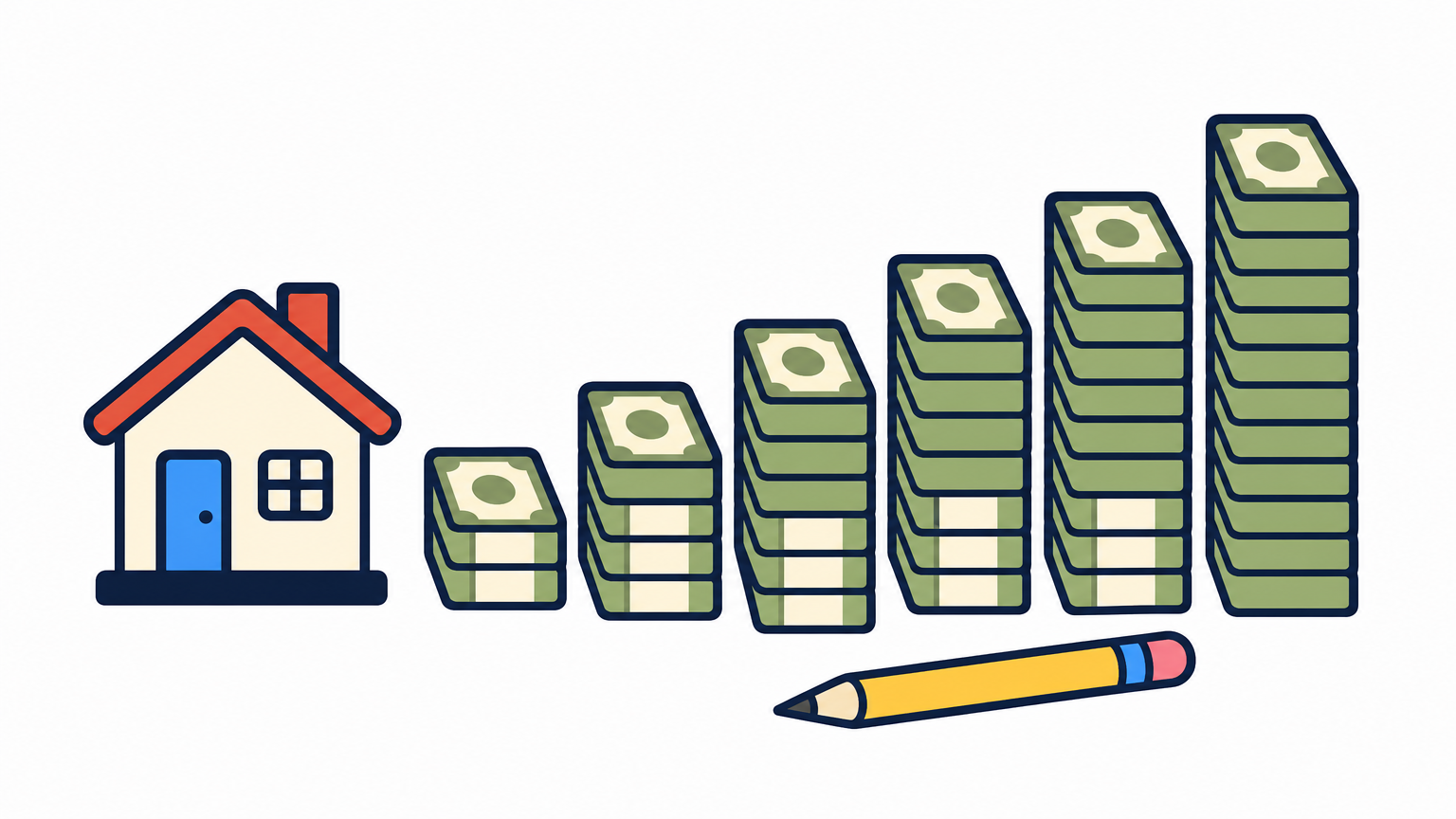
The math is simple: multiply the price by the percentage. A 3.5% down payment on a 200 000 house is $200,000 × 0.035, which is $7,000. The table shows the common levels and the loan you would carry at each one.
| Down payment | Dollar amount | Loan amount | Typical use |
|---|---|---|---|
| 3% | $6,000 | $194,000 | Conventional loan for eligible first-time or low-to-moderate income buyers |
| 3.5% | $7,000 | $193,000 | FHA minimum with a credit score of 580 or higher |
| 5% | $10,000 | $190,000 | Conventional minimum for buyers who do not qualify for 3% |
| 10% | $20,000 | $180,000 | FHA with a score of 500 to 579, or a lower payment by choice |
| 15% | $30,000 | $170,000 | Middle ground between low-down and no PMI |
| 20% | $40,000 | $160,000 | No PMI on a conventional loan |
The gap between the smallest and largest common choices is $34,000. That gap is the real decision in front of you.
What the down payment changes after closing
The first effect is loan size. Every extra $10,000 you put down cuts the loan by $10,000 and trims the monthly principal and interest payment by about $60 at a 6% rate over 30 years. A smaller loan also means less total interest over the life of the mortgage.
Mortgage insurance is the second effect. On a conventional loan, putting down less than 20% means you pay PMI. US lenders must cancel it automatically once your scheduled balance reaches 78% of the original home price, which is $156,000 on a $200,000 purchase. You can usually ask for removal earlier, at 80% ($160,000). FHA loans charge their own monthly premium, covered in the loan type section below.
Equity and rate are the third. With 10% down you own $20,000 of equity at closing, versus $6,000 with 3% down. That starting equity is a cushion if prices dip or you need to sell early. A larger down payment may also qualify you for a lower interest rate, because the lender takes on less risk.
Your down payment is more than an entry fee: it sets your loan size, your insurance cost and your starting equity.
How to find the minimum down payment for your loan type
Start with your loan type, because the program sets the minimum, not the $200,000 price. Most buyers fall into one of four groups: VA or USDA at 0%, conventional at 3% or 5%, or FHA at 3.5% or 10%.
Minimum down payment on $200,000 by loan type
This table shows what each loan program asks for on a $200,000 purchase.
| Loan type | Minimum | Dollars | Who it fits |
|---|---|---|---|
| VA loan | 0% | $0 | Eligible veterans, service members and some surviving spouses |
| USDA loan | 0% | $0 | Homes in eligible rural areas, with household income under local limits |
| Conventional, 3% option | 3% | $6,000 | First-time buyers, buyers who have not owned in 3 years, or low-to-moderate income; fixed-rate loans only |
| Conventional, standard | 5% | $10,000 | Buyers who do not meet the 3% rules, and adjustable-rate loans |
| FHA, score 580 or higher | 3.5% | $7,000 | Buyers with lower credit or limited savings |
| FHA, score 500 to 579 | 10% | $20,000 | Buyers with damaged credit |
| Conventional, second home or investment | 10% to 25% | $20,000 to $50,000 | Anyone not buying a primary residence |
FHA loans are insured by the Federal Housing Administration, and HUD publishes the program rules. VA loans are backed by the Department of Veterans Affairs, which explains eligibility and the Certificate of Eligibility on its site.
Steps to confirm your own minimum
Work through these four checks in order. They narrow the table above to one or two rows.
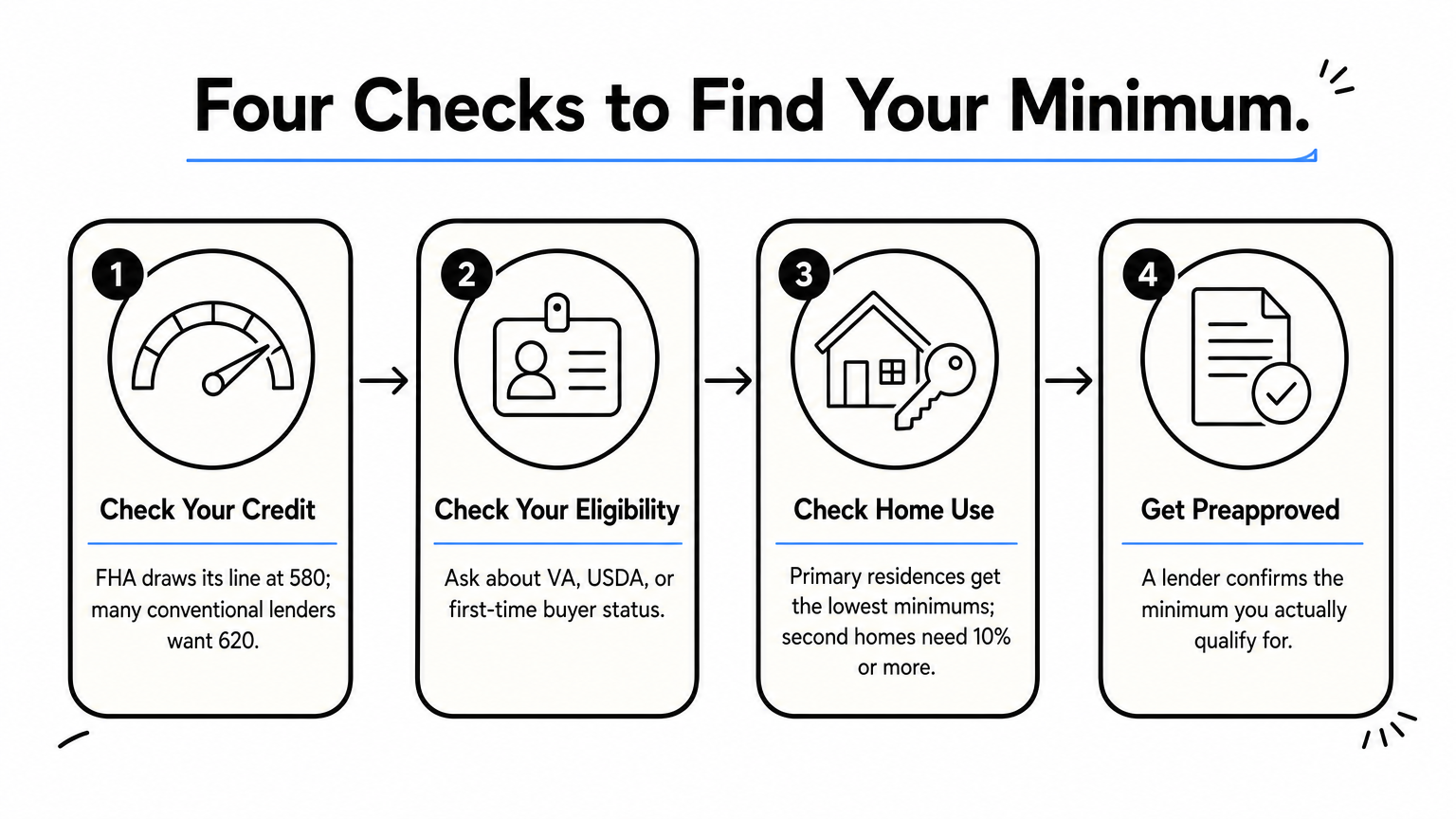
- Check your credit score. FHA draws its line at 580. Many conventional lenders want at least 620.
- Check your eligibility. Ask whether you have military service for VA, a rural property and qualifying income for USDA, or first-time buyer or low-to-moderate income status for the 3% conventional option.
- Check how you will use the home. Primary residences get the lowest minimums. Second homes and rentals move you to 10% or more.
- Get preapproved. A lender confirms the minimum you actually qualify for, which can be stricter than the program floor.
Lenders can ask for more than the minimum. A debt-to-income ratio above 50%, or a bankruptcy or foreclosure in the last 7 years, can push you toward 10% or more. If the number you get back is higher than you planned, it is a signal to fix the cause before you shop, not just to save more.
The loan program sets your minimum down payment, so match your credit, service history and property use to a program before you pick a savings target.
How each down payment changes your monthly payment
At a 6% rate on a 30-year fixed loan, going from 3% down to 20% down lowers your principal and interest payment by about $204 a month. The rule of thumb is that every extra $10,000 down saves roughly $60 a month, or about $6 for every $1,000.
Principal and interest at each level
This table shows the monthly principal and interest payment for each down payment on a $200,000 house.
| Down payment | Amount | Loan | Monthly principal and interest |
|---|---|---|---|
| 3% | $6,000 | $194,000 | $1,163 |
| 3.5% | $7,000 | $193,000 | $1,157 |
| 5% | $10,000 | $190,000 | $1,139 |
| 10% | $20,000 | $180,000 | $1,079 |
| 15% | $30,000 | $170,000 | $1,019 |
| 20% | $40,000 | $160,000 | $959 |
These figures exclude property tax, homeowners insurance and mortgage insurance, so your real payment is higher. Moving from 5% to 10% down also saves about $11,500 in interest over 30 years if the rate stays the same. You can test your own price, term and rate in the Down Payment Calculator, which compares 5%, 10%, 15% and 20% side by side and flags whether PMI is likely to apply.
Each extra $10,000 you put down lowers a 30-year payment at 6% by about $60 a month.
Mortgage insurance and fees on top
Conventional loans add PMI below 20% down. Suppose you put down 5% and your PMI costs 0.75% of the loan a year. That is $1,425 a year, or about $119 a month, which lifts the $1,139 payment to roughly $1,258. Your actual PMI rate depends on your credit score and down payment, and it is typically lower the more you put down.
FHA loans charge two premiums. Take the 3.5% down payment on a 200 000 house, $7,000, which leaves a base loan of $193,000. The upfront premium of 1.75% is $3,377.50, usually financed into the loan, so you borrow about $196,378 and the principal and interest payment is about $1,177. Add an annual premium of 0.55%, about $88 a month, and the payment is roughly $1,265 before taxes and homeowners insurance. With less than 10% down, the FHA premium generally lasts for the life of the loan, while 10% or more down ends it after 11 years.
VA loans have no monthly mortgage insurance, but they charge a one-time funding fee. For first use, it is 2.15% with less than 5% down ($4,300 on this house), 1.50% with 5% to 9.99% down ($2,850 at 5%), and 1.25% with 10% or more down ($2,250 at 10%). After first use, the fee is 3.30% with less than 5% down, and you can tick the exemption box in the VA Loan Calculator if you qualify for one.
How much to put down and what cash you need
Put down at least your loan's minimum, aim higher when you can without draining your savings, and keep cash for closing costs and repairs. The best down payment is the one that leaves you comfortable the day after closing.
Minimum, 20% or somewhere between
A larger down payment has real benefits. You borrow less, pay less interest, build equity faster and may qualify for a lower rate. At 20% down you avoid PMI on a conventional loan, and with 10% down on FHA you stop paying the premium after 11 years.
A smaller down payment can still be the smarter move. A new home often needs repairs, and moving costs add up, so a cash buffer protects you from borrowing at high rates. If you carry high-interest debt, paying it down can beat a bigger down payment. If waiting to save more means missing a home that fits your goals today, putting less down may be worth the PMI.
Cash to budget beyond the down payment
Closing costs are separate from the down payment. The Closing Cost Calculator's typical breakdown for a $200,000 purchase adds up to about 2.2% of the price, or $4,400:
| Item | Share of price | On $200,000 |
|---|---|---|
| Loan origination | 1% | $2,000 |
| Title insurance | 0.5% | $1,000 |
| Recording and transfer | 0.3% | $600 |
| Legal fees | 0.2% | $400 |
| Appraisal | 0.1% | $200 |
| Inspection | 0.1% | $200 |
Real totals vary by lender and state. Still, an FHA buyer putting down $7,000 should plan for roughly $11,400 in cash at closing, and a buyer putting down 20% should plan for about $44,400.
Help with the cash is common. You can use gift money for all or part of a down payment, but you need a gift letter from the giver and documentation of where the funds came from. Keep the money in your account for about two months before you apply. Down payment assistance programs, often run by state housing finance agencies or nonprofits, offer grants, deferred loans or forgivable loans, and many can also cover closing costs.
Quick answers to common questions
Can you afford a $200,000 house on a $50,000 salary? It is tight. Your gross monthly income is about $4,167, and a 28% housing cap is about $1,167. At 3.5% down, principal and interest alone is $1,157 plus about $88 for FHA mortgage insurance, so taxes and insurance do not fit. At 20% down, principal and interest is $959, leaving about $208 for taxes and insurance, which is workable only with low debts.
Can you put $10,000 down on a $200,000 house? Yes. That is 5%, enough for the conventional minimum for most buyers and well above the FHA minimum of $7,000. Remember to keep money aside for closing costs.
Is $200,000 enough for a down payment? Far more than enough for this purchase. At 20% down, it covers a $1,000,000 home.
Setting your number
The down payment on a $200k house can be anywhere from $0 to $40,000 or more. Your loan type sets the floor, and your savings, monthly budget and cash cushion should set the amount you actually pay. Every $10,000 you add trims about $60 off a 30-year payment at 6%, but it also drains cash you may need on move-in day.
To see how this works for your own price, rate and term, compare down payment scenarios in the HomeLoanCalc.io calculators. They are free, need no signup, and update as you type.
This article is for general information and is not financial advice. Confirm figures with your lender or an official source before you decide.
Run your own numbers
Use our free calculators to see what this means for your loan.
More articles
- How to Use a Pay Down Loan Calculator to Save Interest
- How to Calculate PMI on a Conventional Loan, Step by Step
- Primary Mortgage Insurance: What PMI Is, Costs and Removal
- How Much Down Payment Do You Need for a 500K House?
- How Much House Can I Afford on 80K Salary? Real Numbers
- Current FHA Interest Rates: What Sets Your 30-Year Rate
- VA Loan Calculator: Find Your Payment and Home Budget
- FHA Debt-to-Income Ratio Calculator: How to Check 31/43
- Mortgage Insurance on FHA: What It Is and What It Costs
- Longest Mortgage Term: Do 40- and 50-Year Loans Exist?