FHA Debt-to-Income Ratio Calculator: How to Check 31/43
By Sohaib Ibrahim · Published November 8, 2026
A debt to income ratio calculator for FHA loans does two divisions. Divide your planned monthly housing payment by your gross monthly income to get the front-end ratio. Then divide that housing payment plus all your monthly debts by the same income to get the back-end ratio. The standard FHA limits are 31% and 43%. If you land at or under both, you pass this test. Higher ratios can still work, but only with strong compensating factors.
Most online calculators hide what they count. You type in a few numbers and get one percentage. You never learn whether it included FHA mortgage insurance, HOA dues, or a deferred student loan. Leave out the monthly mortgage insurance premium and you can understate your front-end ratio by a point or two. That is often enough to turn a "pass" into a surprise at underwriting.
This guide shows you how to run the check yourself in four steps. You will see which limits apply, what to count, and how to estimate the full FHA payment. A worked example with real numbers shows how to read the result. Along the way you will see where the free FHA Loan and Affordability calculators on HomeLoanCalc.io fit in.
What FHA looks at in your debt-to-income ratio
FHA lenders review two ratios, and the standard limits are 31% front-end and 43% back-end. Every other limit in this guide is an exception to that baseline.
The two ratios and what each one measures
The front-end ratio measures housing cost only: principal, interest, property taxes, homeowners insurance, FHA mortgage insurance premium (MIP), and any HOA dues. The back-end ratio adds every recurring monthly debt on top of that housing cost. Both use gross income, meaning your income before taxes and deductions.
Lenders focus on the back-end number because it shows your total monthly obligations. The front-end number still matters, because a high housing payment can fail the test even when your other debts are small.
Limits by underwriting path
The limits you face depend on your credit score and on how the loan is underwritten. The manual underwriting figures below follow HUD's FHA handbook (4000.1). Automated approvals vary by file.
| Situation | Front-end limit | Back-end limit |
|---|---|---|
| Standard, no compensating factors | 31% | 43% |
| Manual underwriting, score 580+, one compensating factor | 37% | 47% |
| Manual underwriting, score 580+, two compensating factors | 40% | 50% |
| Automated approval, strong file | up to about 46.9% | up to about 56.9% |
Scores from 500 to 579 stay at 31% and 43% and need 10% down. Scores of 580 or higher can put down as little as 3.5%. Compensating factors include cash reserves, a small increase over your current housing cost, and extra income that is documented. Individual lenders can set stricter limits than FHA does, so confirm theirs before you shop.
Treat 31% and 43% as the standard, and anything higher as an exception you have to earn.
Step 1. Gather your income and monthly debts
Start with your gross monthly income and a complete list of recurring debts. Mistakes here carry through every later step.
Use gross income, not take-home pay
Gross income is what you earn before taxes, health premiums, and retirement contributions. For a salary, divide the annual figure by 12. For hourly work, use your average monthly pay. Lenders generally average overtime, bonuses, and self-employment income over two years, so do the same instead of using your best recent month.
List the debts FHA counts
Count every payment that appears on your credit report or is court-ordered:

- Car loans and leases
- Student loans
- Credit card minimum payments (not the full balance)
- Personal loans and other installment loans
- Child support and alimony
Do not count utilities, groceries, phone plans, auto insurance, or subscriptions. Two rules catch people out. If your student loan is deferred and shows a $0 payment, lenders typically use 0.5% of the outstanding balance. A $40,000 balance counts as $200 a month. An installment loan with fewer than 10 months left may be excluded when its payment is small, at or below 5% of your gross monthly income, so ask your lender about that.
Count the payment your credit report shows, not the one you wish you had.
Step 2. Estimate the full FHA housing payment
Your housing payment is principal, interest, taxes, insurance, MIP, and HOA dues, and MIP is the part most people leave out. A front-end ratio without it is too low.
Know the FHA mortgage insurance costs
FHA charges an upfront MIP, usually 1.75% of the base loan, often financed into the loan. It also charges an annual MIP, commonly 0.55% a year for most 30-year loans, collected monthly. On a $225,000 base loan, the upfront premium is $3,937.50, which raises the financed balance to $228,937.50. The annual premium is $1,237.50, or about $103 a month.

Add up the monthly payment
Use HomeLoanCalc.io's FHA Loan Calculator to get the payment with both premiums built in. Then add your tax, insurance, and HOA estimates. Here is the example at an illustrative 6.5% rate over 30 years:
| Component | Monthly amount |
|---|---|
| Principal and interest on $228,937.50 | $1,447 |
| Property taxes | $300 |
| Homeowners insurance | $95 |
| Monthly MIP | $103 |
| HOA dues | $0 |
| Total housing payment | $1,945 |
Treat the tax and insurance lines as placeholders. The final figures come from your local assessor and insurer, and a lender's actual payment can differ slightly from any calculator.
If your housing payment skips MIP, your front-end ratio is wrong before you divide anything.
Step 3. Calculate your front-end and back-end ratios
Divide twice, using the same gross income each time. You can do it in a spreadsheet in under a minute.
The formulas and a spreadsheet layout
Paste this into a sheet. Put gross monthly income in B1, the housing payment in B2, and other monthly debts in B3.
Front-end DTI:  =B2/B1
Back-end DTI:   =(B2+B3)/B1
Format both cells as percentages.
A worked example
Say your gross income is $6,500 a month. Your debts are a $380 car payment, a $250 student loan, and $120 in card minimums, which is $750 in total. Your housing payment from Step 2 is $1,945.
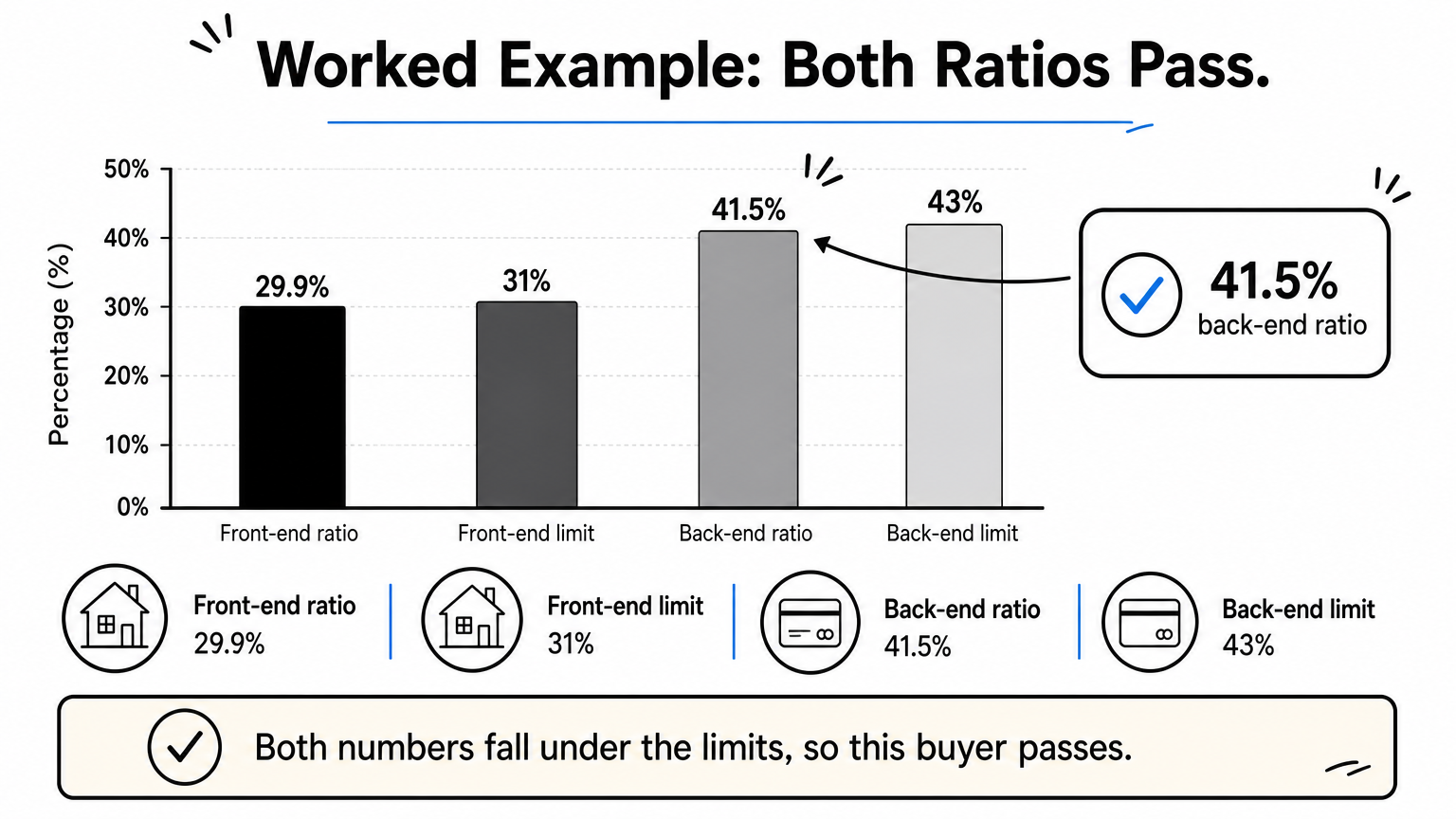
- Front-end: $1,945 / $6,500 = 29.9%
- Back-end: ($1,945 + $750) / $6,500 = $2,695 / $6,500 = 41.5%
Both numbers fall under 31% and 43%, so this buyer passes the standard test.
Reverse the formula to find your ceiling
You can also work backward to find the largest payment you could carry. At 31%, the housing ceiling is $6,500 x 0.31 = $2,015. At 43%, total obligations top out at $2,795, which leaves $2,795 - $750 = $2,045 for housing. The lower figure rules, so this buyer's ceiling is $2,015 a month, only $70 above the planned payment.
With no debts, only the front-end limit matters. A $200,000 income is $16,667 a month, so 31% allows a housing payment of about $5,167. County FHA loan limits can cap the loan well before that payment does.
Your real ceiling is whichever of the two limits runs out first.
Step 4. Compare your results and lower them if needed
Check both ratios against the limits, then fix whichever one is too high. Small changes often move the numbers more than you expect.
Read your result
If both ratios are at or under 31% and 43%, you meet the standard limits. If you land between those and the higher figures in the table, you need compensating factors and a lender willing to underwrite the file. That usually means cash reserves after closing and a payment that is not much above your current rent. If you are over the higher limits, change the inputs before you apply.
Bring the ratios down
Removing a debt works best. Paying off the $380 car loan in the example drops the back-end ratio by 5.8 points, from 41.5% to 35.7%. Paying card balances down also lowers the minimums. On the housing side, a larger down payment lowers principal, interest, and MIP together. A cheaper home does the same, and a co-borrower's documented income raises the denominator.
For a cross-check, run your numbers through the Affordability Calculator. It caps housing at 22%, 28%, or 33% of gross income and total debt at 36%. That is stricter than FHA, so it shows what a cautious budget looks like next to the FHA maximum.
Wiping out one mid-sized monthly debt can shift your back-end ratio further than a month of saving.
Run your numbers before you talk to a lender
Checking FHA eligibility takes four moves: collect your gross income and debts, estimate the full payment with MIP, divide twice, and compare the results to 31% and 43%. If you are within the limits, you are in good shape. If you are above them, you know which debt or payment to adjust first.
Your calculation is a planning estimate. A lender will verify your income and credit, and its own rules may be tighter than FHA's. For your payment estimate, try HomeLoanCalc.io's free calculators. They need no signup and update as you type, so you can test different down payments and prices before you apply.
This article is for general information and is not financial advice. Confirm figures with your lender or an official source before you decide.
Run your own numbers
Use our free calculators to see what this means for your loan.
More articles
- Current FHA Interest Rates: What Sets Your 30-Year Rate
- Longest Mortgage Term: Do 40- and 50-Year Loans Exist?
- How Much Down Payment Do You Need for a 500K House?
- $60K Salary Home Budget: How Much House Can You Afford?
- How to Calculate PMI on a Conventional Loan, Step by Step
- Excel Mortgage Amortization Schedule: Build One in 4 Steps
- Down Payment on 200k House: What You Need by Loan Type
- How Much House Can I Afford with 300K Salary? Step by Step
- How to Use a Pay Down Loan Calculator to Save Interest
- How Much House Can I Afford with 70K Salary? $170K to $305K