$60K Salary Home Budget: How Much House Can You Afford?
By Sohaib Ibrahim · Published November 10, 2026
On a $60,000 salary, most buyers can afford a home priced at roughly $190,000 to $220,000. The exact answer to how much house you can afford on a 60K salary moves from about $150,000 up to $260,000. It depends on your down payment, your monthly debts, and the interest rate you get. The number is not the price a lender might approve. It is the price whose monthly payment you can carry without strain.
"Affordable" has a standard definition. Lenders look at gross income, which here is $5,000 a month. The common 28/36 guideline caps your housing payment at 28% of that ($1,400) and your total monthly debts at 36% ($1,800). Everything in this article follows from those two caps.
Below, you will see why the answer is a range, how to work out your own number step by step, how debts, down payment, and rates change it, and what a $60K income buys in common cases like a $200,000 or $300,000 home. HomeLoanCalc.io runs this same math for free in its Affordability Calculator, with no signup, so you can check each figure against your own situation.
Why a $60K salary gives a price range, not one number
A $60K salary gives a range because the price you can afford depends on the monthly payment you can carry, and that payment depends on more than income. Two buyers earning the same amount can differ by $100,000 in what they can buy.
The 28/36 rule on $5,000 a month
Start with the monthly figure: $60,000 divided by 12 is $5,000 in gross monthly income. At 28%, your housing payment tops out at $1,400, and at 36%, your housing payment plus every other debt tops out at $1,800. Lenders also weigh credit score and savings, but these two caps do most of the work.
Three scenarios, three price points
HomeLoanCalc.io's Affordability Calculator shows conservative (about 22%), moderate (about 28%), and maximum (about 33%) scenarios. Here is what each means for a $60K earner, assuming a 6.5% 30-year fixed rate, property tax and insurance of 1.5% of the price per year, and PMI of 0.5% of the loan per year when you put down 10%. These are illustrative assumptions, not current rate quotes.
| Scenario | Share of income | Monthly housing payment | Price with 10% down | Price with 20% down |
|---|---|---|---|---|
| Conservative | 22% | $1,100 | about $150,000 | about $174,000 |
| Moderate | 28% | $1,400 | about $191,000 | about $222,000 |
| Maximum | 33% | $1,650 | about $226,000 | about $262,000 |
Your take-home pay is lower than $5,000 once taxes and deductions come out, so the maximum scenario leaves very little room for savings, repairs, or a bad month. I would aim between conservative and moderate, and treat the maximum as a ceiling, not a target.
Your payment limit sets your price, so start with the $1,400, not with a listing.
How to work out your own home budget on 60K
You work out your budget by converting salary to a monthly payment cap, subtracting existing debts, and then turning the remaining payment into a price. The steps take about five minutes.
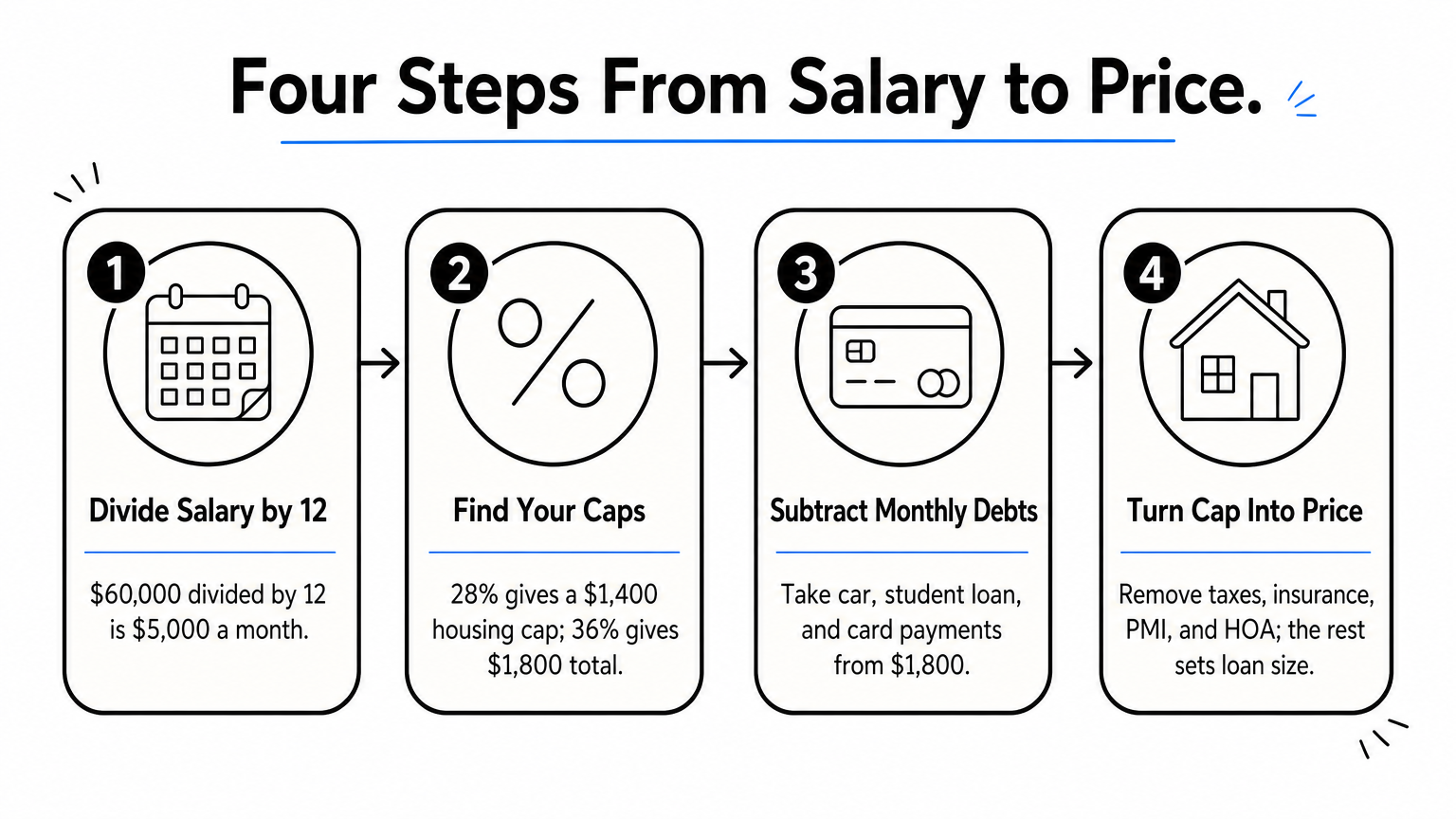
Four steps from salary to price
- Divide your salary by 12. For $60,000, that is $5,000.
- Multiply by 28% for your housing cap ($1,400) and by 36% for your total debt cap ($1,800).
- Subtract your monthly debts (car, student loans, card minimums) from the $1,800. If the result is below $1,400, that lower number is your housing cap.
- Take taxes, insurance, PMI, and any HOA dues out of the cap. What remains pays principal and interest, and that sets your loan size.
Here is the worked example. With a $1,400 cap and 20% down at 6.5%, about $278 goes to taxes and insurance and about $1,122 to principal and interest. That supports a loan near $177,600, so the home price is about $222,000 with $44,400 down.
Costs that sit inside the payment
Four items shrink the share left for the loan. Property taxes and homeowners insurance vary widely by location, so check real figures for areas you are considering. PMI applies on most conventional loans with under 20% down, and US lenders must cancel it automatically once your scheduled balance reaches 78% of the original home price. HOA dues come off the top if the home has them.
Cash at closing matters too. HomeLoanCalc.io's Closing Cost Calculator uses fee shares that add up to about 2.2% of the price. On a $222,000 home, that is roughly $4,900, so you need about $49,300 in cash for the 20% scenario. The 10% scenario on a $191,000 home needs about $23,300, which is $19,100 down plus about $4,200 in closing costs.
The payment you can carry is the real number, and the home price is only what that payment buys.
How down payment, debts, and rates move your price
Monthly debts move your price the most, followed by down payment and then interest rate. Debts are the sneakiest because they cut your payment cap, not just the loan.
Monthly debts shrink your cap
Your first $400 of debt costs you nothing, because $1,800 minus $400 still leaves the full $1,400. After that, every dollar of debt takes a dollar from your housing cap.
| Monthly debts | Housing cap | Price with 10% down | Price with 20% down |
|---|---|---|---|
| $0 | $1,400 | about $191,000 | about $222,000 |
| $400 | $1,400 | about $191,000 | about $222,000 |
| $600 | $1,200 | about $164,000 | about $190,000 |
| $800 | $1,000 | about $137,000 | about $159,000 |
Paying off a car loan before you apply can raise your buying power by more than a year of saving would.
Down payment and rate
Moving from 10% to 20% down lifts the price from about $191,000 to $222,000 at the same payment. The extra gain comes from a smaller loan and no PMI. Your credit score feeds into both your rate and your PMI cost.
Rates matter less than people fear, but they still count. At 20% down and a $1,400 payment, 6% supports about $232,000, 6.5% about $222,000, and 7% about $213,000. Each half-point shifts the price by roughly $9,000 to $10,000. The Down Payment Calculator compares 5%, 10%, 15%, and 20% side by side if you want to test your own cash.
Pay down debt before you chase a lower rate, because a debt-free $1,400 beats a cheaper rate on a $1,000 cap.
What a $60K salary buys in common scenarios
A $200,000 home fits a $60K salary, and a $300,000 home does not fit standard ratios. Between those two, your down payment decides how comfortable the purchase feels.
Can you afford a $200K or $300K house?
The same assumptions as above give these payments:
| Home price | Down payment | Estimated monthly payment | Share of gross income |
|---|---|---|---|
| $200,000 | 20% | about $1,261 | 25% |
| $200,000 | 10% | about $1,463 | 29% |
| $300,000 | 20% | about $1,892 | 38% |
| $300,000 | 10% | about $2,194 | 44% |
At $200,000, you are inside the 28% guideline with 20% down and slightly above it with 10% down. At $300,000, you are well above both caps even with a full 20% down. You would need an income near $81,000 to carry that payment at 28%.
Other salaries and local prices
Every $10,000 of salary changes your price by roughly $37,000 at 20% down or $32,000 at 10% down. That puts $50K near $185,000, $55K near $204,000, and $70K near $259,000, all at 20% down.
If homes near you cost more than your range, you have three real options. You can bring in a co-borrower, look into down payment assistance programs, or search a lower-priced area. Stretching past 36% is the fourth option, and it is the one I would avoid.
On $60K, a $200,000 home is realistic and a $300,000 home is not, unless your income or down payment changes.
Start with the payment, then the price
A $60,000 salary supports a $1,400 monthly housing payment on the standard 28% guideline. That payment buys roughly $190,000 to $220,000 of house for most buyers. Debts, down payment, and rate decide where you land, so work backward from the payment, not forward from a listing. Treat all figures here as planning estimates, not a lender quote, because your actual rate, taxes, and insurance come from the lender and local assessor.
To see your own numbers, enter your income, debts, down payment, and credit score into the free Affordability Calculator at HomeLoanCalc.io. It shows conservative, moderate, and maximum prices instantly, with nothing to sign up for.
This article is for general information and is not financial advice. Confirm figures with your lender or an official source before you decide.
Run your own numbers
Use our free calculators to see what this means for your loan.
More articles
- Longest Mortgage Term: Do 40- and 50-Year Loans Exist?
- Excel Mortgage Amortization Schedule: Build One in 4 Steps
- FHA Debt-to-Income Ratio Calculator: How to Check 31/43
- How Much House Can I Afford with 300K Salary? Step by Step
- Current FHA Interest Rates: What Sets Your 30-Year Rate
- How Much House Can I Afford with 70K Salary? $170K to $305K
- How Much Down Payment Do You Need for a 500K House?
- Mortgage Insurance Disbursement: What the Line Item Means
- How to Calculate PMI on a Conventional Loan, Step by Step
- Mortgage Calculator with Tax and Insurance: How to Use It