How Much Down Payment Do You Need for a 500K House?
By Sohaib Ibrahim · Published November 6, 2026
The down payment for a 500k house runs from $15,000 at 3% to $100,000 at 20%, and the right number for you sits somewhere in that range. A down payment is the cash you pay upfront toward the purchase price. Your mortgage covers the rest. Lenders quote it as a percentage of the price, so 10% on this house means $50,000.
This article shows the dollar amount at each percentage, what each choice does to your loan and monthly payment, and how to pick a number you can live with. It also lists the minimums by loan type and the income you need to carry the payment. Every payment figure uses an example rate of 6.5% on a 30-year fixed loan, so swap in your own rate before you decide anything.
HomeLoanCalc.io builds free mortgage calculators, and the math here follows the same standard amortization formula those tools use. Treat the numbers as planning estimates, not a quote or financial advice. Your lender's final rate, taxes, and insurance will differ.
Why your down payment on a $500K house matters
Your down payment decides four things at once: how much you borrow, what you pay each month, whether you owe mortgage insurance, and how much cash you keep after closing. On a $500,000 home, every 1% you put down equals $5,000.
Down payment amounts from 3% to 20%
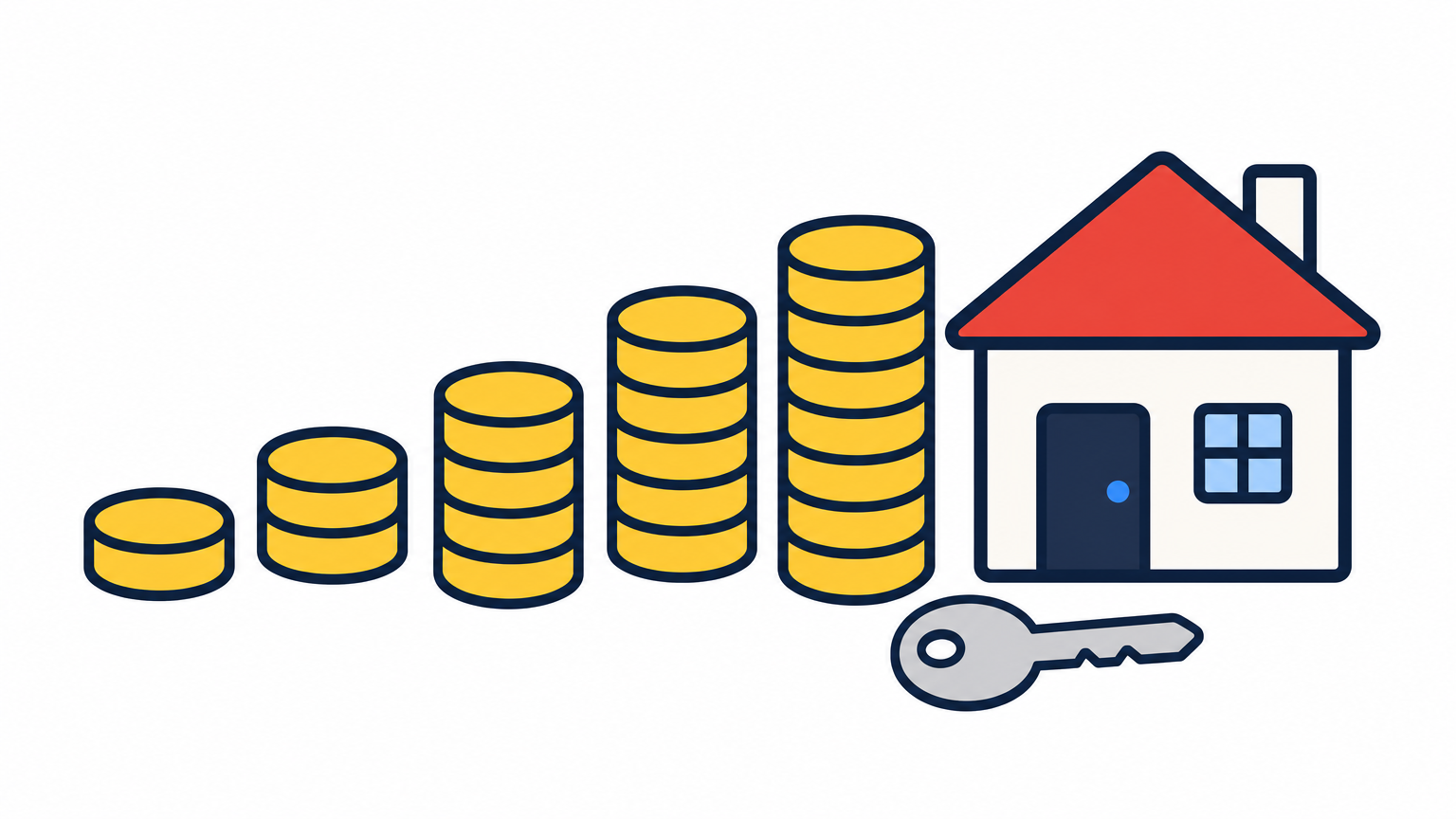
The table shows what each common percentage costs, the loan it leaves you, and the monthly principal and interest at 6.5% over 30 years.
| Down payment | Amount | Loan amount | Monthly principal and interest |
|---|---|---|---|
| 3% | $15,000 | $485,000 | $3,066 |
| 5% | $25,000 | $475,000 | $3,002 |
| 10% | $50,000 | $450,000 | $2,844 |
| 15% | $75,000 | $425,000 | $2,686 |
| 20% | $100,000 | $400,000 | $2,528 |
The payment column leaves out property tax, homeowners insurance, and mortgage insurance, which all come on top. Moving from 3% to 20% costs you $85,000 more upfront and lowers your payment by about $538 a month.
What a bigger down payment changes
A larger down payment also cuts the total interest you pay. Over 30 years at 6.5%, the 3% loan costs about $618,600 in interest and the 20% loan about $510,200. That is roughly $108,000 less interest for the bigger down payment.
Mortgage insurance is the other cost. On a conventional loan, putting down less than 20% usually means paying private mortgage insurance (PMI), often around 0.5% to 1.5% of the loan per year depending on your credit score and down payment. On the $485,000 loan from the 3% scenario, that works out to about $200 to $605 a month. PMI cancels automatically once your scheduled balance reaches 78% of the original home price.
Reaching 20% down is the one threshold that removes mortgage insurance on a conventional loan.
How to choose your down payment on a $500K house
Put down the most you can while still covering closing costs and keeping an emergency fund. Twenty percent is a target, not a requirement.
Start with your cash, not the percentage
Work backward from what you actually have:
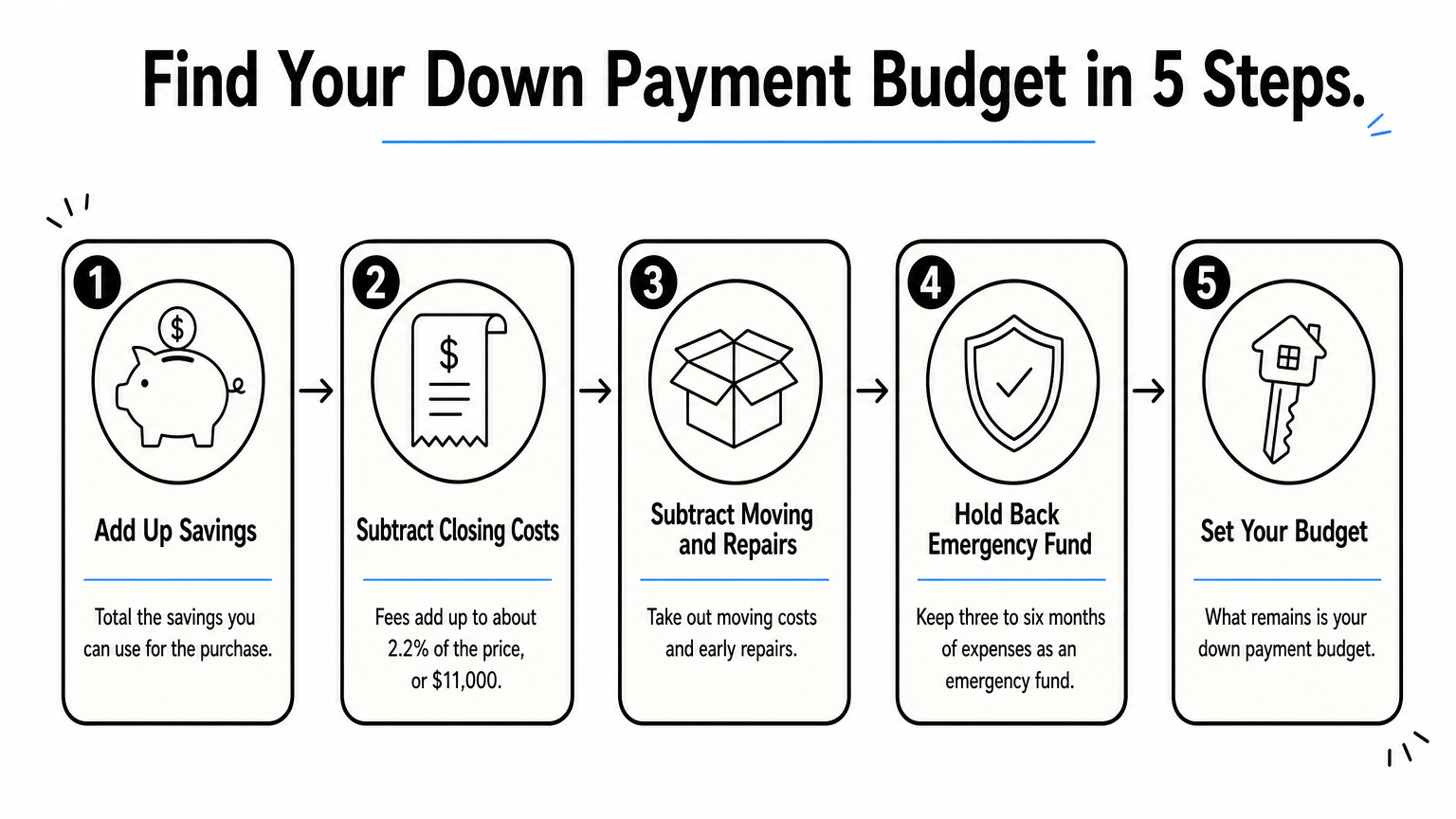
- Add up the savings you can use for the purchase.
- Subtract closing costs. Itemized fees such as origination, appraisal, title, inspection, recording, and legal add up to about 2.2% of the price, or $11,000 on this home.
- Subtract moving costs and early repairs.
- Hold back an emergency fund, ideally three to six months of expenses.
- What remains is your down payment budget.
Cash to close matters more than the down payment alone. A 20% down payment needs about $111,000 once closing costs are in. A 3% down payment needs about $26,000.
Compare scenarios side by side
Once you know your budget, compare outcomes before you commit. The free Down Payment Calculator at HomeLoanCalc.io shows 5%, 10%, 15%, and 20% side by side. For each it shows the loan amount, the monthly principal and interest, and whether PMI is likely to apply.
My position is simple. A 10% down payment with a full emergency fund beats 20% down with an empty bank account. A house costs money after you buy it, and a leaking roof does not wait for you to rebuild your savings.
Put down what leaves you comfortable the day after closing, not just the day of.
Minimum down payment by loan type
The minimum depends on the loan program. Conventional loans start at 3% for qualified first-time buyers, FHA loans at 3.5%, and VA loans at 0% for eligible borrowers.
Minimums on a $500,000 home
| Loan type | Minimum down payment | Amount on $500,000 |
|---|---|---|
| Conventional | 3% for qualified first-time buyers | $15,000 |
| FHA, credit score 580 or higher | 3.5% | $17,500 |
| FHA, credit score 500 to 579 | 10% | $50,000 |
| VA, eligible borrowers | 0% | $0 |
Many conventional lenders ask for 5% or more outside special programs, so confirm what you qualify for. A $500 down payment is only 0.1% of the price, and no conventional or FHA loan allows that.
What the cheaper routes add
Low down payments shift costs elsewhere. An FHA loan with 3.5% down leaves a $482,500 base loan. The upfront mortgage insurance premium is usually 1.75%, about $8,444, and is often financed into the loan. Annual mortgage insurance is commonly 0.55%, or about $221 a month on that balance. FHA loan limits vary by county, so check yours.
A VA loan has no monthly mortgage insurance. It charges a funding fee instead: 2.15% for first use with less than 5% down, or $10,750 on a $500,000 loan. You can usually roll it into the loan, and eligible borrowers may be exempt.
A low down payment gets you in the door sooner, but you pay for it in insurance and interest.
Can you afford a $500K house?
Using the 28% rule, you need roughly $138,000 to $179,000 in annual income, depending on your down payment. The 28% rule caps your housing payment at 28% of gross monthly income.
Income needed at each down payment
The table adds an assumed $700 a month for property tax and homeowners insurance. It also assumes PMI of 1.0% of the loan at 3% down and 0.7% at 10% down. Your real tax and insurance bills will differ.
| Down payment | Principal and interest | Tax and insurance | PMI | Total monthly | Income needed |
|---|---|---|---|---|---|
| 3% | $3,066 | $700 | $404 | $4,170 | about $179,000 |
| 10% | $2,844 | $700 | $263 | $3,807 | about $163,000 |
| 20% | $2,528 | $700 | $0 | $3,228 | about $138,000 |
A quick check agrees: the old rule of thumb of 3 times income points to about $167,000. The 36% rule also limits housing plus other debt. At $163,000 of income, 36% is about $4,890 a month. After the $3,807 housing payment, that leaves about $1,080 for car loans, student loans, and cards.
What a $100,000 salary buys
On $100,000, 28% gives you about $2,333 a month. Even a 20% down payment on a $500,000 home costs $3,228 under the assumptions above, and the 33% maximum of $2,750 still falls short. To fit $2,333, you would need roughly $240,000 down, close to half the price.
The Affordability Calculator at HomeLoanCalc.io tests this with your own debts. It shows conservative, moderate, and maximum scenarios at about 22%, 28%, and 33% of income. The same math rules out a $400,000 home on $70,000, where 28% gives $1,633 a month against about $2,023 in principal and interest alone at 20% down.
If the payment is above 28% of your income, the fix is a cheaper house or a bigger down payment, not a longer stretch.
What to put down on a $500K home
The down payment for a $500,000 home can be as low as $15,000 or as high as $100,000 and beyond. Your best number depends on your cash after closing costs, your emergency fund, and the monthly payment your income supports. A larger down payment lowers your payment, your total interest, and your mortgage insurance. A smaller one gets you in sooner at a higher monthly cost.
Start with your cash budget, then test the percentages against the income you earn. If you want to see how each choice changes your payment, compare your own down payment scenarios with HomeLoanCalc.io's free calculators. They are free, need no signup, and update as you type.
This article is for general information and is not financial advice. Confirm figures with your lender or an official source before you decide.
Run your own numbers
Use our free calculators to see what this means for your loan.
More articles
- How to Calculate PMI on a Conventional Loan, Step by Step
- Current FHA Interest Rates: What Sets Your 30-Year Rate
- Down Payment on 200k House: What You Need by Loan Type
- FHA Debt-to-Income Ratio Calculator: How to Check 31/43
- How to Use a Pay Down Loan Calculator to Save Interest
- Longest Mortgage Term: Do 40- and 50-Year Loans Exist?
- Primary Mortgage Insurance: What PMI Is, Costs and Removal
- $60K Salary Home Budget: How Much House Can You Afford?
- How Much House Can I Afford on 80K Salary? Real Numbers
- Excel Mortgage Amortization Schedule: Build One in 4 Steps