Current FHA Interest Rates: What Sets Your 30-Year Rate
By Sohaib Ibrahim · Published November 7, 2026
Current FHA interest rates for a 30-year fixed loan have recently sat in a band of roughly 6.65% to 7.65% at national lenders, with APRs closer to 7.7% to 8.7%. An FHA interest rate is the yearly percentage a lender charges on a mortgage insured by the Federal Housing Administration. The lender sets it, not the government, so your number depends on who you ask, your credit, your down payment, and the day you lock.
Published rates change daily, so treat any figure in an article as a benchmark and not a quote. What lasts is knowing how to read the range. This guide shows what a rate swing costs on a real loan, how FHA rates compare with conventional ones, what drives your own rate, and how to collect quotes that are worth comparing.
At HomeLoanCalc.io we build free mortgage calculators, including an FHA Loan Calculator that adds the upfront and monthly mortgage insurance for you. The examples below use the standard amortization formula that lenders use, so you can rerun them with your own numbers.
Why current FHA interest rates matter for your payment
A small move in your FHA rate changes your payment by hundreds of dollars a year and your total interest by tens of thousands. The examples here use a $300,000 home with 3.5% down. The base loan is $289,500. The 1.75% upfront mortgage insurance premium ($5,066) is financed, so you borrow $294,566.
What a one-point swing costs on a 30-year loan
| 30-year FHA rate | Monthly principal and interest | Total interest over 30 years |
|---|---|---|
| 6.75% | $1,910 | about $393,000 |
| 7.25% | $2,009 | about $429,000 |
| 7.75% | $2,110 | about $465,000 |
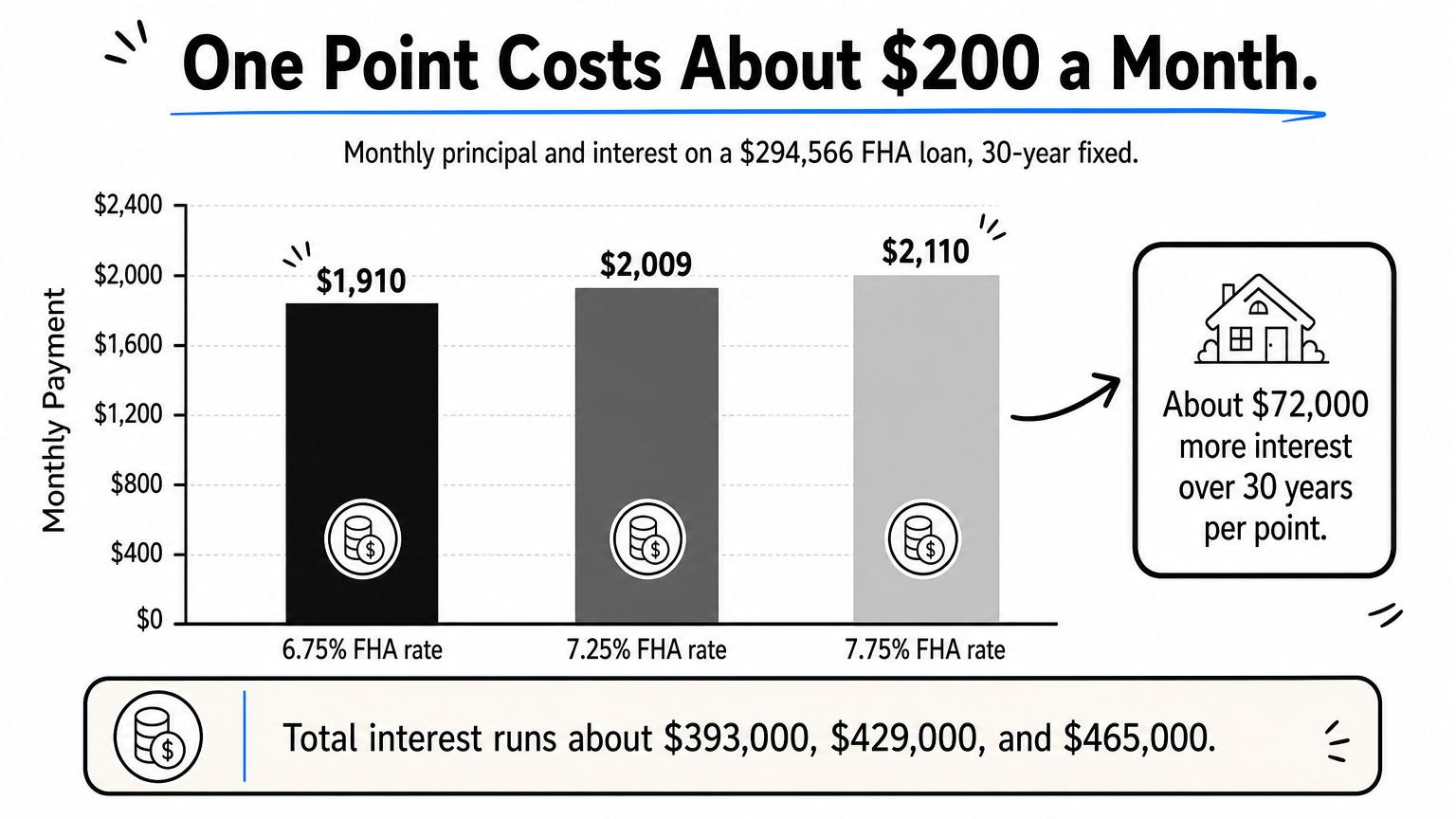
Read the gap between rows, not the rows themselves. One percentage point costs about $200 a month, which adds up to roughly $72,000 over 30 years. A quarter point between two lenders is worth ten minutes of comparison.
One point of rate on a typical FHA loan costs about $72,000 over 30 years.
Why the rate is only part of the monthly cost
FHA loans add mortgage insurance on top of interest. Upfront MIP is usually 1.75% of the base loan. Annual MIP commonly runs 0.55% for most 30-year loans. On the loan above, that adds about $133 a month in the first year (0.55% × $289,500 ÷ 12). Property taxes and homeowners insurance come on top of that.
Because of this, the principal and interest figures in the table understate your real payment. APR counts the loan's finance charges, including FHA mortgage insurance, so it is a better yardstick than the headline rate when you compare offers.
FHA 30-year fixed rates sit in a band, not at one number
Across national lenders, a 30-year fixed FHA rate has recently run from about 6.65% to 7.63%, a spread of nearly a full point for the same product. Anyone checking FHA rates today will see that spread, so you need to know what it means.
Recent rate ranges by loan type
| Loan type | Typical rate range | Typical APR range |
|---|---|---|
| 30-year FHA fixed | 6.65% to 7.63% | 7.7% to 8.7% |
| 15-year FHA fixed | 6.13% to 6.99% | 7.9% to 8.0% |
| 30-year conventional fixed | 7.08% to 7.50% | 7.5% to 7.8% |
These ranges come from lender-published rate sheets, and they move daily. Much of the spread comes from assumptions. Lenders publish rates built on different credit scores, down payments, and discount points, so two sheets are rarely an apples-to-apples match. A published rate is a starting point, and your Loan Estimate is the real number.
A published FHA rate is a benchmark, and only a lender's Loan Estimate tells you your own rate.
How FHA rates compare with conventional rates
For the same lender, the 30-year FHA rate often runs a few tenths of a point below the conventional rate. The APR gap then narrows or flips, because FHA mortgage insurance is costly. In several published sheets the FHA rate is about half a point lower while its APR is slightly higher.
The insurance also lasts longer. With less than 10% down, FHA annual MIP stays for the life of the loan. Conventional PMI can be removed once your balance reaches 78% of the original home value. If you have strong credit and can put down 5% or more, price a conventional loan too before you commit to FHA.
What sets your FHA interest rate
Your FHA rate is the market's base rate, plus the lender's margin, plus adjustments for your own risk. You control the last two parts. The first part moves on its own.
Market forces behind every FHA rate
Lenders price mortgages off what investors will pay for mortgage-backed securities. Those prices loosely track the 10-year Treasury yield, and they react to inflation data, jobs reports, and expectations about the Federal Reserve. The Fed does not set mortgage rates directly, but its signals move the bond market, and lenders reprice rate sheets as often as daily.
FHA insurance protects the lender if you default. That lower risk is why base FHA rates tend to sit below conventional rates.
Your rate starts with the bond market, and no lender can promise you a number past your lock date.
Factors specific to you
- Credit score: FHA allows 3.5% down with a score of 580 or higher, and 10% down for scores of 500 to 579. Many lenders set a higher floor of their own, often 620 or more. Higher scores earn better pricing, but FHA pricing tends to be less sensitive to score than conventional pricing. A 750 score helps you qualify and negotiate, yet it will not move you far from the market range. FHA mortgage insurance does not vary with your score at all.
- Down payment: A larger down payment lowers lender risk. At 10% or more down, FHA annual MIP drops off after 11 years.
- Loan term: A 15-year loan carries a lower rate than a 30-year loan, with a much higher monthly payment.
- Points and lock period: Paying discount points lowers the rate. A longer lock usually costs more.
- Lender: Margins and overlays differ, which is why the same borrower can get quotes nearly a point apart.
How to get the lowest FHA rate you qualify for
You get a lower FHA rate by making lenders compete on identical terms, on the same day. Rate shopping is the single biggest lever you control.
A six-step quote process
- Pull your credit reports and fix errors before any lender checks your score.
- Decide your down payment and term, so every quote covers the same loan.
- Ask at least three lenders for a Loan Estimate on the same day. Lenders must give you this standard form within three business days of an application.
- Compare APR and lender fees on each Loan Estimate, not only the headline rate.
- Enter each offer into the FHA Loan Calculator and the Mortgage Comparison Calculator to see the monthly payment and total interest. Treat the results as planning estimates, since your lender's quote controls.
- Lock your rate once you accept an offer.
Points, locks, and waiting for lower rates
Discount points are worth it only if you stay long enough to recoup them. Take a hypothetical case on the loan above. One point costs about $2,946 (1% of $294,566) and cuts the rate from 7.25% to 7.00%. Your principal and interest drops from about $2,009 to $1,960, a saving of roughly $50 a month. Divide $2,946 by $50 and you break even in about 59 months. If you expect to move or refinance sooner, skip the points.
People often ask whether FHA rates will fall to 4%. Nobody can forecast that reliably, and 4% sits about three points below recent FHA rates. Buy at a payment you can afford now. If rates drop later, a refinance can lower your rate, and it pays off once your monthly savings cover the closing costs. Divide closing costs by monthly savings to find that break-even point.
Do not wait for a rate you cannot predict. Buy at a payment you can afford and refinance if rates fall.
Plan around the range, not one number
Current FHA interest rates are a band, not a single figure, and your own rate lands somewhere inside it. The market sets the base. Your credit, down payment, term, and chosen lender decide where you fall. Because one point costs about $72,000 on a typical loan, the real work is comparing same-day Loan Estimates by APR and testing each offer against your budget.
To see what a rate does to your own payment, run your numbers in the free HomeLoanCalc.io calculators. No signup is needed, and the results update as you type.
This article is for general information and is not financial advice. Confirm figures with your lender or an official source before you decide.
Run your own numbers
Use our free calculators to see what this means for your loan.
More articles
- How Much Down Payment Do You Need for a 500K House?
- FHA Debt-to-Income Ratio Calculator: How to Check 31/43
- How to Calculate PMI on a Conventional Loan, Step by Step
- Longest Mortgage Term: Do 40- and 50-Year Loans Exist?
- Down Payment on 200k House: What You Need by Loan Type
- $60K Salary Home Budget: How Much House Can You Afford?
- How to Use a Pay Down Loan Calculator to Save Interest
- Excel Mortgage Amortization Schedule: Build One in 4 Steps
- Primary Mortgage Insurance: What PMI Is, Costs and Removal
- How Much House Can I Afford with 300K Salary? Step by Step