How to Calculate PMI on a Conventional Loan, Step by Step
By Sohaib Ibrahim · Published November 5, 2026
To calculate PMI, subtract your down payment from the home price to get your loan amount, pick an annual PMI rate based on your loan-to-value ratio and credit score, then multiply the loan by that rate and divide by 12. On a $300,000 home with 5% down and a credit score of 700 to 759, an example rate of 0.90% gives about $214 a month. PMI ends once your scheduled balance falls to 78% of the original home price.
The hard part is that no single PMI number exists. Lenders price it from roughly 0.2% to 2.1% of the loan per year, so the same $285,000 loan can cost about $130 a month or more than $400 depending on your score. Many online tools give you one figure without showing where it came from, so you can't tell whether it fits your loan.
This guide walks through the math in four steps: find your loan amount and LTV, choose a rate, calculate the monthly cost, and estimate the total and the date PMI ends. Each step has worked examples for $300,000 and $500,000 homes. At the end you can check your result with the free PMI calculator at HomeLoanCalc.io.
What you need before you calculate PMI
You need four inputs: home price, down payment, credit score, and loan term. PMI is not a flat fee. It is a yearly rate applied to your loan amount.
When PMI applies
PMI applies to a conventional loan with less than 20% down. It protects the lender, not you, and most borrowers pay it as a monthly add-on to the mortgage payment.
So "is PMI 10% or 20%" has a simple answer: neither. Twenty percent down is the line that removes the requirement. Below it, the cost is an annual rate of about 0.2% to 2.1% of the loan. FHA and VA loans use different insurance or fees, so this method fits conventional loans only.
Put down 20% and PMI disappears; put down less and your credit score decides how much you pay.
The numbers to gather
- Home price: the purchase price, or the appraised value if it is lower.
- Down payment: in dollars or as a percentage.
- Credit score: your current FICO score, because PMI is priced in score bands.
- Loan term and interest rate: needed only to estimate when PMI ends.
Step 1. Find your loan amount and LTV
Subtract your down payment from the home price to get the loan amount, then divide the loan by the home price to get your loan-to-value ratio (LTV). LTV decides which row of the PMI rate card applies to you.
Run the two formulas
Loan amount = Home price - Down payment
LTV = Loan amount ÷ Home price
Here is a $300,000 home at four down payment levels:
| Down payment | Down payment ($) | Loan amount | LTV | PMI required? |
|---|---|---|---|---|
| 5% | $15,000 | $285,000 | 95% | Yes |
| 10% | $30,000 | $270,000 | 90% | Yes |
| 15% | $45,000 | $255,000 | 85% | Yes |
| 20% | $60,000 | $240,000 | 80% | No |
Every point of down payment lowers your LTV, and LTV is the biggest lever on your PMI rate.
Use the lower of price or appraisal
Lenders measure LTV against the lower of the purchase price or the appraised value. If you pay $300,000 and the home appraises at $290,000, your LTV is calculated on $290,000. Run your numbers both ways if the appraisal is close.
Step 2. Choose your annual PMI rate
Your PMI rate comes from a rate card that crosses LTV with credit score, and it typically falls between 0.2% and 2.1% of the loan per year. A higher LTV and a lower score both push it up.
Use a rate band for planning
The table below shows example rates for estimating. They are planning figures, not quotes, and each insurer publishes its own card.
| Credit score | 95% LTV (5% down) | 90% LTV (10% down) | 85% LTV (15% down) |
|---|---|---|---|
| 760+ | 0.55% | 0.40% | 0.25% |
| 700 to 759 | 0.90% | 0.65% | 0.45% |
| 660 to 699 | 1.30% | 0.95% | 0.65% |
| 620 to 659 | 1.75% | 1.30% | 0.90% |
A flat 0.5% shortcut works only for borrowers with strong scores. At 95% LTV it understates the cost for a 640 score by more than two-thirds.
Get your real rate from a lender
Ask for a Loan Estimate, which lists mortgage insurance inside the projected monthly payment. Also ask whether the PMI is monthly, a single upfront premium, or lender-paid. Lender-paid PMI has no separate line item because it is built into a higher interest rate.
Credit score and LTV together set your rate, so improving either one shrinks the bill.
Step 3. Calculate monthly PMI
Multiply your loan amount by the annual PMI rate, then divide by 12. This is how PMI is calculated on a conventional loan.
Monthly PMI = (Loan amount × Annual PMI rate) ÷ 12
Worked example: a $300,000 home
With 5% down, the loan is $285,000. At a 0.90% rate, $285,000 × 0.009 equals $2,565 a year, or $213.75 a month. The same loan at different score bands looks like this:
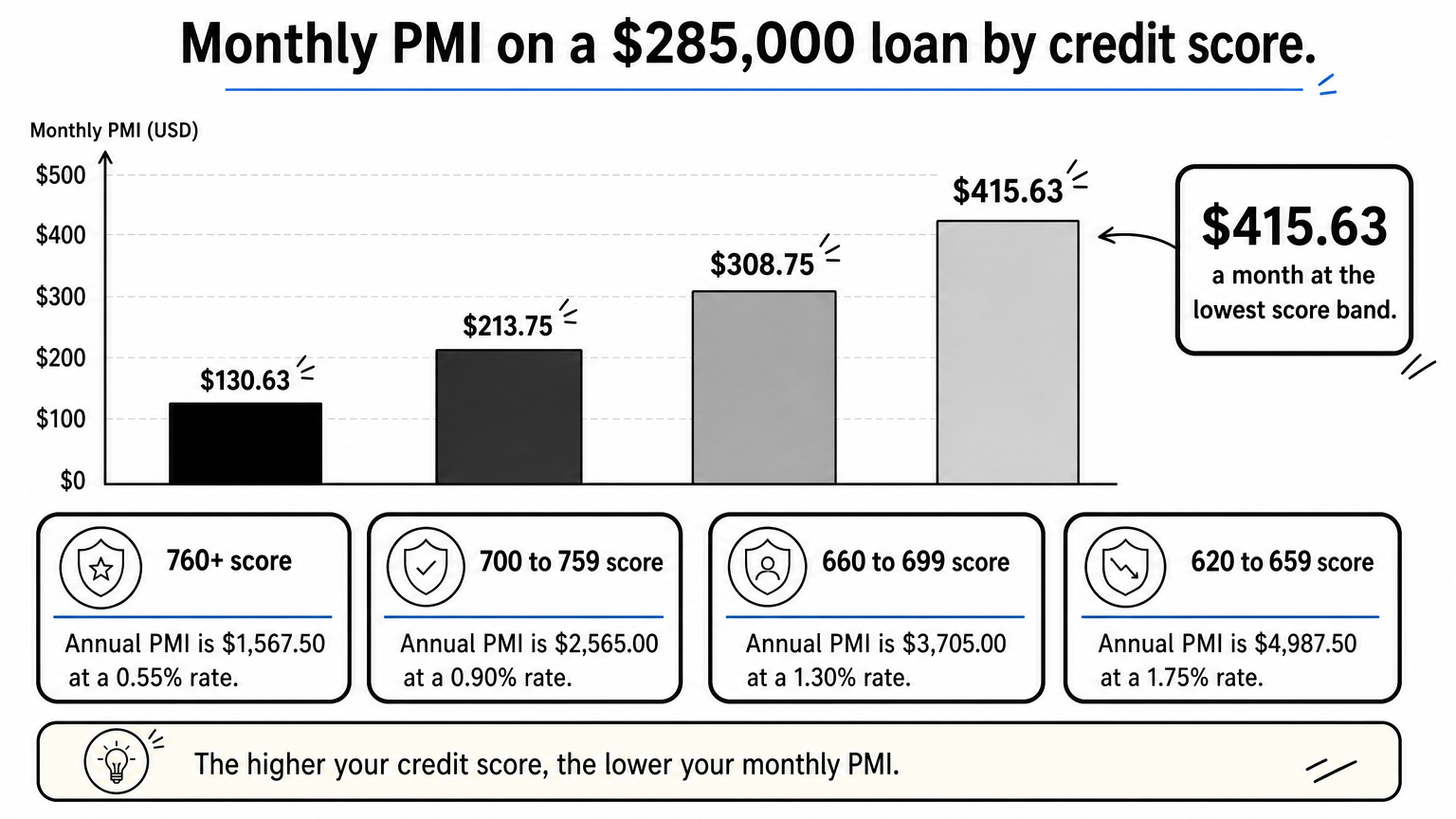
| Credit score | Rate | Annual PMI | Monthly PMI |
|---|---|---|---|
| 760+ | 0.55% | $1,567.50 | $130.63 |
| 700 to 759 | 0.90% | $2,565.00 | $213.75 |
| 660 to 699 | 1.30% | $3,705.00 | $308.75 |
| 620 to 659 | 1.75% | $4,987.50 | $415.63 |
Scale it to a $500,000 home
With 10% down, the loan is $450,000 and the LTV is 90%. At 0.65%, annual PMI is $2,925, or $243.75 a month. With 5% down, the loan is $475,000 at 0.90%, so PMI is $4,275 a year, or $356.25 a month. Putting an extra $25,000 down cuts the premium by $112.50 a month.
Monthly PMI is loan amount times rate divided by 12, so a smaller loan or a lower rate cuts it directly.
Step 4. Estimate total cost and removal date
Total PMI equals your monthly premium times the months until PMI ends. Lenders must cancel PMI automatically when your scheduled balance reaches 78% of the original home value, if you are current on payments. You can request cancellation at 80%.
Find the month PMI ends
On the $300,000 home with a $285,000 loan, 80% is $240,000 and 78% is $234,000. Assume a 6.5% rate over 30 years, which gives a principal and interest payment of about $1,801. The balance reaches $240,000 around month 123 and $234,000 around month 135, or just over 11 years.
At $213.75 a month, automatic cancellation means about $28,900 in total PMI. Extra principal payments or a rise in your home's value can bring the date forward. A lender may require an appraisal before it cancels early.
Check your math with a calculator
HomeLoanCalc.io's free PMI Calculator estimates your PMI cost from your loan-to-value ratio and credit score. Enter your home price, down payment percentage, credit score, loan term, and interest rate. It returns your LTV, estimated monthly and annual PMI, and an approximate date when PMI can be removed. It works in USD, runs in your browser, and needs no signup.
To see how much each down payment tier saves, the Down Payment Calculator compares 5%, 10%, 15%, and 20% side by side. Treat every result as a planning estimate. Your lender's quote sets the final premium.
PMI is temporary, so the number that matters is your monthly cost multiplied by the months until your balance hits 78%.
Turning your PMI estimate into a plan
PMI comes down to three steps. Find your LTV, apply a rate based on LTV and credit score, then divide by 12 for the monthly cost. Multiply by the months until your balance reaches 78% to see what it costs in total.
With your estimate in hand, compare down payment levels, check how much a higher score would save, and ask lenders for a Loan Estimate to confirm the real rate. If you want to skip the arithmetic, run your own numbers in the free PMI calculator and see your monthly cost and removal timeline in seconds.
This article is for general information and is not financial advice. Confirm figures with your lender or an official source before you decide.
Run your own numbers
Use our free calculators to see what this means for your loan.
More articles
- Down Payment on 200k House: What You Need by Loan Type
- How Much Down Payment Do You Need for a 500K House?
- How to Use a Pay Down Loan Calculator to Save Interest
- Current FHA Interest Rates: What Sets Your 30-Year Rate
- Primary Mortgage Insurance: What PMI Is, Costs and Removal
- FHA Debt-to-Income Ratio Calculator: How to Check 31/43
- How Much House Can I Afford on 80K Salary? Real Numbers
- Longest Mortgage Term: Do 40- and 50-Year Loans Exist?
- VA Loan Calculator: Find Your Payment and Home Budget
- $60K Salary Home Budget: How Much House Can You Afford?