How to Use a Mortgage Calculator to Estimate Your Payment
By Sohaib Ibrahim · Published October 25, 2026
The fastest way to use a mortgage calculator is to enter your home price, down payment, interest rate and loan term, then add property tax, homeowners insurance, PMI and HOA dues. That gives you your full monthly cost, not just the loan payment. Next, open the amortization schedule to see how much interest you pay over time, and test a few rates and terms before you talk to a lender.
Most buyers stop at the first number on the screen, and that number covers only principal and interest. On a $400,000 home with 20% down at 7%, it is $2,128.97 a month. Modest tax and insurance assumptions add about $458 more every month. Skip those inputs, or ignore PMI on a smaller down payment, and your budget is wrong before you make an offer.
This guide walks you through the process with the free calculators at HomeLoanCalc.io, which need no signup or email and update as you type. You will see the formula behind the result, four steps built on one worked example, and a way to check the payment against your income. The figures are planning estimates, not a quote, so your lender's final numbers can differ.
What a mortgage calculator does and what to gather
A mortgage calculator turns four loan inputs into a monthly principal-and-interest payment with a fixed formula. It then adds your recurring housing costs so you see what you will actually pay each month.
The formula behind the payment
A payment calculator for a fixed-rate mortgage uses the standard amortization formula that banks and lenders use. HomeLoanCalc.io runs the same math, so the principal-and-interest figure should match what a lender calculates for the same loan. You never need to do this by hand, but seeing it explains why results move the way they do.
M = P × [ r(1 + r)^n ] / [ (1 + r)^n − 1 ]

M = monthly principal and interest
P = loan amount
r = annual rate ÷ 12 (7% becomes 0.07 ÷ 12 = 0.005833)
n = years × 12 (30 years = 360 payments)
Put in $320,000, 7% and 360 payments, and M comes to $2,128.97. Over the full term you pay back about $766,429, which is roughly $2.40 for every $1 you borrowed. The calculators model fixed-rate loans only. An adjustable-rate mortgage resets after its introductory period, so a single payment figure cannot describe it.
What to gather before you start
Collect these numbers first, because the result is only as good as the inputs:
- Home price from the listing or your target budget
- Down payment in dollars or as a percentage
- Interest rate from a lender quote, or a realistic estimate
- Loan term, usually 30 or 15 years
- Property tax and homeowners insurance estimates for the area
- HOA dues, if the home has them
- Credit score range, which affects your rate and PMI
A mortgage calculator is only as accurate as the numbers you type in, so gather real figures before you start.
Step 1. Enter price, down payment, rate and term
Start with the four core inputs. They set your loan amount and your principal-and-interest payment, which is the base every other cost sits on.
Fill in the four core inputs
Enter the home price first, then the down payment. In this guide's example the price is $400,000 and the down payment is 20%, or $80,000. The loan amount is the difference, $320,000. Set the rate to 7% and the term to 30 years.
The result is a principal-and-interest payment of $2,128.97. HomeLoanCalc.io pre-fills country defaults, such as USD for the US, and you can change every field. If you prefer to think in dollars, type the down payment as an amount. If you think in percentages, type it as a percent.
Choose a realistic rate and term
Use a rate a lender has actually quoted you. If you have none, pick a figure near the going rate and plan to rerun the numbers at half a point higher and lower. The term matters just as much. A 15-year mortgage on the same $320,000 at 7% costs $2,876.25 a month but only about $197,725 in total interest, against about $446,429 on a 30-year loan.
Reference payments for common questions, all on 30-year fixed loans:
| Loan amount | Rate | Monthly principal and interest |
|---|---|---|
| $300,000 | 7% | $1,995.91 |
| $320,000 | 7% | $2,128.97 |
| $500,000 | 6% | $2,997.75 |
A shorter term raises your monthly payment but cuts your total interest by more than half.
Step 2. Add taxes, insurance, PMI and HOA fees
Principal and interest is only part of the bill. A payment on a mortgage calculator should include four more items, because lenders count them when they judge what you can afford.
Estimate each extra cost
Each cost needs an estimate you can defend. The table shows where to find each one and the figure used in the example.

| Cost | How to estimate it | Example for a $400,000 home |
|---|---|---|
| Property tax | Check the county assessor's rate for the area. About 1% of value is a common planning figure. | $4,000 a year, or $333.33 a month |
| Homeowners insurance | Get a quote for the specific property. | $125 a month (assumed) |
| PMI | Applies when your down payment is under 20%. Typically 0.3% to 1.5% of the loan per year, depending on credit score and loan type. | $0 with 20% down |
| HOA dues | Listed in the listing or HOA documents. | $0 (none) |
Add them to the $2,128.97 and the full monthly cost is $2,587.30. Tax rates and premiums vary widely by location, so treat these as placeholders until you have real quotes.
See what a smaller down payment does
PMI is where a small down payment gets expensive. Take the same $400,000 home with 5% down, a $380,000 loan, and PMI at an assumed 0.75% a year. The principal and interest rises to $2,528.15, and PMI adds $237.50 a month.
| Monthly cost at 7%, 30 years | 20% down | 5% down |
|---|---|---|
| Principal and interest | $2,128.97 | $2,528.15 |
| PMI | $0 | $237.50 |
| Property tax | $333.33 | $333.33 |
| Insurance | $125.00 | $125.00 |
| Total | $2,587.30 | $3,223.98 |
The smaller down payment adds about $637 a month. PMI is not permanent. Lenders must cancel it automatically when your scheduled balance reaches 78% of the original home price, and you can usually ask earlier, at 80%.
Under 20% down, PMI plus a larger loan can add more than $600 a month on a $400,000 home.
Step 3. Read the amortization schedule and total cost
Once the payment looks right, open the full amortization schedule. It shows how each payment splits between interest and principal, and it reveals the true price of the loan.
Read the totals first
The summary shows three numbers worth writing down: the monthly payment, the total interest, and the total cost. For the $320,000 loan at 7%, total interest is about $446,429. That is more than the amount you borrowed. The schedule can be toggled between an annual summary and a detailed monthly view, so start with the annual one to see the shape of the loan.
Watch where the early payments go
In month one, interest is $320,000 × 0.07 ÷ 12 = $1,866.67. Only $262.30 of your $2,128.97 reduces the balance. After five years you will have paid about $127,700, yet the balance will have fallen only to roughly $301,200, about $18,800 less.

That slow start explains why extra payments early in the loan are so powerful, and why selling in the first few years rarely builds much equity from payments alone. It also helps you time PMI. Find the month where the balance reaches 78% of the original price, and that is when the PMI line should disappear.
In the first years of a 30-year loan, most of each payment goes to interest, not to the balance.
Step 4. Test scenarios against your budget
A single result tells you little. Run the calculator several times, then compare each payment with your income and with the loan alternatives.
Check the payment against the 28/36 rule
The 28/36 rule caps your housing payment at about 28% of gross monthly income, and your total debt payments at about 36%. HomeLoanCalc.io's affordability calculator shows conservative, moderate and maximum scenarios at roughly 22%, 28% and 33% of income.
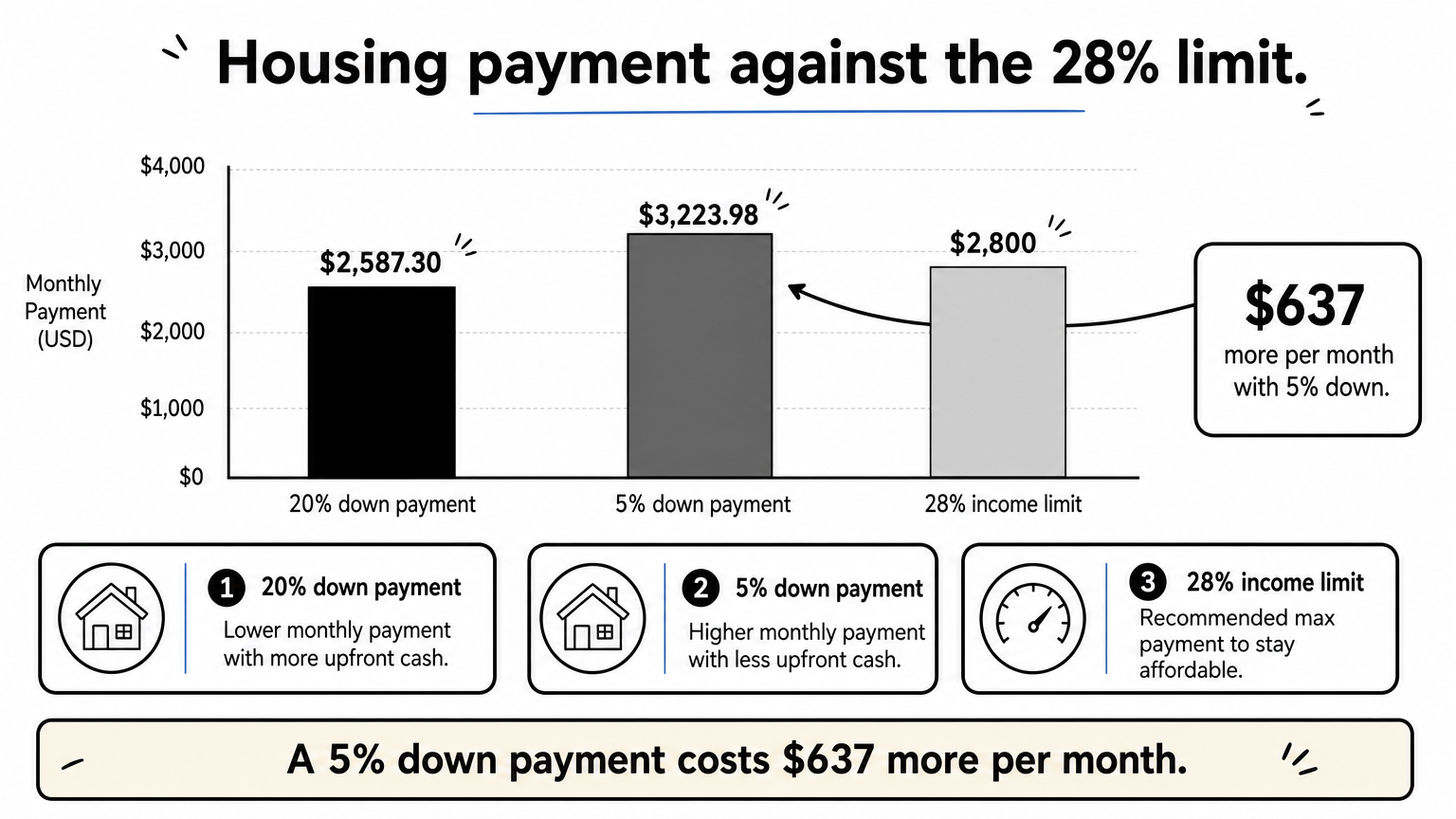
Take a $120,000 income, or $10,000 a month. The 28% limit is $2,800. With $600 in other debts, the 36% limit leaves $3,000. The lower of the two wins, so $2,800 is your ceiling. The $2,587.30 payment from Step 2 fits. The 5%-down payment of $3,223.98 is about 32% of income and falls outside the 28% line.
The same test answers a common question. On a $50,000 salary, a $300,000 house with 20% down at 7% has a principal-and-interest payment of about $1,597 alone. The 28% limit is $1,167, so it does not fit comfortably.
Compare rates, terms and extra payments
Rate changes add up fast. Here is the $320,000, 30-year loan at three rates:
| Rate | Monthly principal and interest | Total interest |
|---|---|---|
| 6% | $1,918.56 | $370,682 |
| 6.5% | $2,022.62 | $408,143 |
| 7% | $2,128.97 | $446,429 |
One point costs about $210 a month and roughly $75,700 over the loan. Then test extra monthly payments. Adding $200 a month to the 7% loan pays it off in about 23 years instead of 30, saving roughly $119,000 in interest. To compare two full offers side by side, use the comparison calculator.
A one-point rate difference on a $320,000 loan changes the payment by about $210 a month.
Run your numbers before you shop
A good mortgage calculator result has four parts: the loan payment, the extra monthly costs, the full cost over time, and a check against your income. Do all four and you will know your real monthly number before you tour a single home.
Keep your estimates honest. Replace assumed taxes and insurance with real quotes, retest at a slightly higher rate, and compare PMI against a larger down payment. The calculators are free, show results as you type, and need no personal information, so you can rerun them as often as your plans change. When you are ready, try the free mortgage calculator at HomeLoanCalc.io with your own price, rate and down payment.
This article is for general information and is not financial advice. Confirm figures with your lender or an official source before you decide.
Run your own numbers
Use our free calculators to see what this means for your loan.
More articles
- How Much Can I Afford on a House? 4 Steps to Your Number
- Oklahoma Mortgage Calculator: Add Taxes, Insurance and PMI
- Amortization Schedule for a Mortgage with a Balloon Payment
- How to Use an Amortisation Calculator and Read the Schedule
- Mortgage Paid Off Calculator: How to Find Your Payoff Date
- Extra Mortgage Payments: How They Work and What You Save
- Amortization Schedule Payment Calculator: How to Use It
- Mortgage Refinance Calculator: How to Find Your Break-Even
- Insurance and Mortgage: How PMI Works and What It Costs
- Mortgage Insurance on FHA: What It Is and What It Costs