Oklahoma Mortgage Calculator: Add Taxes, Insurance and PMI
By Sohaib Ibrahim · Published October 26, 2026
To use an Oklahoma mortgage calculator, enter your home price, down payment, loan term and interest rate. Then add your property tax, homeowners insurance and PMI, so the result shows your full monthly payment and not just principal and interest. Run it a second time with a larger down payment and compare the two totals. It takes about five minutes and gives you a number you can plan around before you talk to a lender.
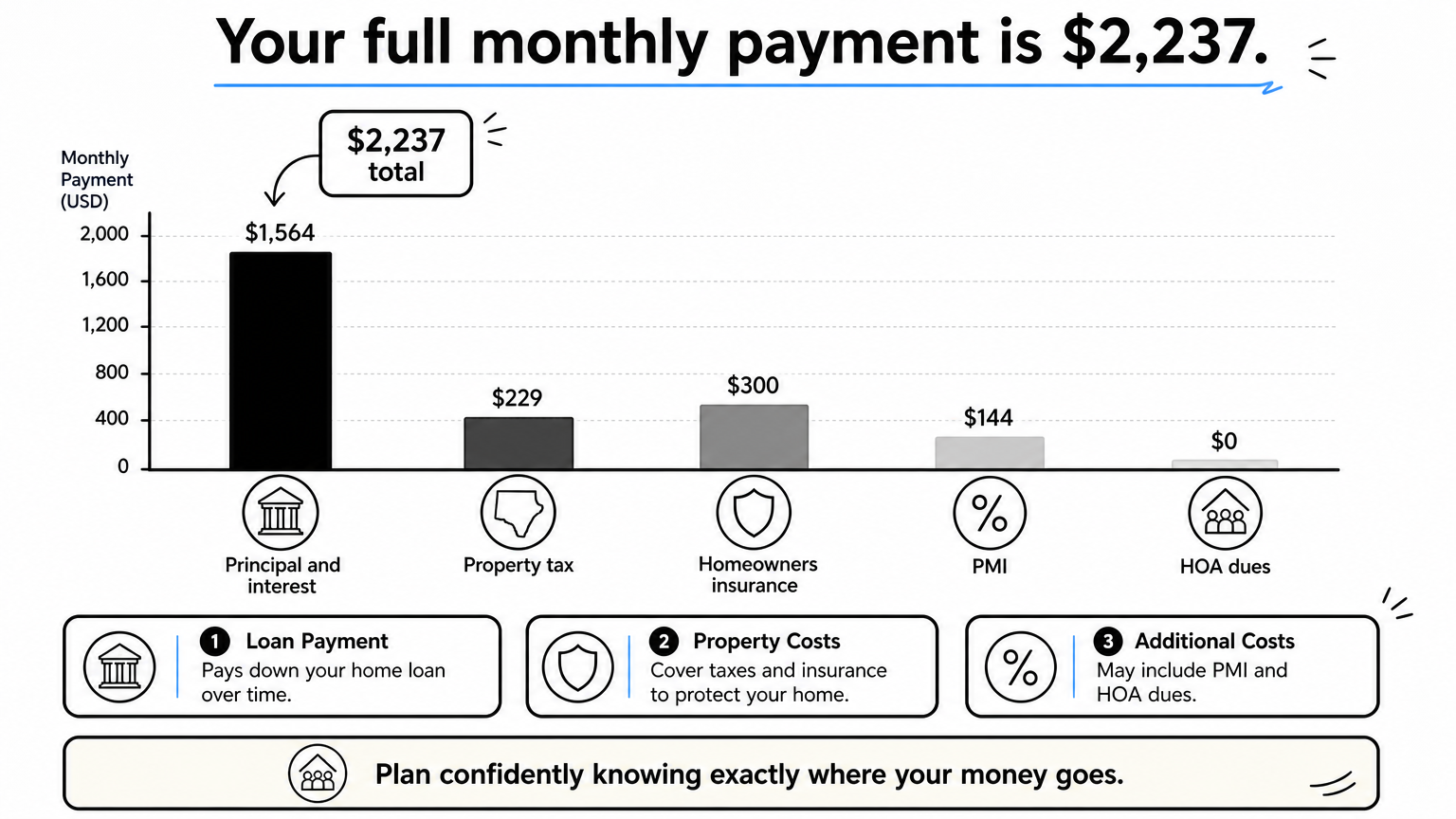
The trouble is that most calculators lead with a small, friendly principal and interest figure. Tax and insurance fields are often pre-filled with national averages, and those can miss badly in Oklahoma, where hail and wind claims push insurance costs up. In the example below, a $1,564 loan payment becomes a $2,237 monthly bill once everything is counted. Buyers who plan around the smaller number get a nasty surprise at closing.
This guide walks you through four steps with a free, simple mortgage payment calculator. HomeLoanCalc.io needs no signup or email, so you can follow along with its mortgage calculator. We use one worked example, a $275,000 home with 10% down, and you can swap in your own figures at every step.
Why your Oklahoma payment is more than the loan
Your monthly payment is the loan repayment plus the costs of owning the house, and in Oklahoma those extras are large enough to change your budget. A good calculation counts every piece.
The parts of the payment
A full payment has up to six components. The first four are often grouped as PITI, and lenders usually collect the tax and insurance portions each month in an escrow account.
- Principal: the part that pays down the amount you borrowed.
- Interest: the lender's charge for the loan, set by your rate.
- Property tax: the annual bill from your county, divided by 12.
- Homeowners insurance: your annual premium, divided by 12.
- PMI: private mortgage insurance, usually required on a conventional loan with less than 20% down.
- HOA dues: only if your home sits in an association.
What is different in Oklahoma
Property tax is set locally. Two homes at the same price in different counties or school districts can carry different bills, so a statewide average only gets you started. Ask the county assessor for the real figure and whether the homestead exemption applies to your home.
Insurance deserves even more attention. Oklahoma sits in Tornado Alley, and hail and wind damage make premiums higher than in many states. Many policies also carry a separate wind and hail deductible, often a percentage of your coverage rather than a flat amount. That does not change the monthly payment, but it changes how much cash you should keep in reserve.
In Oklahoma, the insurance and tax lines can matter as much as the interest rate, so never accept a calculator's defaults for them.
Step 1. Enter price, down payment, term and rate
Start with the four loan inputs: home price, down payment, loan term and interest rate. They set principal and interest, the only part of the payment that stays fixed on a fixed-rate loan.
Price and down payment
Enter the price of the homes you are actually touring, not the most a lender might approve. Then enter your down payment as a dollar amount or a percentage. Many conventional loans allow as little as 3% down for some first-time buyers, and 20% avoids PMI. The calculator subtracts your down payment from the price to show the loan amount.
In our example, a $275,000 home with 10% down ($27,500) gives a loan amount of $247,500.
Loan term and rate
Choose 30 years if you want the lowest monthly payment, or 15 years if you want to pay far less interest and can handle a higher payment. For the rate, use a quote from a lender if you have one. Rates change often, so this guide uses 6.5% as an assumption and not as today's Oklahoma rate. At 6.5% over 30 years, $247,500 costs about $1,564 a month in principal and interest.
The table below shows principal and interest for common Oklahoma-range prices, with 20% down, a 6.5% rate and a 30-year term.
| Home price | Loan (20% down) | Principal and interest |
|---|---|---|
| $150,000 | $120,000 | $758 |
| $200,000 | $160,000 | $1,011 |
| $250,000 | $200,000 | $1,264 |
| $300,000 | $240,000 | $1,517 |
| $350,000 | $280,000 | $1,770 |
If you want to borrow a flat $400,000 on a 30-year loan at the same rate, principal and interest is about $2,528 a month.
Check the math by hand
Lenders use the standard amortization formula, and you can verify any calculator with it:
M = P × r(1 + r)^n / ((1 + r)^n − 1)

M = monthly payment
P = loan amount
r = annual rate ÷ 12 (6.5% → 0.065 ÷ 12 = 0.005417)
n = years × 12 (30 years → 360 payments)
Principal and interest is the one part of your payment that never moves on a fixed-rate loan, so get it right first.
Step 2. Add Oklahoma property tax and insurance
Next, replace the default tax and insurance values with real figures for the address you are considering. Enter them in whatever period the field asks for, and divide the annual bill by 12 if it wants a monthly amount.
Property tax
Look up the home's current tax bill on the listing or the county assessor's site, then ask the assessor how your purchase price could change it. As a placeholder until you have a real number, many buyers use roughly 1% of the home price per year. That is a planning assumption, not an Oklahoma average, and the right figure depends on your county and school district.
For the $275,000 example, 1% is $2,750 a year, or about $229 a month.
Homeowners insurance
Get quotes from two or three insurers for the specific address, not a generic estimate. Tell them the roof's age and material, and ask what the wind and hail deductible is. A newer roof can lower the premium noticeably, so the quote is worth getting before you finalize the budget.
For the example, we use a placeholder of $3,600 a year, or $300 a month, until you have a real quote. If the home is in an association, enter the HOA dues as well. Leave the field at zero if there are none.
A real tax bill and a real insurance quote beat any default, because those two lines are where Oklahoma estimates go wrong.
Step 3. Add PMI and read your total payment
PMI is the last piece, and you need it on a conventional loan when your down payment is under 20%. It typically costs about 0.46% to 1.5% of the loan amount per year, depending on your credit score, down payment and loan type.
Estimate your PMI
Divide the annual cost by 12 to get the monthly figure. With 10% down and a placeholder rate of 0.7%, PMI on a $247,500 loan is $1,732.50 a year, or about $144 a month. If you do not know your rate, HomeLoanCalc.io's PMI cost calculator estimates it from your loan-to-value ratio and credit score.
PMI does not last forever. On a conventional loan, US lenders must cancel it automatically when your scheduled balance reaches 78% of the original home price, and you can ask for it sooner. Government-backed loans work differently. FHA loans carry their own mortgage insurance, often for much longer, and VA loans skip PMI but charge a funding fee.
Read the total
With every line filled in, the example looks like this:
| Component | Monthly cost |
|---|---|
| Principal and interest | $1,564 |
| Property tax (1% placeholder) | $229 |
| Homeowners insurance (placeholder) | $300 |
| PMI (0.7% placeholder) | $144 |
| HOA dues | $0 |
| Total | about $2,237 |
PMI, tax and insurance add roughly $673 to the loan payment. That is the gap between the number a basic calculator shows and the number you will pay.
Your real budget number is the total line, not the principal and interest figure at the top.
Step 4. Test scenarios against your budget
Change one input at a time, note the new total, and then compare it with your income. This is where the calculator stops being a quote tool and starts helping you decide.
Compare down payments
Rerun the example with 20% down. The loan drops to $220,000, principal and interest falls to about $1,391, and PMI disappears. With the same tax and insurance, the total becomes $1,920 a month, which is $317 less than at 10% down.
The extra cash needed is $27,500, so you would save about $3,800 a year. That is a strong return, but keep an emergency fund for hail or storm repairs before you empty your savings. The down payment calculator at HomeLoanCalc.io shows 5%, 10%, 15% and 20% side by side if you want the full picture.
Check the payment against your income
The common 28/36 rule says your housing payment should stay under 28% of gross monthly income, and total debt, housing included, under 36%. To afford the $2,237 example at 28%, you would need about $7,990 in gross monthly income, or roughly $96,000 a year. For comparison, a $350,000 salary means about $29,167 a month, so 28% is roughly $8,167 for housing.
HomeLoanCalc.io's mortgage affordability calculator uses the same rule with conservative (22%), moderate (28%) and maximum (33%) scenarios, plus the 36% total debt limit.
Treat the result as an estimate
A calculator gives you a planning figure, and the lender's final payment can differ slightly because the real rate, tax and insurance come from the lender and the county. Use the result to set a price range, then get preapproved to confirm. If you want to see how the loan plays out over time, the amortization schedule calculator and extra payment calculator show your balance and the interest you could save.
Test two or three scenarios before you shop, because the cheapest-looking house is not always the cheapest payment.
Put your numbers in before you shop
An Oklahoma payment is made of principal, interest, local property tax, insurance that reflects the state's storm risk, and PMI when your down payment is small. Enter real figures for each, compare a couple of down payments, and check the total against your income.
When you are ready to see your own total, run your numbers in the mortgage calculator with taxes, insurance and PMI. It needs no signup and shows results as you type.
This article is for general information and is not financial advice. Confirm figures with your lender or an official source before you decide.
Run your own numbers
Use our free calculators to see what this means for your loan.
More articles
- How to Use a Mortgage Calculator to Estimate Your Payment
- How to Use an Amortisation Calculator and Read the Schedule
- How Much Can I Afford on a House? 4 Steps to Your Number
- Extra Mortgage Payments: How They Work and What You Save
- Amortization Schedule for a Mortgage with a Balloon Payment
- Mortgage Refinance Calculator: How to Find Your Break-Even
- Mortgage Paid Off Calculator: How to Find Your Payoff Date
- Mortgage Insurance on FHA: What It Is and What It Costs
- Amortization Schedule Payment Calculator: How to Use It
- VA Loan Calculator: Find Your Payment and Home Budget